







Question: We assume that g(x) is a function defined on (0, 100) and has a derivative g'(x) and a primitive function G(x) = g(t)dt defined
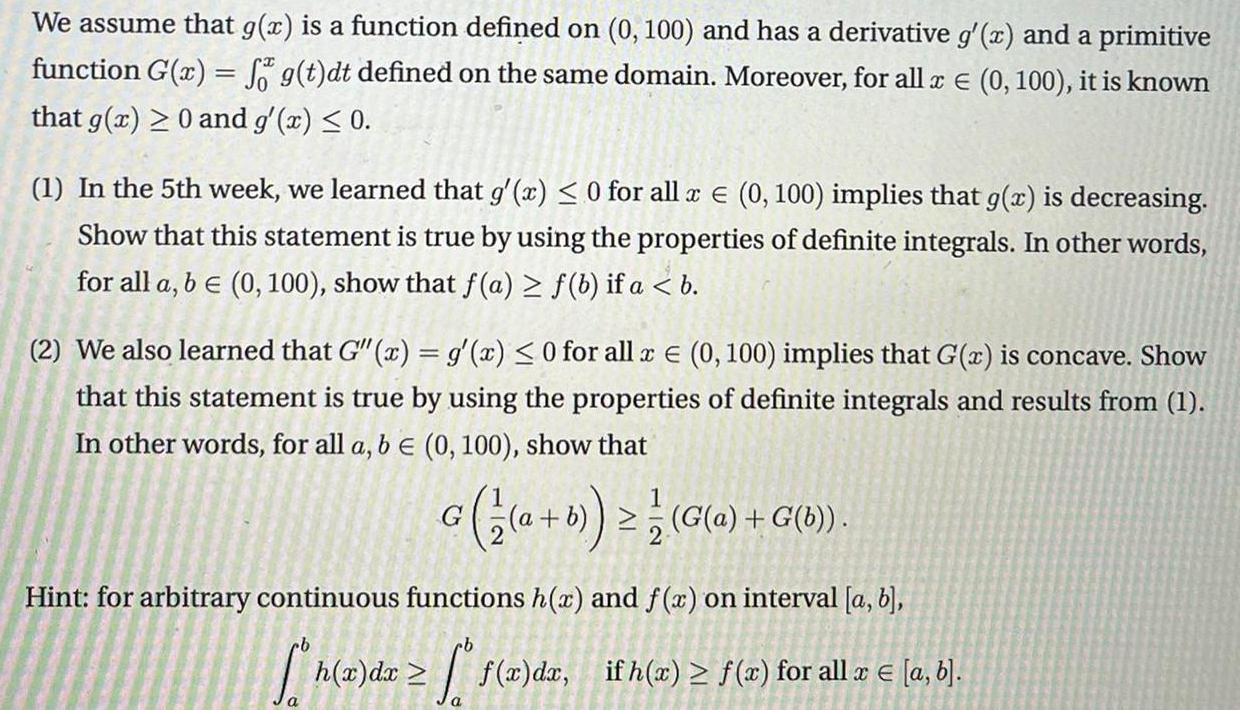
We assume that g(x) is a function defined on (0, 100) and has a derivative g'(x) and a primitive function G(x) = g(t)dt defined on the same domain. Moreover, for all x (0, 100), it is known that g(x) > 0 and g'(x) 0. (1) In the 5th week, we learned that g'(x) 0 for all x (0, 100) implies that g(x) is decreasing. Show that this statement is true by using the properties of definite integrals. In other words, for all a, b (0, 100), show that f(a) f(b) if a < b. (2) We also learned that G"(x) = g'(x) 0 for all x (0, 100) implies that G(x) is concave. Show that this statement is true by using the properties of definite integrals and results from (1). In other words, for all a, b (0, 100), show that G (12(a + b)) 1/ (G(a) + G(b)). Hint: for arbitrary continuous functions h(x) and f(x) on interval [a, b], ["h(x)dx f(x)dx, _ifh(x) (x) for all x = [, b]. a
Step by Step Solution
3.45 Rating (152 Votes )
There are 3 Steps involved in it

Get step-by-step solutions from verified subject matter experts
 Study Help