







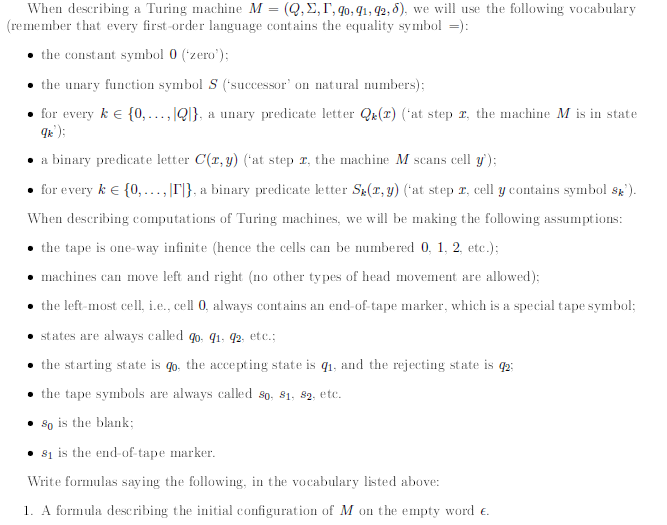
Question: When describing a Turing machine M = ( Q , Sigma , Gamma , q 0 , q 1 , q 2 ,
When describing a Turing machine M QSigma Gamma q q qdelta we will use the following vocabulary
remember that every rstorder language contains the equality symbol :
the constant symbol zero;
the unary function symbol S successor on natural numbers;
for every k in Q a unary predicate letter Qkxat step x the machine M is in state
qk;
a binary predicate letter Cx yat step x the machine M scans cell y;
for every k in Gamma a binary predicate letter Skx yat step x cell y contains symbol sk
When describing computations of Turing machines, we will be making the following assumptions:
the tape is oneway innite hence the cells can be numbered etc.;
machines can move left and right no other types of head movement are allowed;
the leftmost cell, ie cell always contains an endoftape marker, which is a special tape symbol;
states are always called q q q etc.;
the starting state is q the accepting state is q and the rejecting state is q;
the tape symbols are always called s s s etc.
s is the blank;
s is the endoftape marker.
Write formulas saying the following, in the vocabulary listed above:
A formula describing the initial conguration of M on the empty word
Step by Step Solution
There are 3 Steps involved in it
1 Expert Approved Answer
Step: 1 Unlock

Question Has Been Solved by an Expert!
Get step-by-step solutions from verified subject matter experts
Step: 2 Unlock
Step: 3 Unlock
 Study Help