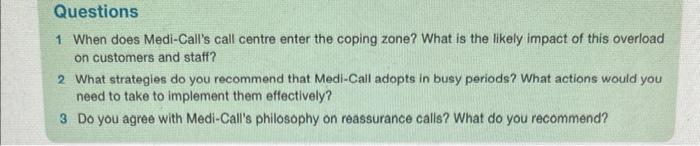
Question: When does Medi-Call's call centre enter the coping zone? What is the likely impact of this overload on customers and staff? What strategies do you
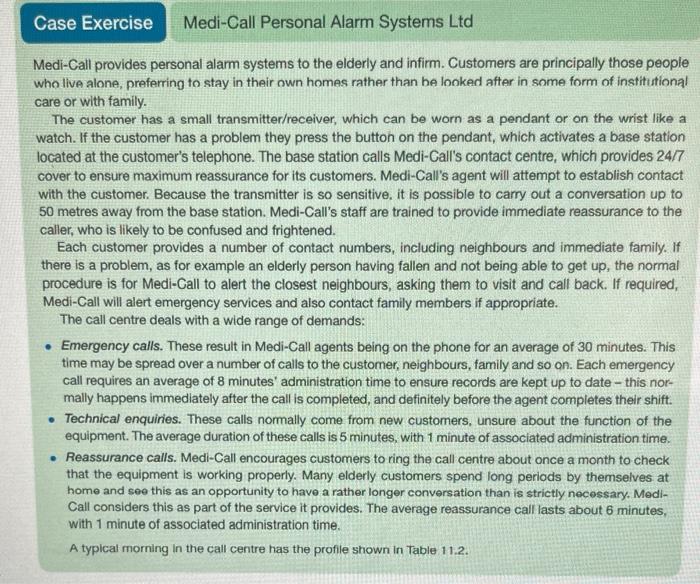
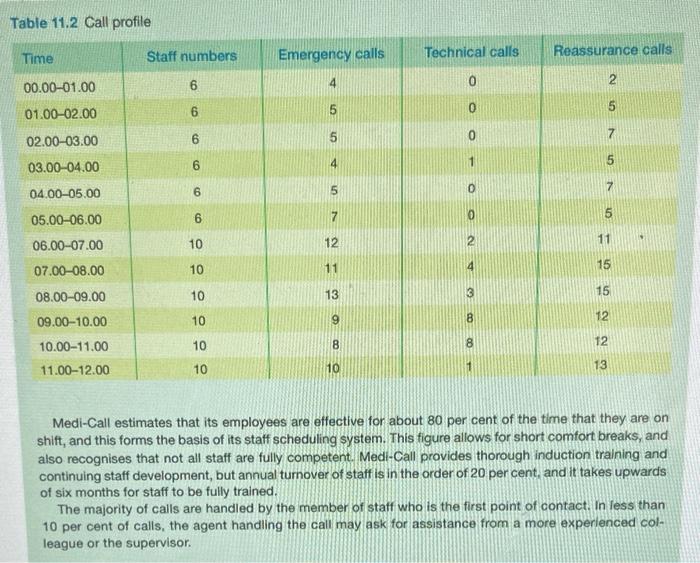
When does Medi-Call's call centre enter the coping zone? What is the likely impact of this overload on customers and staff? What strategies do you recommend that Medi-Call adopts in busy periods? What actions would you need to take to implement them effectively? 3 Do you agree with Medi-Call's philosophy on reassurance calls? What do you recommend? Medi-Call provides personal alarm systems to the elderly and infirm. Customers are principally those people who live alone, preferring to stay in their own homes rather than be lonked after in some form of institutional care or with family. The customer has a small transmitter/receiver, which can be worn as a pendant or on the wrist like a watch. If the customer has a problem they press the buttoh on the pendant, which activates a base station located at the customer's telephone. The base station calls Medi-Call's contact centre, which provides 24/7. cover to ensure maximum reassurance for its customers. Medi-Call's agent will attempt to establish contact with the customer. Because the transmitter is so sensitive, it is possible to carry out a conversation up to 50 metres away from the base station. Medi-Call's staff are trained to provide immediate reassurance to the caller, who is likely to be confused and frightened. Each customer provides a number of contact numbers, including neighbours and immediate family. If there is a problem, as for example an elderly person having fallen and not being able to get up, the normal procedure is for Medi-Call to alert the closest neighbours, asking them to visit and call back. If required, Medi-Call will alert emergency services and also contact family members if appropriate. The call centre deals with a wide range of demands: - Emergency calls. These result in Medi-Call agents being on the phone for an average of 30 minutes. This time may be spread over a number of calls to the customer, neighbours, family and so on. Each emergency call requires an average of 8 minutes' administration time to ensure records are kept up to date - this normally happens immediately after the call is completed, and definitely before the agent completes their shift. - Technical enquiries. These calls nomally come from new customers, unsure about the function of the equipment. The average duration of these calls is 5 minutes, with 1 minute of associated administration time. - Reassurance calls. Medi-Call encourages customers to ring the call centre about once a month to check that the equipment is working properly. Many elderly customers spend long periods by themselves at home and see this as an opportunity to have a rather longer conversation than is strictly necessary. MediCall considers this as part of the service it provides. The average reassurance call lasts about 6 minutes, with 1 minute of associated administration time. A typical morning in the call centre has the profile shown in Table 11.2. Table 11.2 Call profile Medi-Call estimates that its employees are effective for about 80 per cent of the time that they are on shift, and this forms the basis of its staff scheduling system. This figure allows for short comfort breaks, and also recognises that not all staff are fully competent. Medi-Call provides thorough induction training and continuing staff development, but annual turnover of staff is in the order of 20 per cent, and it takes upwards of six months for staff to be fully trained. The majority of calls are handled by the member of staff who is the first point of contact. In less than 10 per cent of calls, the agent handling the call may ask for assistance from a more experienced colleague or the supervisor. When does Medi-Call's call centre enter the coping zone? What is the likely impact of this overload on customers and staff? What strategies do you recommend that Medi-Call adopts in busy periods? What actions would you need to take to implement them effectively? 3 Do you agree with Medi-Call's philosophy on reassurance calls? What do you recommend? Medi-Call provides personal alarm systems to the elderly and infirm. Customers are principally those people who live alone, preferring to stay in their own homes rather than be lonked after in some form of institutional care or with family. The customer has a small transmitter/receiver, which can be worn as a pendant or on the wrist like a watch. If the customer has a problem they press the buttoh on the pendant, which activates a base station located at the customer's telephone. The base station calls Medi-Call's contact centre, which provides 24/7. cover to ensure maximum reassurance for its customers. Medi-Call's agent will attempt to establish contact with the customer. Because the transmitter is so sensitive, it is possible to carry out a conversation up to 50 metres away from the base station. Medi-Call's staff are trained to provide immediate reassurance to the caller, who is likely to be confused and frightened. Each customer provides a number of contact numbers, including neighbours and immediate family. If there is a problem, as for example an elderly person having fallen and not being able to get up, the normal procedure is for Medi-Call to alert the closest neighbours, asking them to visit and call back. If required, Medi-Call will alert emergency services and also contact family members if appropriate. The call centre deals with a wide range of demands: - Emergency calls. These result in Medi-Call agents being on the phone for an average of 30 minutes. This time may be spread over a number of calls to the customer, neighbours, family and so on. Each emergency call requires an average of 8 minutes' administration time to ensure records are kept up to date - this normally happens immediately after the call is completed, and definitely before the agent completes their shift. - Technical enquiries. These calls nomally come from new customers, unsure about the function of the equipment. The average duration of these calls is 5 minutes, with 1 minute of associated administration time. - Reassurance calls. Medi-Call encourages customers to ring the call centre about once a month to check that the equipment is working properly. Many elderly customers spend long periods by themselves at home and see this as an opportunity to have a rather longer conversation than is strictly necessary. MediCall considers this as part of the service it provides. The average reassurance call lasts about 6 minutes, with 1 minute of associated administration time. A typical morning in the call centre has the profile shown in Table 11.2. Table 11.2 Call profile Medi-Call estimates that its employees are effective for about 80 per cent of the time that they are on shift, and this forms the basis of its staff scheduling system. This figure allows for short comfort breaks, and also recognises that not all staff are fully competent. Medi-Call provides thorough induction training and continuing staff development, but annual turnover of staff is in the order of 20 per cent, and it takes upwards of six months for staff to be fully trained. The majority of calls are handled by the member of staff who is the first point of contact. In less than 10 per cent of calls, the agent handling the call may ask for assistance from a more experienced colleague or the supervisor









 Study Help