







Question: When entering numbers that involve multiples (such as Revenue = unit sales Price/unit x Quantity) enter formulas so that you can change either Price/unit or
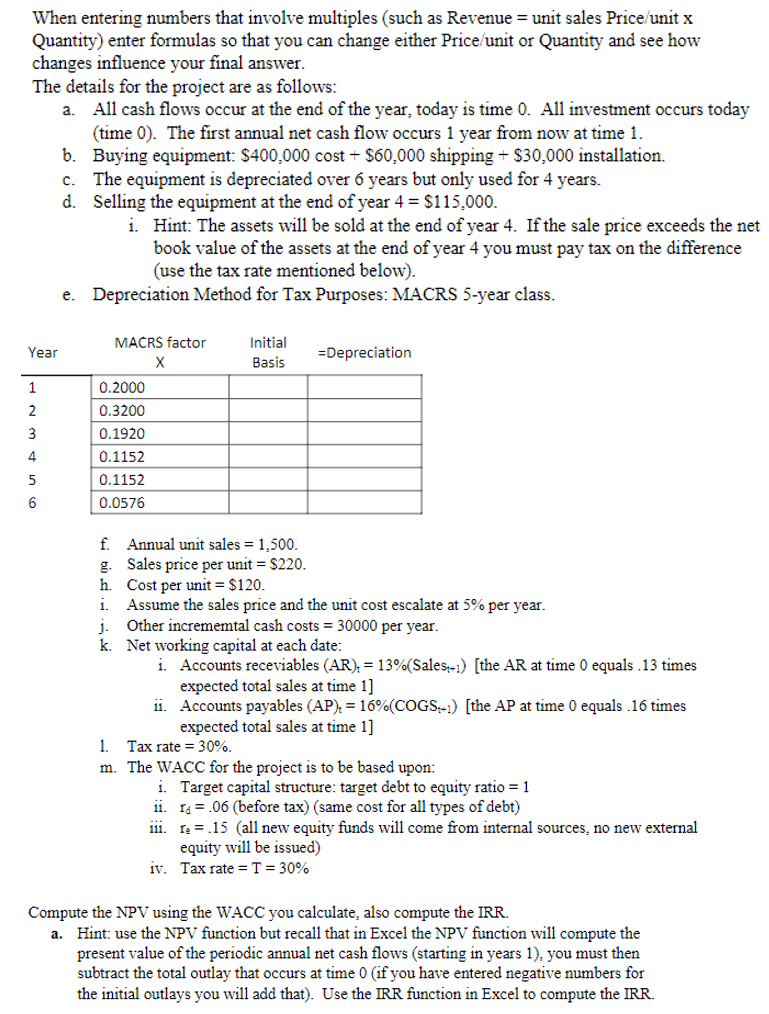
When entering numbers that involve multiples (such as Revenue = unit sales Price/unit x Quantity) enter formulas so that you can change either Price/unit or Quantity and see how changes influence your final answer. The details for the project are as follows: a. All cash flows occur at the end of the year, today is time 0 . All investment occurs today (time 0). The first annual net cash flow occurs 1 year from now at time 1. b. Buying equipment: $400,000 cost +$60,000 shipping +$30,000 installation. c. The equipment is depreciated over 6 years but only used for 4 years. d. Selling the equipment at the end of year 4=$115,000. i. Hint: The assets will be sold at the end of year 4 . If the sale price exceeds the net book value of the assets at the end of year 4 you must pay tax on the difference (use the tax rate mentioned below). e. Depreciation Method for Tax Purposes: MACRS 5-year class. f. Annual unit sales =1,500. g. Sales price per unit =$220. h. Cost per unit =$120. i. Assume the sales price and the unit cost escalate at 5% per year. j. Other incrememtal cash costs =30000 per year. k. Net working capital at each date: i. Accounts receviables (AR)t=13%(Sales+1) [the AR at time 0 equals .13 times expected total sales at time 1] ii. Accounts payables (AP)t=16%(COGSt+1) [the AP at time 0 equals .16 times expected total sales at time 1] 1. Tax rate =30%. m. The WACC for the project is to be based upon: i. Target capital structure: target debt to equity ratio =1 ii. rd=.06 (before tax) (same cost for all types of debt) iii. re=.15 (all new equity funds will come from internal sources, no new external equity will be issued) iv. Tax rate =T=30% Compute the NPV using the WACC you calculate, also compute the IRR. a. Hint: use the NPV function but recall that in Excel the NPV function will compute the present value of the periodic annual net cash flows (starting in years 1), you must then subtract the total outlay that occurs at time 0 (if you have entered negative numbers for the initial outlays you will add that). Use the IRR function in Excel to compute the IRR
Step by Step Solution
There are 3 Steps involved in it

Get step-by-step solutions from verified subject matter experts
 Study Help