







Question: When evaluating a project a firm's managers should select projects whose can flows: exceed some target cash flow level set by management. Have the lowest
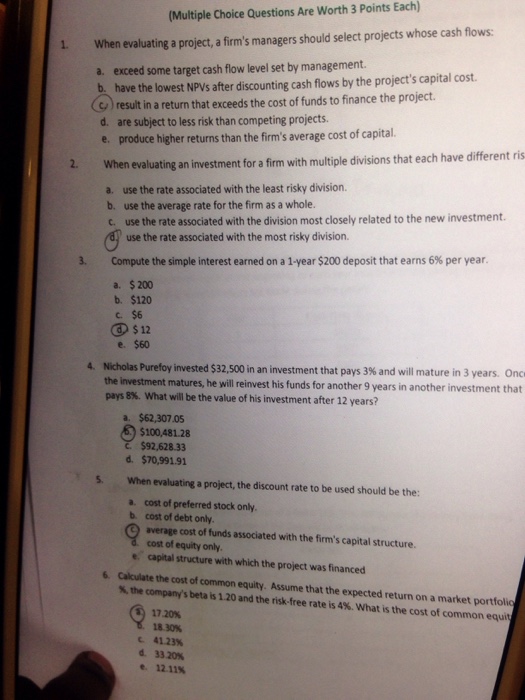
When evaluating a project a firm's managers should select projects whose can flows: exceed some target cash flow level set by management. Have the lowest NPVs after discounting cash flows by the projects's capital cost. Result in a return that exceeds the cost of funds to finance the project. are subject to less risk than competing projects. produce higher returns that the firm's average cost of capital. When evaluating an investment for a firm with multiple divisions that each have different risks use the rate associated with the least risky division. use the average rate for the firm as a whole. use the rate associated with the division most closely related to the new investment. use the rate associated with the most risky division. Compute the simple interest earned on a 1-year $200 deposit that earns 6% per year. $200 $120 $6 $12 $60 Nicholas Purefoy invested $32, 500 in an investment pays 3% and will mature in 3 years. Once the investment matures, he will reinvest his funds for another 9 years in another investment that pays 8%. What will be the value of his investment after 12 years? $62, 307.05 $100, 481.28 $92, 628.33 $70, 991.91 When evaluating a project, the discount rate to be used should be the: cost of preferred stock only. cost of debt only. average cost of funds associated with the firm's capital structure. cost of equity only. capital structure with which the project was financed Calculate the cost of common equity. Assume that the expected return on a market portfolio % the company's beta is 1.20 and the risk-free rate is 4%. What is the cost of common equity? 17.205 18.30% 41.23% 33.20% 12.11%
Step by Step Solution
There are 3 Steps involved in it

Get step-by-step solutions from verified subject matter experts
 Study Help