







Question: Some typical choices of(f(dot u) ), (s(u)), and (F(t)) in (90) are listed below: Linear friction force (low velocities): (f(dot u) = 6 pimu
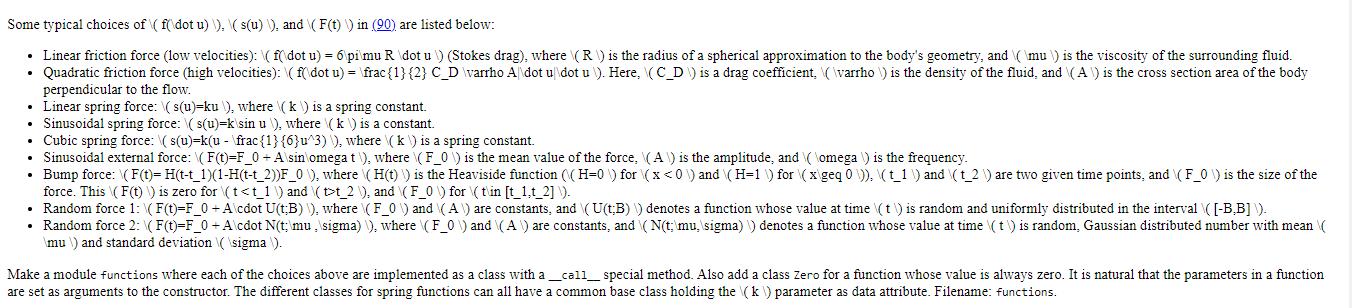
Some typical choices of(f(\dot u) ), (s(u)), and (F(t)) in (90) are listed below: Linear friction force (low velocities): (f(dot u) = 6 pi\mu R \dot u) (Stokes drag), where (R) is the radius of a spherical approximation to the body's geometry, and \(\mu) is the viscosity of the surrounding fluid. Quadratic friction force (high velocities): (f(\dot u) = \frac {1}{2} C_D \varrho A\dot u\dot u). Here, (C_D) is a drag coefficient, \(\varrho) is the density of the fluid, and (A) is the cross section area of the body perpendicular to the flow. Linear spring force: \(s(u)-ku), where (k) is a spring constant. Sinusoidal spring force: (s(u)-k\sin u), where (k) is a constant. Cubic spring force: (s(u)-k(u- \frac{1}{6}u^3) \), where (k) is a spring constant. Sinusoidal external force: \(F(t)=F_0+ A\sin omega t \), where (F_0\) is the mean value of the force, (A) is the amplitude, and \(\omega) is the frequency. Bump force: \(F(t)= H(t-t_1)(1-H(t-t_2))F_0 \), where (H(t)\) is the Heaviside function ((H=0\) for (x
Step by Step Solution
There are 3 Steps involved in it
functionspy class LinearFrictionForce def initself mu R selfmu mu selfR R def callspecialself dotu r... View full answer

Get step-by-step solutions from verified subject matter experts
 Study Help