







Question: When implementing change orders ( adding or deleting activities ) in the schedule, you need to review the network logic after the changes are made
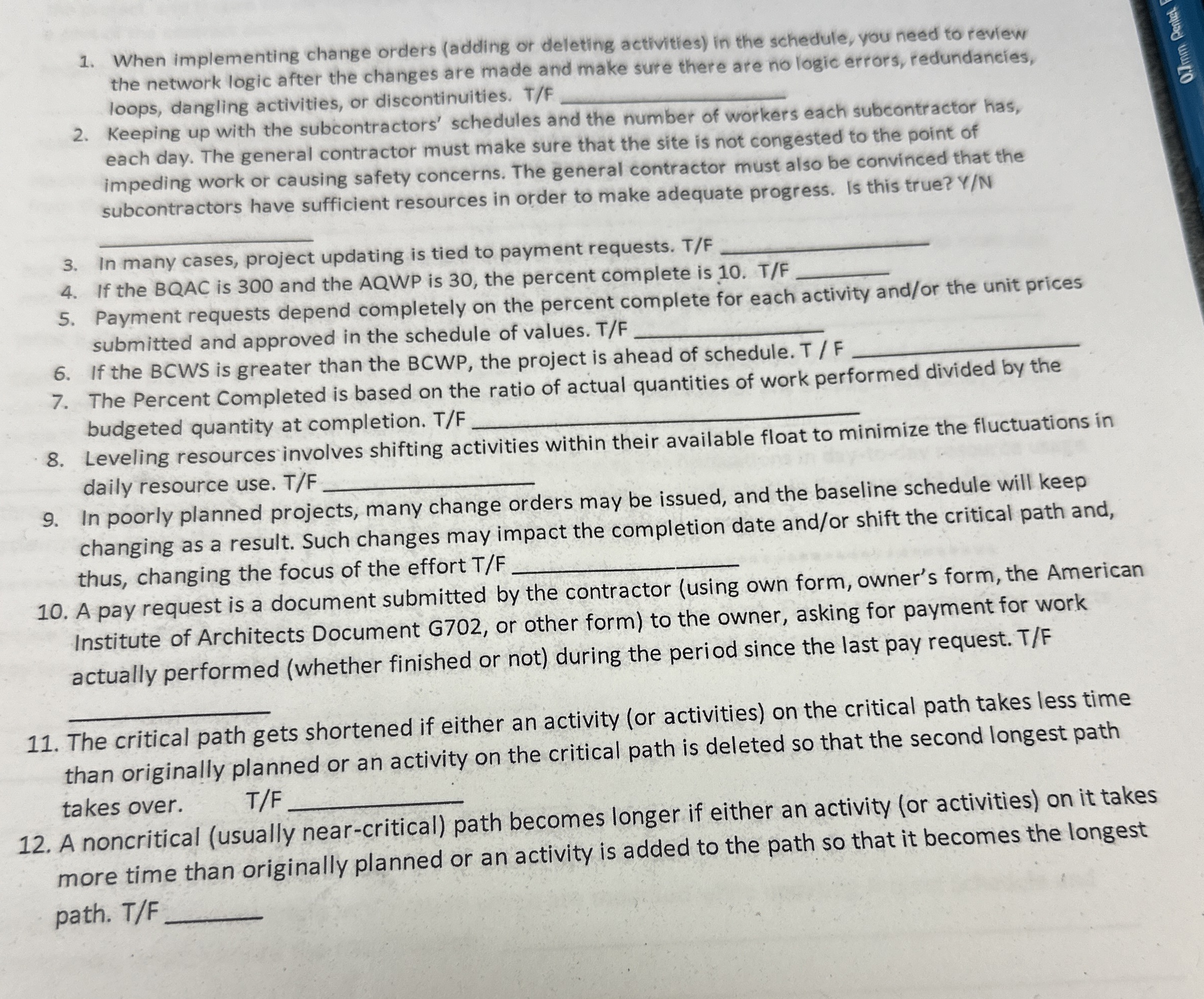
When implementing change orders adding or deleting activities in the schedule, you need to review the network logic after the changes are made and make sure there are no logic errors, redundancies, loops, dangling activities, or discontinuities.
Keeping up with the subcontractors' schedules and the number of workers each subcontractor has, each day. The general contractor must make sure that the site is not congested to the point of impeding work or causing safety concerns. The general contractor must also be convinced that the subcontractors have sufficient resources in order to make adequate progress. Is this true? YN
In many cases, project updating is tied to payment requests. TF
If the BQAC is and the AQWP is the percent complete is
Payment requests depend completely on the percent complete for each activity andor the unit prices submitted and approved in the schedule of values. TF
If the BCWS is greater than the BCWP the project is ahead of schedule. TF
The Percent Completed is based on the ratio of actual quantities of work performed divided by the budgeted quantity at completion. TF
Leveling resources involves shifting activities within their available float to minimize the fluctuations in daily resource use. TF
In poorly planned projects, many change orders may be issued, and the baseline schedule will keep changing as a result. Such changes may impact the completion date andor shift the critical path and, thus, changing the focus of the effort T
A pay request is a document submitted by the contractor using own form, owner's form, the American Institute of Architects Document G or other form to the owner, asking for payment for work actually performed whether finished or not during the period since the last pay request.
The critical path gets shortened if either an activity or activities on the critical path takes less time than originally planned or an activity on the critical path is deleted so that the second longest path takes over. TF
A noncritical usually nearcritical path becomes longer if either an activity or activities on it takes more time than originally planned or an activity is added to the path so that it becomes the longest path. TF
Step by Step Solution
There are 3 Steps involved in it
1 Expert Approved Answer
Step: 1 Unlock

Question Has Been Solved by an Expert!
Get step-by-step solutions from verified subject matter experts
Step: 2 Unlock
Step: 3 Unlock
 Study Help