







Question: When is a debtor entitled to a discharge under chapter 13. 457 CHAPTER 15: Creditors' Rights and Bankruptcy Critical Thinking and Writing Assignments 15-10. Time-Limited
When is a debtor entitled to a discharge under chapter 13.
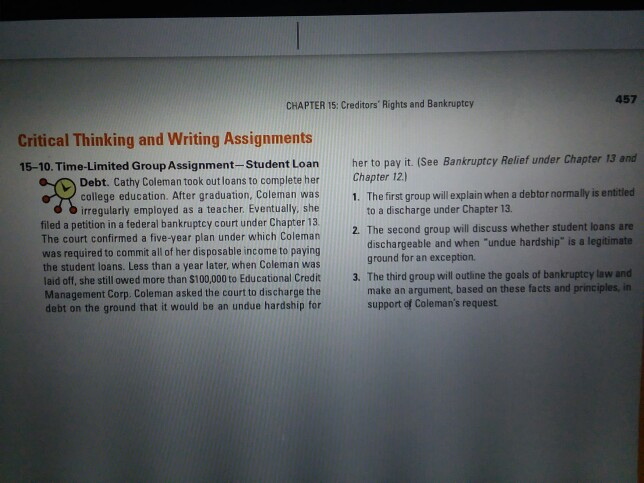
457 CHAPTER 15: Creditors' Rights and Bankruptcy Critical Thinking and Writing Assignments 15-10. Time-Limited Group Assignment-Student Loan Debt. Cathy Coleman took out loans to complete her college education. After graduation, Coleman was irregularly employed as a teacher. Eventually, she filed a petition in a federal bankruptcy court under Chapter 13 The court confirmed a five-year plan under which Coleman was required to commit all of her disposable income to paying the student loans. Less than a year later, when Coleman was laid off, she still owed more than $100,000 to Educational Credit Management Corp. Coleman asked the court to discharge the debt on the ground that it would be an undue hardship for her to pay it. (See Bankruptcy Relief under Chapter 13 and Chapter 12.) 1. The first group will explain when a debtor normally is entitled to a discharge under Chapter 13. 2. The second group will discuss whether student loans are dischargeable and when "undue hardship is a legitimate ground for an exception 3. The third group will outline the goals of bankruptcy law and make an argument, based on these facts and principles, in support of Coleman's requestStep by Step Solution
There are 3 Steps involved in it
1 Expert Approved Answer
Step: 1 Unlock

Question Has Been Solved by an Expert!
Get step-by-step solutions from verified subject matter experts
Step: 2 Unlock
Step: 3 Unlock
 Study Help