







Question: When lim_(x->a)f(x) exists, it always equals f(a) . State whether this statement is true or false. Choose the correct answer. A. True. Evaluate f(x) at
When
\\\\lim_(x->a)f(x)exists, it always equals
f(a). State whether this statement is true or false.\ Choose the correct answer.\ A. True. Evaluate
f(x)at
x=a. Therefore
\\\\lim_(x->a)f(x)=f(a).\ B. False. The limit can never exist if
f(a)is not defined.\ C. False. The value of
\\\\lim_(x->a)f(x)(if it exists) depends on values of
fnear
a, but it does not depend on the value of
f(a).\ D. True. If
x=a, then
f(x)=f(a).
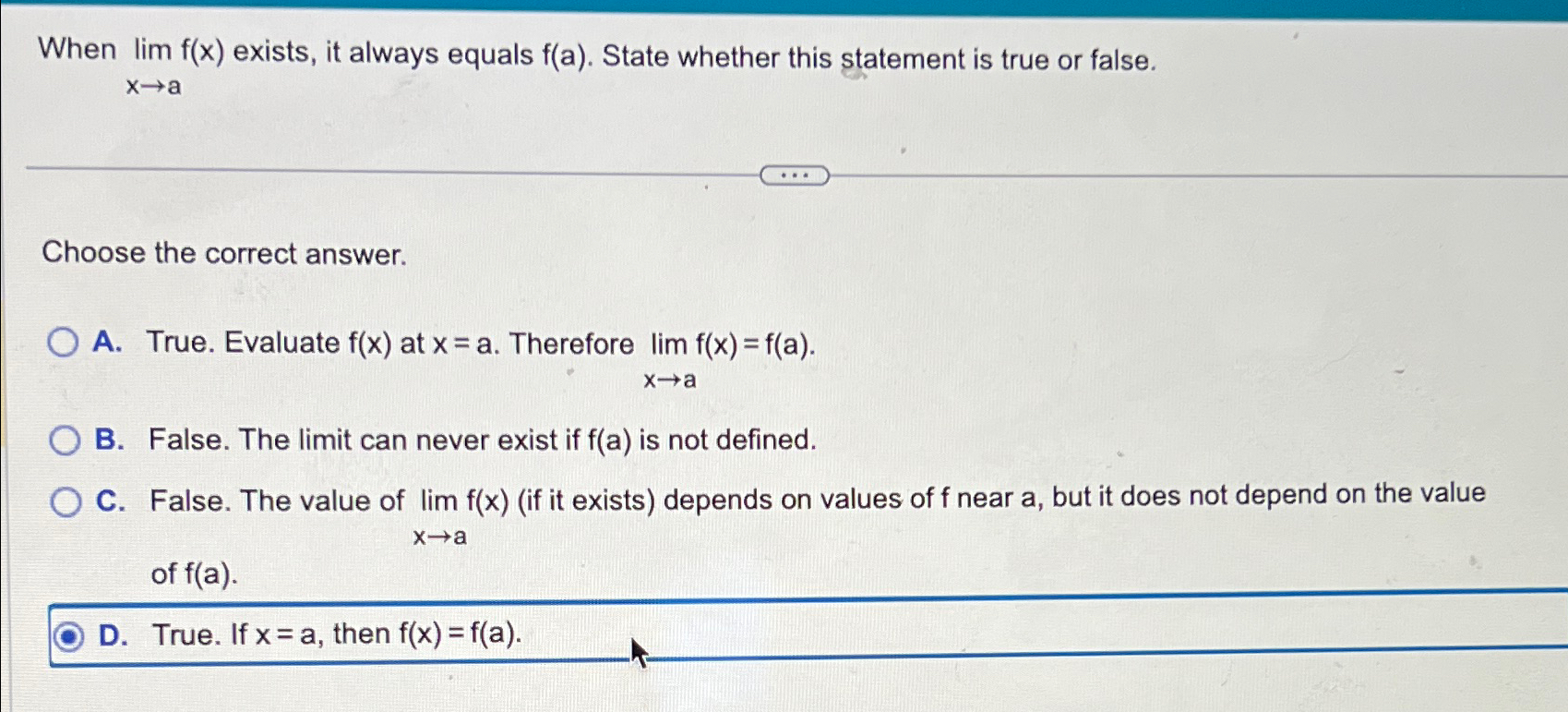
When limxaf(x) exists, it always equals f(a). State whether this statement is true or false. Choose the correct answer. A. True. Evaluate f(x) at x=a. Therefore limxaf(x)=f(a). B. False. The limit can never exist if f(a) is not defined. C. False. The value of limxaf(x) (if it exists) depends on values of f near a, but it does not depend on the value of f(a). D. True. If x=a, then f(x)=f(a)
Step by Step Solution
There are 3 Steps involved in it

Get step-by-step solutions from verified subject matter experts
 Study Help