







Question: When picking up an object from the ground, it is generally recommended that you lift with your legs - that is, raise and lower
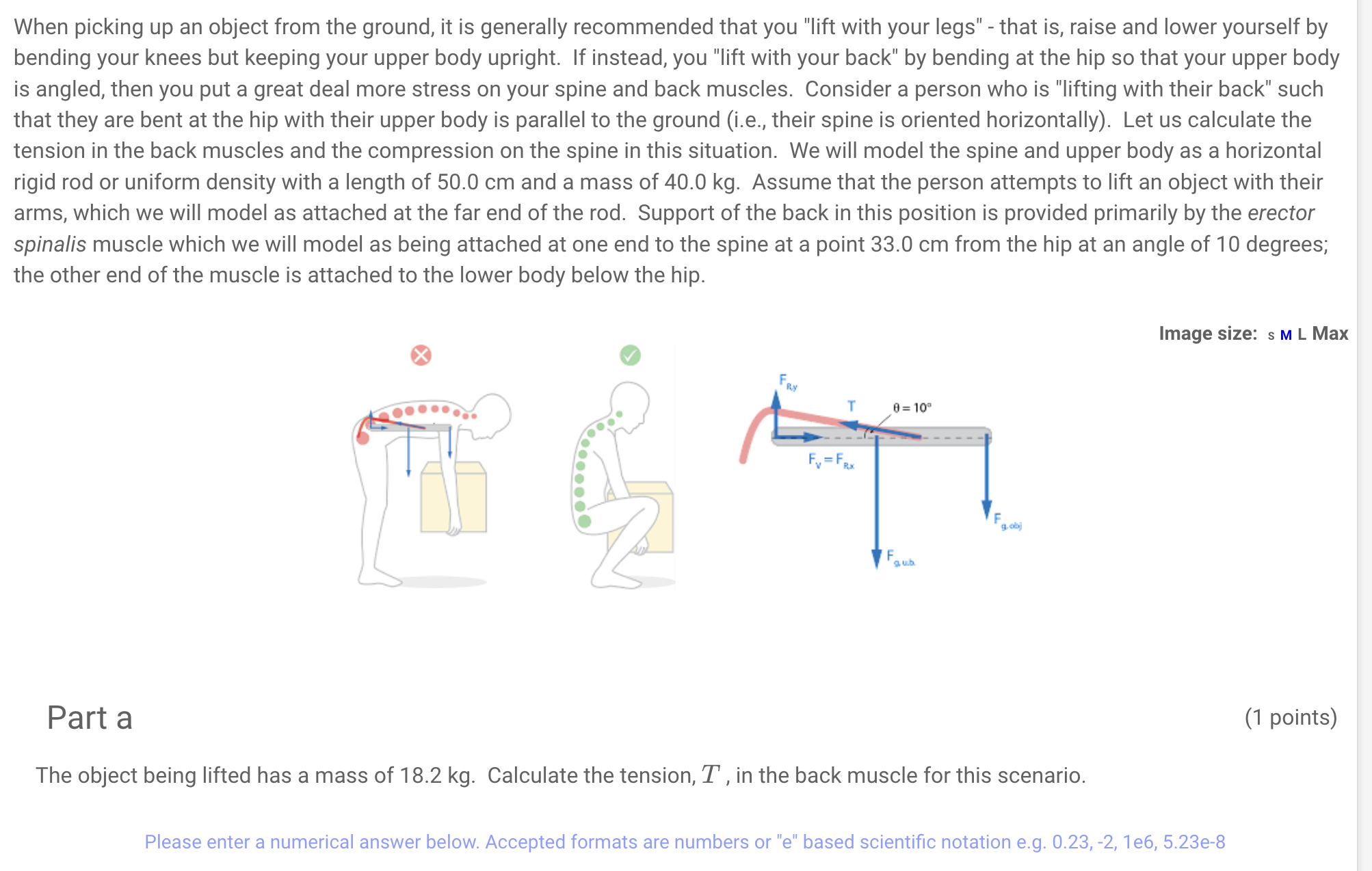
When picking up an object from the ground, it is generally recommended that you "lift with your legs" - that is, raise and lower yourself by bending your knees but keeping your upper body upright. If instead, you "lift with your back" by bending at the hip so that your upper body is angled, then you put a great deal more stress on your spine and back muscles. Consider a person who is "lifting with their back" such that they are bent at the hip with their upper body is parallel to the ground (i.e., their spine is oriented horizontally). Let us calculate the tension in the back muscles and the compression on the spine in this situation. We will model the spine and upper body as a horizontal rigid rod or uniform density with a length of 50.0 cm and a mass of 40.0 kg. Assume that the person attempts to lift an object with their arms, which we will model as attached at the far end of the rod. Support of the back in this position is provided primarily by the erector spinalis muscle which we will model as being attached at one end to the spine at a point 33.0 cm from the hip at an angle of 10 degrees; the other end of the muscle is attached to the lower body below the hip. Part a FRY T 0=10 Fv=FRX F aub gobj The object being lifted has a mass of 18.2 kg. Calculate the tension, T, in the back muscle for this scenario. Image size: S M L Max Please enter a numerical answer below. Accepted formats are numbers or "e" based scientific notation e.g. 0.23, -2, 1e6, 5.23e-8 (1 points) Part b (1 points) For lifting a 18.2 kg object, calculate the compressive reaction force, Fy, that is transmitted to the pivot point of the spine (at the level of the hips) by the vertebrae of the lower back. Please enter a numerical answer below. Accepted formats are numbers or "e" based scientific notation e.g. 0.23, -2, 1e6, 5.23e-8 Enter answer here No answer submitted N CHECK ANSWER 0 of Unlimited checks used Part c (1 points) Determine how many times more stress in put on the spine by lifting the 18.2 kg object in this way by calculating the ratio of the compression on the spine in this scenario compared to the simple weight of the upper body plus the object (i.e., calculate the ratio: Fy Wu.b. + Wobj .) Please enter a numerical answer below. Accepted formats are numbers or "e" based scientific notation e.g. 0.23, -2, 1e6, 5.23e-8
Step by Step Solution
There are 3 Steps involved in it

Get step-by-step solutions from verified subject matter experts
 Study Help