



Question: ** When providing the answers can you please put them into an easy way to read? Maybe just the answers first, or fill in where
** When providing the answers can you please put them into an easy way to read? Maybe just the answers first, or fill in where the answers should be then show work? Thank you so much!
Delsing Canning Company is considering an expansion of its facilities. Its current income statement is as follows:
| Sales | $ | 5,100,000 |
| Variable costs (50% of sales) | 2,550,000 | |
| Fixed costs | 1,810,000 | |
| Earnings before interest and taxes (EBIT) | $ | 740,000 |
| Interest (10% cost) | 220,000 | |
| Earnings before taxes (EBT) | $ | 520,000 |
| Tax (35%) | 182,000 | |
| Earnings after taxes (EAT) | $ | 338,000 |
| Shares of common stock | 210,000 | |
| Earnings per share | $ | 1.61 |
The company is currently financed with 50 percent debt and 50 percent equity (common stock, par value of $10). In order to expand the facilities, Mr. Delsing estimates a need for $2.1 million in additional financing. His investment banker has laid out three plans for him to consider:
- Sell $2.1 million of debt at 9 percent.
- Sell $2.1 million of common stock at $15 per share.
- Sell $1.05 million of debt at 10 percent and $1.05 million of common stock at $20 per share.
Variable costs are expected to stay at 50 percent of sales, while fixed expenses will increase to $2,310,000 per year. Delsing is not sure how much this expansion will add to sales, but he estimates that sales will rise by $1 million per year for the next five years. Delsing is interested in a thorough analysis of his expansion plans and methods of financing.He would like you to analyze the following:
a. The break-even point for operating expenses before and after expansion (in sales dollars). (Enter your answers in dollars not in millions, i.e, $1,234,567.)
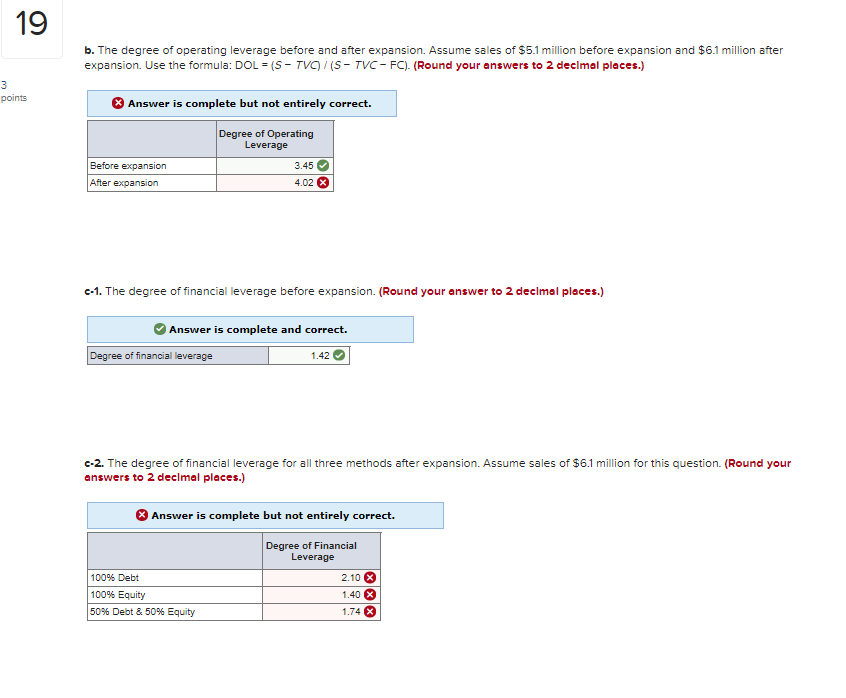
b. The degree of operating leverage before and after expansion. Assume sales of $5.1 million before expansion and $6.1 million after expansion. Use the formula: DOL = (S TVC) / (S TVC FC). (Round your answers to 2 decimal places.)
c-1. The degree of financial leverage before expansion. (Round your answer to 2 decimal places.)
c-2. The degree of financial leverage for all three methods after expansion. Assume sales of $6.1 million for this question. (Round your answers to 2 decimal places.)
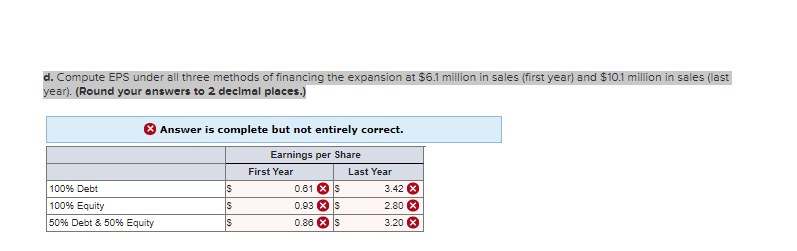
d. Compute EPS under all three methods of financing the expansion at $6.1 million in sales (first year) and $10.1 million in sales (last year). (Round your answers to 2 decimal places.)
This is what I have and what was wrong. Please provide help/answers to the ones that are wrong. THANK YOU!!! 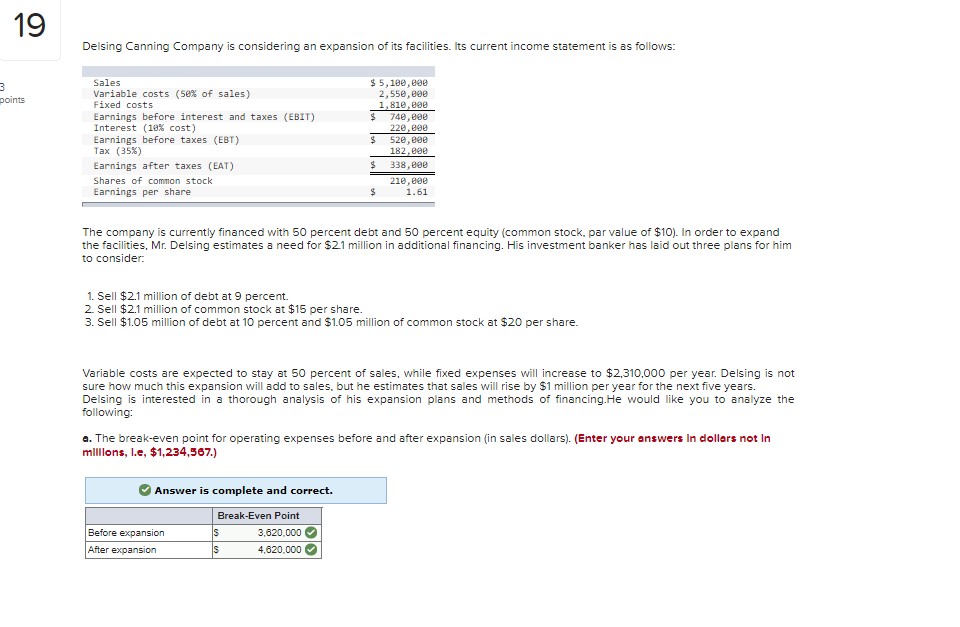
19 Delsing Canning Company is considering an expansion of its facilities. Its current income statement is as follows: 3 points Sales Variable costs (50% of sales) Fixed costs Earnings before interest and taxes (EBIT) Interest (10% cost) Earnings before taxes (EBT) Tax (35%) Earnings after taxes (EAT) Shares of common stock Earnings per share $ 5,180,00 2,550, eee 1,810,000 $ 740, eee 220, 800 $ 520, eee 182,800 $ 338,800 210,000 $ 1.61 The company is currently financed with 50 percent debt and 50 percent equity (common stock, par value of $10). In order to expand the facilities, Mr. Delsing estimates a need for $21 million in additional financing. His investment banker has laid out three plans for him to consider: 1. Sell $2.1 million of debt at 9 percent. 2. Sell $2.1 million of common stock at $15 per share. 3. Sell $1.05 million of debt at 10 percent and $1.05 million of common stock at $20 per share. Variable costs are expected to stay at 50 percent of sales, while fixed expenses will increase to $2,310.000 per year. Delsing is not sure how much this expansion will add to sales, but he estimates that sales will rise by $1 million per year for the next five years. Delsing is interested in a thorough analysis of his expansion plans and methods of financing.He would like you to analyze the following: a. The break-even point for operating expenses before and after expansion (in sales dollars). (Enter your answers in dollars not In mllllons, le, $1,234,567.) Answer is complete and correct. Before expansion After expansion Break-Even Point IS 3.620.000 s 4,620.000 19 b. The degree of operating leverage before and after expansion. Assume sales of $5.1 million before expansion and $6.1 million after expansion. Use the formula: DOL = (S-TVOJ/(S-TVC-FC). (Round your answers to 2 decimal places.) 3 points Answer is complete but not entirely correct. Degree of Operating Leverage 3.45 Before expansion After expansion 4.02 X 6-1. The degree of financial leverage before expansion (Round your answer to 2 decimal places.) Answer is complete and correct. Degree of financial leverage 1.42 c-2. The degree of financial leverage for all three methods after expansion. Assume sales of $6.1 million for this question. (Round your answers to 2 decimal places.) Answer is complete but not entirely correct. Degree of Financial Leverage 100% Debt 100% Equity 50% Debt & 50% Equity 2.10 X 1.40 X 1.74 X d. Compute EPS under all three methods of financing the expansion at $6.1 million in sales (first year) and $10.1 million in sales (last year). (Round your answers to 2 decimal places.) Answer is complete but not entirely correct. Earnings per Share First Year Last Year 100% Debt IS 0.61 Xs 3.42 X 100% Equity IS 0.93 XS 2.80 X 50% Debt & 50% Equity IS 0.86 XS 3.20 X 19 Delsing Canning Company is considering an expansion of its facilities. Its current income statement is as follows: 3 points Sales Variable costs (50% of sales) Fixed costs Earnings before interest and taxes (EBIT) Interest (10% cost) Earnings before taxes (EBT) Tax (35%) Earnings after taxes (EAT) Shares of common stock Earnings per share $ 5,180,00 2,550, eee 1,810,000 $ 740, eee 220, 800 $ 520, eee 182,800 $ 338,800 210,000 $ 1.61 The company is currently financed with 50 percent debt and 50 percent equity (common stock, par value of $10). In order to expand the facilities, Mr. Delsing estimates a need for $21 million in additional financing. His investment banker has laid out three plans for him to consider: 1. Sell $2.1 million of debt at 9 percent. 2. Sell $2.1 million of common stock at $15 per share. 3. Sell $1.05 million of debt at 10 percent and $1.05 million of common stock at $20 per share. Variable costs are expected to stay at 50 percent of sales, while fixed expenses will increase to $2,310.000 per year. Delsing is not sure how much this expansion will add to sales, but he estimates that sales will rise by $1 million per year for the next five years. Delsing is interested in a thorough analysis of his expansion plans and methods of financing.He would like you to analyze the following: a. The break-even point for operating expenses before and after expansion (in sales dollars). (Enter your answers in dollars not In mllllons, le, $1,234,567.) Answer is complete and correct. Before expansion After expansion Break-Even Point IS 3.620.000 s 4,620.000 19 b. The degree of operating leverage before and after expansion. Assume sales of $5.1 million before expansion and $6.1 million after expansion. Use the formula: DOL = (S-TVOJ/(S-TVC-FC). (Round your answers to 2 decimal places.) 3 points Answer is complete but not entirely correct. Degree of Operating Leverage 3.45 Before expansion After expansion 4.02 X 6-1. The degree of financial leverage before expansion (Round your answer to 2 decimal places.) Answer is complete and correct. Degree of financial leverage 1.42 c-2. The degree of financial leverage for all three methods after expansion. Assume sales of $6.1 million for this question. (Round your answers to 2 decimal places.) Answer is complete but not entirely correct. Degree of Financial Leverage 100% Debt 100% Equity 50% Debt & 50% Equity 2.10 X 1.40 X 1.74 X d. Compute EPS under all three methods of financing the expansion at $6.1 million in sales (first year) and $10.1 million in sales (last year). (Round your answers to 2 decimal places.) Answer is complete but not entirely correct. Earnings per Share First Year Last Year 100% Debt IS 0.61 Xs 3.42 X 100% Equity IS 0.93 XS 2.80 X 50% Debt & 50% Equity IS 0.86 XS 3.20 X
Step by Step Solution
There are 3 Steps involved in it

Get step-by-step solutions from verified subject matter experts