







Question: When requirements for high reliability make redundancy necessary, a good arrangement has one unit operating until it fails. At that time, a second unit,
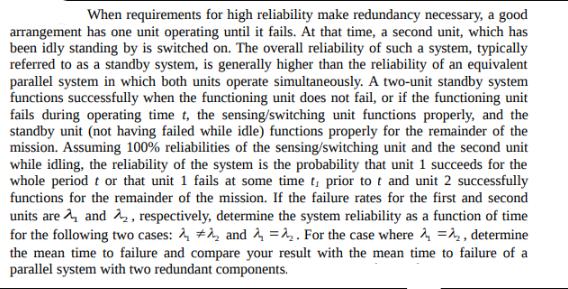
When requirements for high reliability make redundancy necessary, a good arrangement has one unit operating until it fails. At that time, a second unit, which has been idly standing by is switched on. The overall reliability of such a system, typically referred to as a standby system, is generally higher than the reliability of an equivalent parallel system in which both units operate simultaneously. A two-unit standby system functions successfully when the functioning unit does not fail, or if the functioning unit fails during operating time t, the sensing/switching unit functions properly, and the standby unit (not having failed while idle) functions properly for the remainder of the mission. Assuming 100% reliabilities of the sensing/switching unit and the second unit while idling, the reliability of the system is the probability that unit 1 succeeds for the whole period t or that unit 1 fails at some time t, prior to t and unit 2 successfully functions for the remainder of the mission. If the failure rates for the first and second units are and 2, respectively, determine the system reliability as a function of time for the following two cases: and. For the case where , determine the mean time to failure and compare your result with the mean time to failure of a parallel system with two redundant components.
Step by Step Solution
3.29 Rating (152 Votes )
There are 3 Steps involved in it
The reliability of the standby system can be calculated as Rt 1 Pf1 t f2 f2 f1 Pf2 t f1 f1 f2 where Rt is the system reliability at time t P is the pr... View full answer

Get step-by-step solutions from verified subject matter experts
 Study Help