





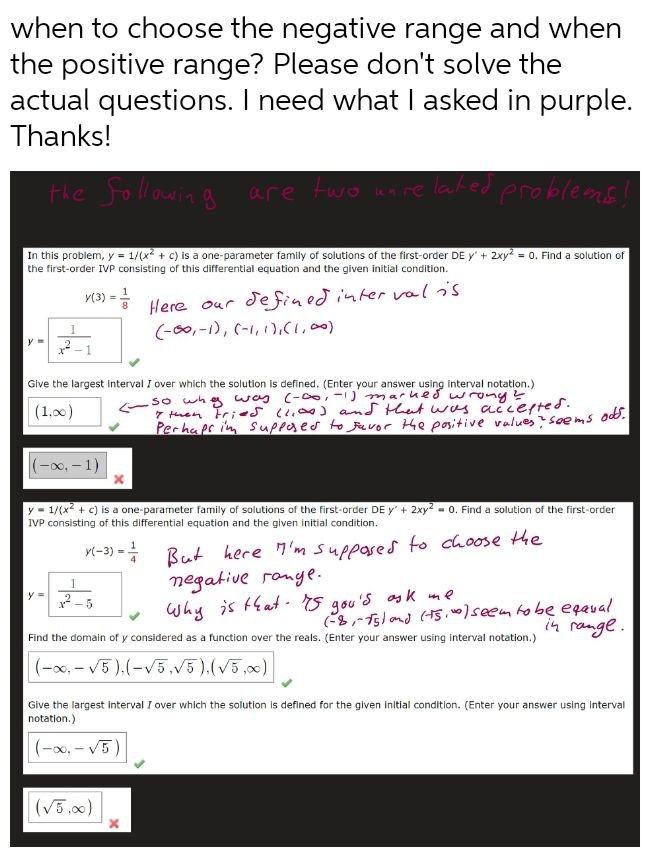
Question: when to choose the negative range and when the positive range? Please don't solve the actual questions. I need what I asked in purple. Thanks!
when to choose the negative range and when the
when to choose the negative range and when the positive range? Please don't solve the actual questions. I need what I asked in purple. Thanks! the following are two unrelated problems In this problem, y = 1/(x*+ c) is a one-parameter family of solutions of the first-order DE y' + 2xy = 0. Find a solution of the first-order IVP consisting of this differential equation and the given initial condition. y(3) = - Here our defined interval is ( - 50 , - 1 ) , ( - 1 , 17 , ( 1 , 00 ) Give the largest Interval I over which the solution is defined. (Enter your answer using interval notation.) so why way ( -00 ,-1) -) marked wrong ! (1,00 ) 7 then tried (1100) and that was accepted. Perhaps ing supposed to Favor the positive values ?s "values "seems odd . (-00, - 1) " = 1/(x"+ c) is a one-parameter family of solutions of the first-order DE y' + 2xy

Step by Step Solution

There are 3 Steps involved in it

1 Expert Approved Answer
Step: 1 Unlock blur-text-image
Question Has Been Solved by an Expert!

Get step-by-step solutions from verified subject matter experts

Step: 2 Unlock
Step: 3 Unlock

Students Have Also Explored These Related Mathematics Questions!