







Question: . When using a numerical method to approximate the value of an integral, we expect there to be some discrepancy between the exact value
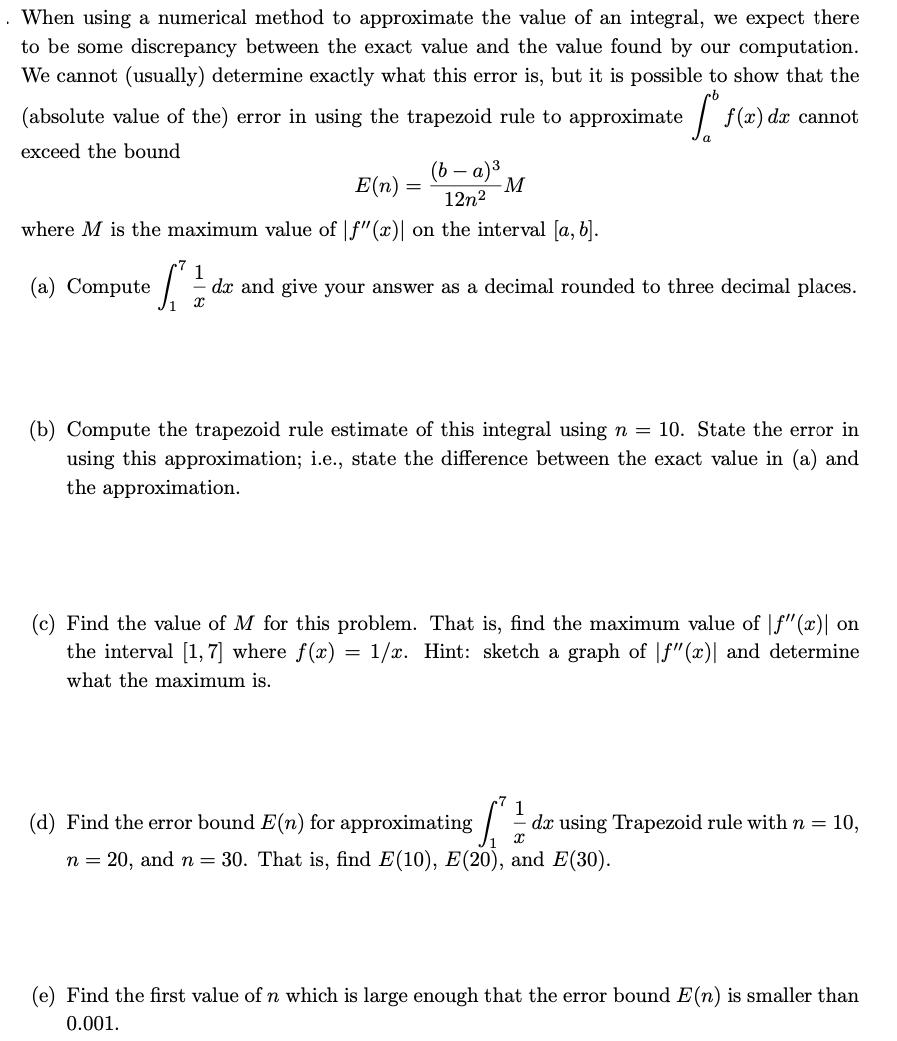
. When using a numerical method to approximate the value of an integral, we expect there to be some discrepancy between the exact value and the value found by our computation. We cannot (usually) determine exactly what this error is, but it is possible to show that the (absolute value of the) error in using the trapezoid rule to approximate So f(x) dx cannot a exceed the bound E(n) = (b-a) -M 12n where M is the maximum value of f"(x)| on the interval [a, b]. (a) Compute [2/1/2 dx and give your answer as a decimal rounded to three decimal places. x (b) Compute the trapezoid rule estimate of this integral using n = 10. State the error in using this approximation; i.e., state the difference between the exact value in (a) and the approximation. (c) Find the value of M for this problem. That is, find the maximum value of f"(x) | on the interval [1,7] where f(x) = 1/2. Hint: sketch a graph of [f"(x)] and determine what the maximum is. (d) Find the error bound E(n) for approximating S x n = 20, and n = 30. That is, find E(10), E(20), and E(30). 1 dx using Trapezoid rule with n = 10, (e) Find the first value of n which is large enough that the error bound E(n) is smaller than 0.001.
Step by Step Solution
3.53 Rating (167 Votes )
There are 3 Steps involved in it
a To compute 1x dx on the interval 1 7 you can simply calculate the natural logarithm of 7 minus the ... View full answer

Get step-by-step solutions from verified subject matter experts
 Study Help