







Question: When w e differentiate and produce a slope function, first derivative, o r instantaneous rate o f change, i t means something concrete t o
When differentiate and produce a slope function, first derivative, instantaneous rate change,
means something concrete the original function. the context modeling motion, the first
derivative the velocity.
The first derivative position velocity.
velocity
often, though not always, start our equation motion time and restrict our domain
this problem, have the position function, and want find the time which a certain
velocity attained. we're not going evaluate the velocity function, but instead solve
equation using the velocity.
Here's the problem statement:
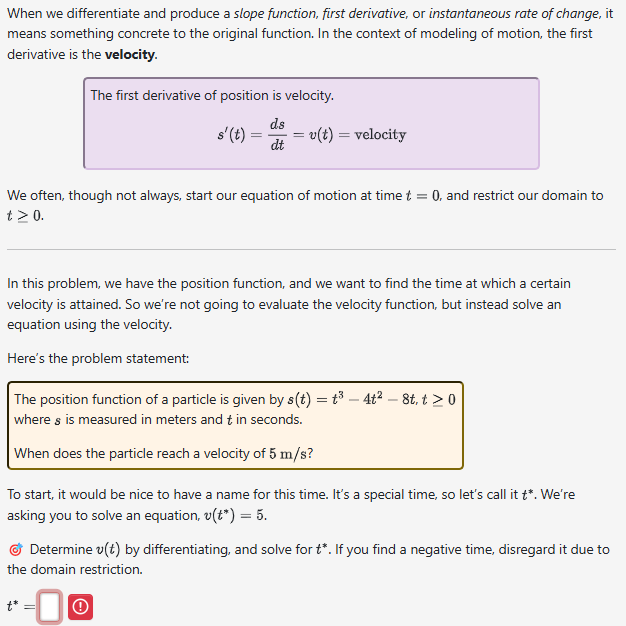
The position function a particle given
where measured meters and seconds.
When does the particle reach a velocity
start, would nice have a name for this time. It's a special time, let's call We're
asking you solve equation,
Determine differentiating, and solve for you find a negative time, disregard due
the domain restriction.
Step by Step Solution
There are 3 Steps involved in it
1 Expert Approved Answer
Step: 1 Unlock

Question Has Been Solved by an Expert!
Get step-by-step solutions from verified subject matter experts
Step: 2 Unlock
Step: 3 Unlock
 Study Help