







Question: when you are abhe. Vector 10. Define a vector to hold ints. Next, fill the vector with even Integers from 10 to 100 inclusive. 15...
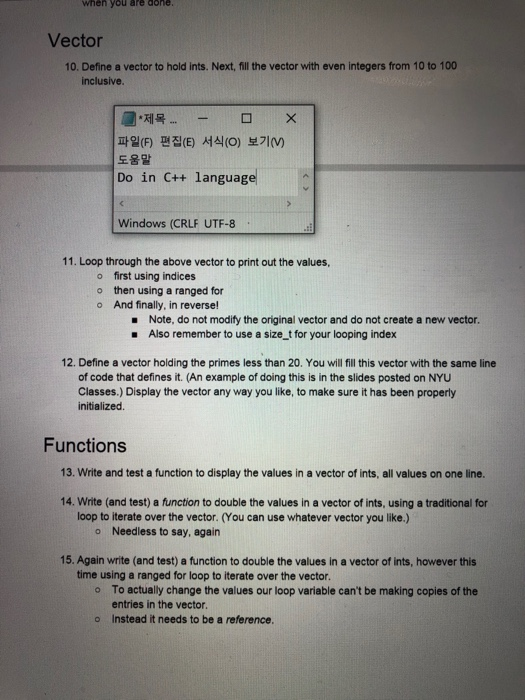
when you are abhe. Vector 10. Define a vector to hold ints. Next, fill the vector with even Integers from 10 to 100 inclusive. 15... - (F) (E) *44(0) Do in C++ language V) Windows (CRLF UTF-8 11. Loop through the above vector to print out the values, o first using indices o then using a ranged for o And finally, in reverse! Note, do not modify the original vector and do not create a new vector. Also remember to use a size_t for your looping index 12. Define a vector holding the primes less than 20. You will fill this vector with the same of code that defines it. (An example of doing this is in the slides posted on NYU Classes.) Display the vector any way you like, to make sure it has been properly initialized. Functions 13. Write and test a function to display the values in a vector of ints, all values on one line. 14. Write (and test) a function to double the values in a vector of ints, using a traditional for loop to iterate over the vector. (You can use whatever vector you like.) o Needless to say, again 15. Again write (and test) a function to double the values in a vector of ints, however this time using a ranged for loop to iterate over the vector. To actually change the values our loop variable can't be making copies of the entries in the vector Instead it needs to be a reference
Step by Step Solution
There are 3 Steps involved in it

Get step-by-step solutions from verified subject matter experts
 Study Help