







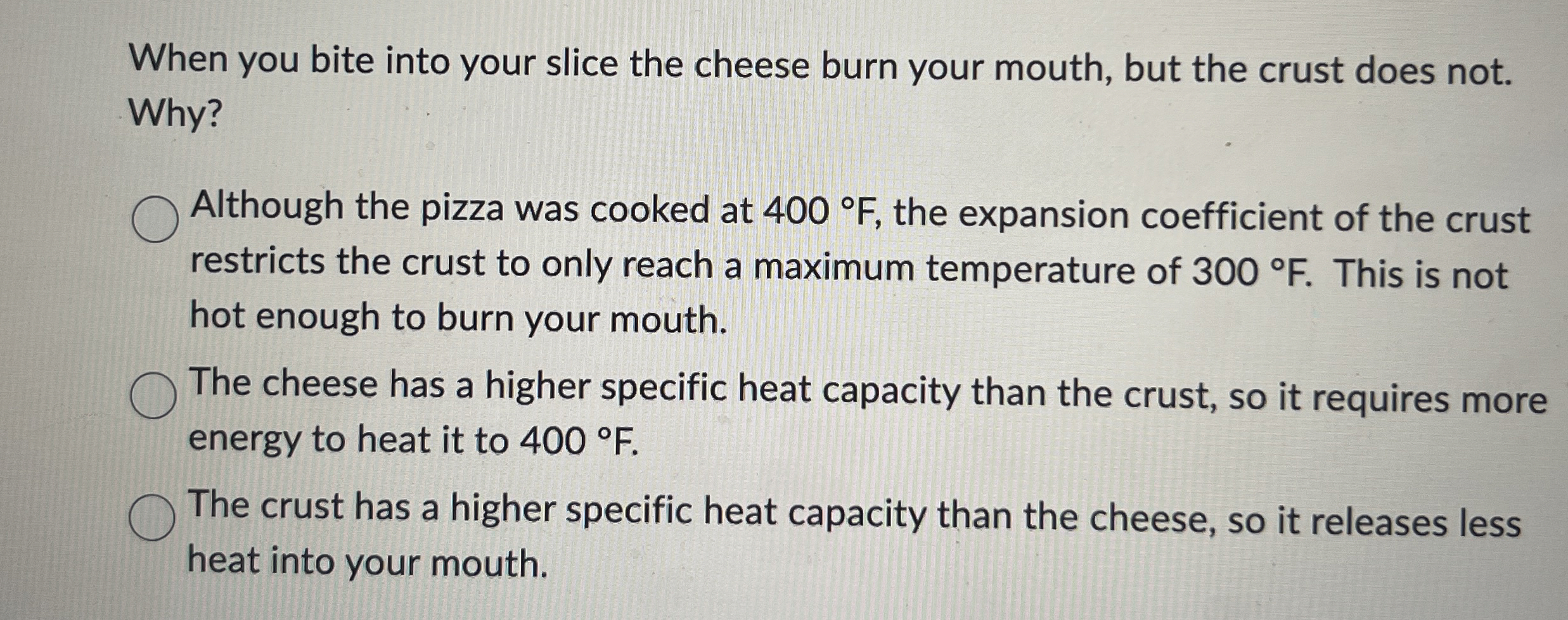
Question: When you bite into your slice the cheese burn your mouth, but the crust does not. Why? Although the pizza was cooked at 4 0
When you bite into your slice the cheese burn your mouth, but the crust does not. Why?
Although the pizza was cooked at the expansion coefficient of the crust restricts the crust to only reach a maximum temperature of This is not hot enough to burn your mouth.
The cheese has a higher specific heat capacity than the crust, so it requires more energy to heat it to
The crust has a higher specific heat capacity than the cheese, so it releases less heat into your mouth.
When you bite into your slice the cheese burn your mouth, but the crust does not. Why?
Although the pizza was cooked at the expansion coefficient of the crust restricts the crust to only reach a maximum temperature of This is not hot enough to burn your mouth.
The cheese has a higher specific heat capacity than the crust, so it requires more energy to heat it to
The crust has a higher specific heat capacity than the cheese, so it releases less heat into your mouth.
When you bite into your slice the cheese burn your mouth, but the crust does not. Why?
Although the pizza was cooked at the expansion coefficient of the crust restricts the crust to only reach a maximum temperature of This is not hot enough to burn your mouth.
The cheese has a higher specific heat capacity than the crust, so it requires more energy to heat it to
The crust has a higher specific heat capacity than the cheese, so it releases less heat into your mouth.
Step by Step Solution
There are 3 Steps involved in it
1 Expert Approved Answer
Step: 1 Unlock

Question Has Been Solved by an Expert!
Get step-by-step solutions from verified subject matter experts
Step: 2 Unlock
Step: 3 Unlock
 Study Help