







Question: Where is the critical value 1.96 found in the solution? I can 't seem to find it in Areas Under the Curve table when I
Where is the critical value 1.96 found in the solution? I can't seem to find it in Areas Under the Curve table when I look up 2.60. Alternatively I find 0.9953. Please see screen shot.
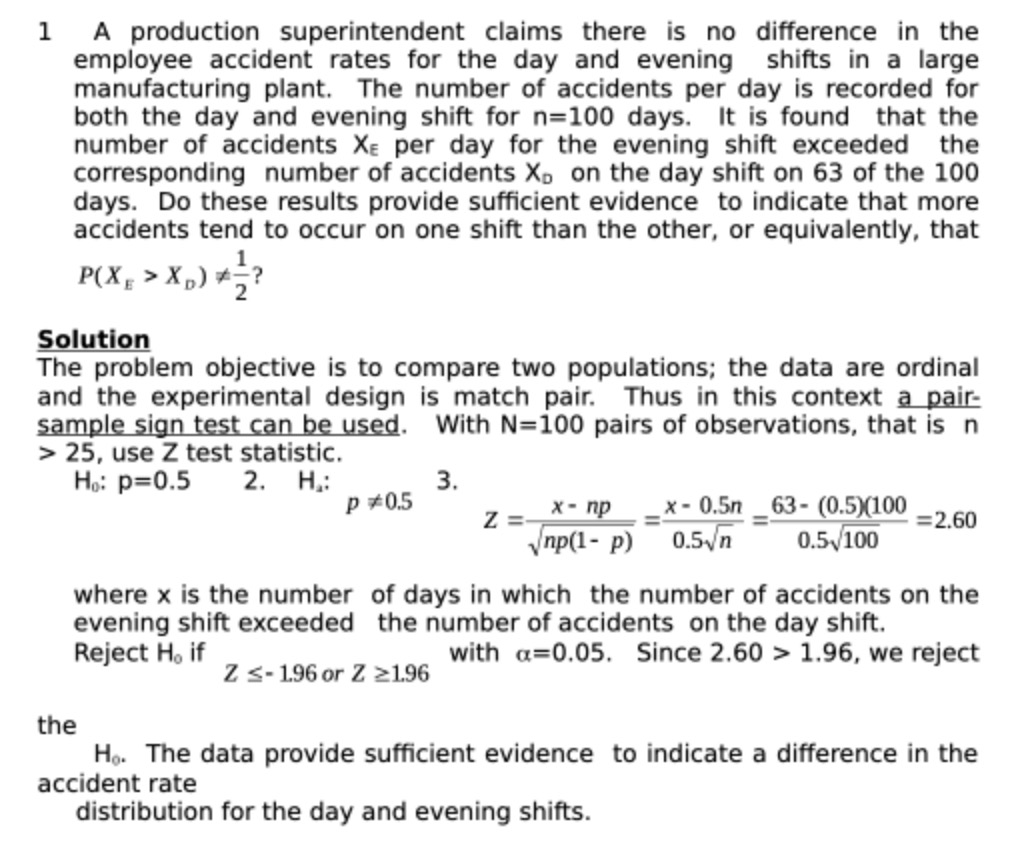
1 A production superintendent claims there is no difference in the employee accident rates for the day and evening shifts in a large manufacturing plant. The number of accidents per day is recorded for both the day and evening shift for n=100 days. It is found that the number of accidents XE per day for the evening shift exceeded the corresponding number of accidents XD on the day shift on 63 of the 100 days. Do these results provide sufficient evidence to indicate that more accidents tend to occur on one shift than the other, or equivalently, that P(X > XD)? Solution The problem objective is to compare two populations; the data are ordinal and the experimental design is match pair. Thus in this context a pair- sample sign test can be used. With N=100 pairs of observations, that is n > 25, use Z test statistic. Ho: p=0.5 2. H: 3. P 0.5 z = x- np _ x - 0.5n _ 63 - (0.5)(100 =2.60 np(1- p) 0.5n 0.5100 where x is the number of days in which the number of accidents on the evening shift exceeded the number of accidents on the day shift. Reject Ho if with a 0.05. Since 2.60 > 1.96, we reject Z -1.96 or Z 1.96 the Ho. The data provide sufficient evidence to indicate a difference in the accident rate distribution for the day and evening shifts.
Step by Step Solution
There are 3 Steps involved in it
The critical value 196 196 is a key value in this hypothesis test scenario It comes from the Zdistri... View full answer

Get step-by-step solutions from verified subject matter experts
 Study Help