







Question: Which answer the following terms in reference to given case study: Synopsis Problem #1 Problem #2 Implementation Plan Measuring Success Risks and Mitigation Conclusion ALso
Which answer the following terms in reference to given case study: Synopsis Problem #1 Problem #2 Implementation Plan Measuring Success Risks and Mitigation Conclusion ALso provide the graphical representation for the same. Pattern is given in the image.
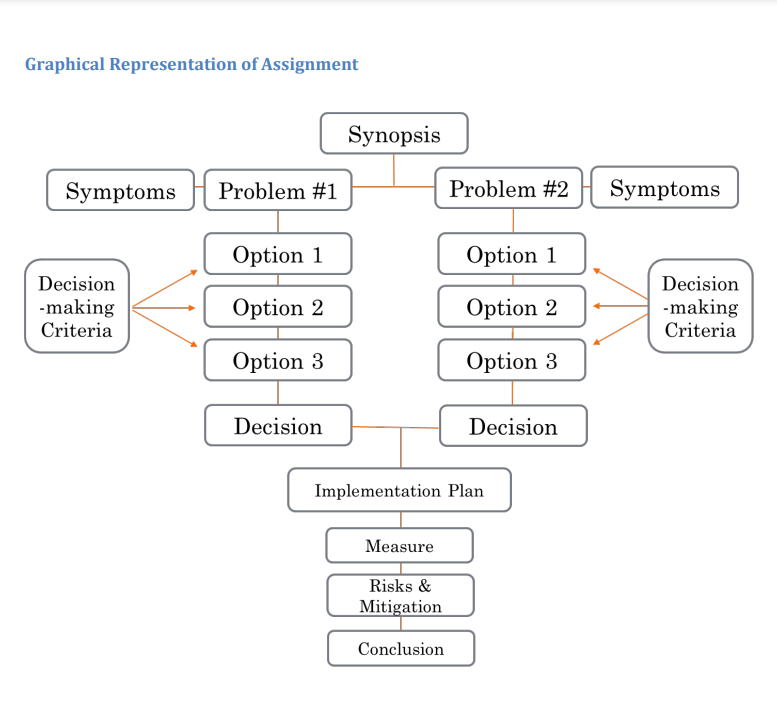
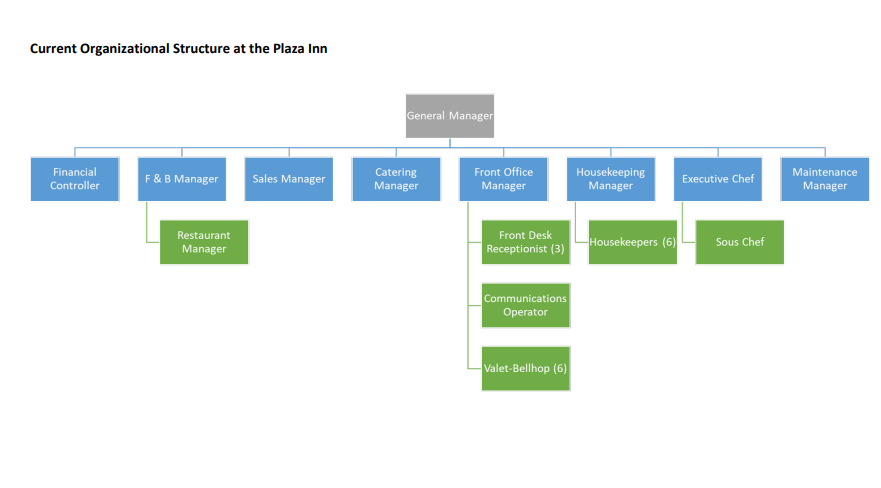
Graphical Representation of Assignment THE PLAZA INN David Bart, General Manager of the Plaza Inn, just finished reading a letter from the prestigious Relais \& Chateaux (R\&C) - a French hotel association of which the Plaza Inn had been a member property since 1993. In a formal and polite tone, the letter was indicating that the last inspection concluded that the Plaza Inn services levels did not measure up to the strict R\&C standards. Moreover, the letter noted that the Front Desk, a critical point-of-contact for guests, received the worst rating among all R\&C member properties. The letter concluded that unless Plaza Inn management could submit a plan to improve guest service to a level that would pass the next inspection (scheduled in six months), the R\&C would "regrettably be forced to terminate Plaza Inn's membership with the R\&C." Unsure of what to do, David Bart has hired your team to develop a renewal strategy that will turn around the business and address the concerns of the R\&C. In 2004, David Bart was hired as the new general manager. A native of Vancouver, Bart had a solid hotel management background in the West, including several years as financial controller at the headquarters of an international chain hotel. As David Bart took control of the Inn in 2004, he faced several challenges leftover by the Duvals, including steadily declining hotel occupancy and revenues. Many of the regular clientele complained that the Inn had not been the same since Antoine departed. Moreover, the Inn was also losing business to a 300-room, upscale Ritz-Carlton hotel which had just opened a few blocks down the street and was offering introductory room rates as low as $99. Given the poor performance of the hotel, David Bart immediately proceeded to cut costs - including the elimination of several staff positions. In the Food and Beverage Department (F\&B), two of the three restaurant managers were eliminated. The St. Jacques and Andre's restaurants were now to be run by the F\&B Director with the assistance of only one restaurant manager. In the Rooms Department, Bart eliminated the position of Communications operator, and transferred the responsibility of answering the phone directly to the front desk. Finally, the Front Office Manager position was eliminated, and the front desk staff came under the supervision of the Sales Manager. All operating departments, except for F\&B, were headed by one person and with no administrative support. The end of David Bart's first year at the Plaza Inn was marked by continued economic upheaval. During the first quarter of 2005, occupancy hit an all-time low of 40%. However, business finally began to pick up in April. This increase in demand was especially hard for the front desk. The reception area, consisting of an elegant antique concierge-type desk, was too small to be staffed by more than one person at a time. Consequently, only one front desk receptionist was scheduled per shift. With no Communications operator and no secretarial staff, this meant that the front desk receptionist was responsible for providing guest service, answering the telephone, taking messages for the management staff, and booking room and restaurant reservations on request. Moreover, the sales office was not connected to the computerized Property Management Data Bank (PMDB), and consequently the sales and catering managers relied on the front desk to check availability and block or update group reservations. Similarly, the housekeeping department was not computerized, and the front desk was charged with the preparation of housekeeping room assignments each morning and evening as well as with the tracking and updating of room status in the PMDB. Bart believed that the front desk should perform a central function in the operation of the Inn. Rather than computerize the housekeeping, sales and catering departments, and train the managers to utilize the PMDB, Bart preferred the front desk to oversee those activities. This, he believed, allowed for greater consistency and control. With only one person scheduled per shift, the front desk receptionist had to juggle the telephone, coordinate department activities, and take care of guest needs in the personalized manner that was the trademark of the Inn. On busy days, guests checking in or out were rudely interrupted by the ringing telephone, or alternatively, callers were put on hold for lengthy periods of time while the front desk receptionist helped a guest. The inability to efficiently expedite phone calls and respond to guest needs became worrisome from both a guest service perspective and a potential revenue loss standpoint. Research showed that room reservation calls usually hung up when put on hold for more than two minutes. Moreover, the significant responsibility was resulting in many mistakes by the front desk receptionist - frequently underquoting rates, mixing up arrival dates and booking rooms on sold out nights and billing customers even though cancellation requests were received. One of the front desk receptionists commented, "It's extremely difficult to make a room sale when I constantly have to ask the customer to hold because I'm trying to pick up the other five lines that are ringing. What is more important - making a $160 room reservation for two nights or taking a message for one of the managers?" Lost revenues and customer complaints about front office service finally convinced David Bart of the need to reinstate the position of the front office manager role. A manager was needed to monitor the rooms inventory, to coordinate activities between departments, and to train the front office staff consisting of front desk receptionists and valets/bellhops. However, to minimize costs, Bart decided that the front office manager would also work three shifts per week at the front desk as a receptionist. In February 2006, Bart offered the position of front office manager to Ms. Claire Ruiz, who had been working as a front desk receptionist since 1998. The promotion worked out well. Claire knew the job thoroughly and was genuinely interested in hotel management. She was able to effectively combine her managerial duties with the three shifts at the front desk. Cooperation between the departments soon increased significantly. Claire believed that the Inn would never be able to afford the specialized and extensive front office staff of a larger hotel, and thus its ability to deliver high quality customer service depended on cooperation between all employees. Consequently, when things got busy, she had the front desk ask other departments for support. For example, if the switchboard was busy, reservation calls were transferred from the front desk to accounting or sales. Even the general manager himself got called on to help the valets park cars or assist guest with luggage. While other managers were willing to help, they had their own responsibilities and were not always available. Since occupancy remained strong, Claire convinced the general manager to reinstate the Communication operator position. However, Claire's idea was to have the Communication operator function as an extension of the front desk. A communication station was set up in an unoccupied reception area in the lobby, and except for checking guests in and out, the Communications operator performed the same duties and was compensated at the same rate of pay as the front desk receptionist. This additional support allowed the front desk to provide more efficient and gracious service to the Inn's guest, and improve their room selling ability. Despite the continuing competition from the Ritz-Carlton, 2006 proved to be a year of record high occupancy and revenues for the Plaza Inn. In August 2007, Claire left the Plaza Inn to pursue a graduate degree in hotel management at the local university. David Bart believed that the situation at the front desk was under control and did not plan to fill the vacant position of front office manager. The front desk staff once again would be indirectly supervised by the sales manager. It wasn't long, however, before the same problems Claire had worked so hard to resolve cropped up again. With the start of the school year, the front desk staff were no longer as flexible in terms of scheduling, and the Communications operator was called on to fill vacant shifts at the front desk. There was often only one person scheduled to work in the front office, and guest service began to suffer again. For example, David Bart discovered that a recently hired front desk receptionist was frequently telling clients that the hotel was sold out because she was too busy to take a reservation. Bart believed that there was no one at the front desk capable of being promoted to the position of front office manager. However, he also thought that it would be difficult to hire an outsider who would be willing to work the three shifts at the front desk for the modest salary he was willing to offer (most managers at the Plaza Inn were paid $3,000 to $5,000 less than other Quebec City hotels). Thus, Bart was relieved to learn that Laura Dunbar, who had previously worked at the Plaza Inn as a front desk receptionist, was interested in the position. In addition to her experience at the Plaza Inn, Laura had worked as a concierge at one of the convention hotels in downtown Quebec City for several years. She had left the Plaza Inn for a secretarial position that offered more pay than the front desk position at the Inn. However, she missed the excitement and pace of the hospitality industry and accepted the front office manager position in December 2007 with enthusiasm. Despite her extensive connections with other Quebec City hotels, as well as the Quebec City Concierge Association, Laura soon found that one of her biggest challenges was the hiring and retaining of the front desk staff. The difficulty of hiring qualified employees forced Laura to work more than three shifts a week at the front desk. This left her with little time for planning and managing the front office operation. Short-staffed, she sometimes found herself working as much as 30 days in a row. In addition, the Communications Operator had quit, and the position had not been filled for several months. Laura noticed that the front desk receptionists were not very attentive to the guests and were unable to meet guest expectations of a personalized concierge-type service. Guest comment cards frequently included negative observations regarding front desk service. In fact, one guest commented that it seemed to him that the front desk receptionists "Were responsible for doing everything with the exception of bartending and bussing the tables in the restaurants." Laura believed that David Bart was reluctant to hire a full-time Communications operator due to financial constraints. She also felt pressured to meet the front office payroll budget, which had been prepared by Bart and which she felt had been grossly underestimated. In a bi-monthly management staff meeting, Laura suggested to the F\&B director that perhaps the restaurant should assume responsibility for managing their own reservations and inquiries to free the front desk staff to improve guest service and sell more rooms. However, the F\&B director was quick to point out that the evening restaurant manager was called on to assist with rooms-related issues daily and sat in for the front desk receptionist during break times. The restaurants, he asserted, could not afford to create a position just to take reservations and answer inquiries. Laura felt especially pressured with managing the front desk operation on the weekends as the hotel was usually at full capacity with limited staff. During the week, Laura could call on the other managers for help. However, on the weekends, the only manager on duty was the restaurant manager, and he was often too busy with the restaurant to help with hotel issues. The Manager on Duty (MOD) program, in which all department managers rotated being at the Inn on Friday and Saturday nights had been canceled when the slow summer period hit and had not been reinstated in the Fall. Furthermore, David Bart was not in on the weekends, and Laura felt he somehow forgot that the hotel existed on weekends. By mid-fall, Bart agreed with Laura that there was a definite need to reinstate the MOD program, as well as the Communications position. However, Bart thought that Laura only had herself to blame for spending too much time as a front desk receptionist and not enough time managing. Bart felt that she surrounded herself with front-desk employees who were either not flexible or not qualified enough, and thus she was left to fill a lot of shifts at the front desk herself. This didn't leave her with any time to carry out her management duties. She still hadn't even finished writing up job descriptions for the Inn which he had instructed her to do two months ago. Bart wondered if the problems at the Front Desk stemmed from Laura's lack of management expertise. It appeared that she was unable to articulate her needs to him and other managers. Perhaps he needed to give her more direction; however, this was contradictory to his belief that each manager should assume the responsibility of defining his or her own role consistent with the objectives of the Inn. The weakness he saw in Laura as a manager was of growing concern to David. It was a key position in the operation of the Inn, and required a highly competent, proactive individual. As he thought back to the ultimatum he had received from the president of R\&C, David Bart wondered what he should do. Current Organizational Structure at the Plaza Inn
Step by Step Solution
There are 3 Steps involved in it

Get step-by-step solutions from verified subject matter experts
 Study Help