







Question: which choice is correct (A,B or C) and why? confidence interval = p+z- VP(1-p 0.04+1.96 V(0.04) (0.96) Vn V250 =4.0% + 2.4% = [1.6%:6.4%] HW.
which choice is correct (A,B or C) and why?
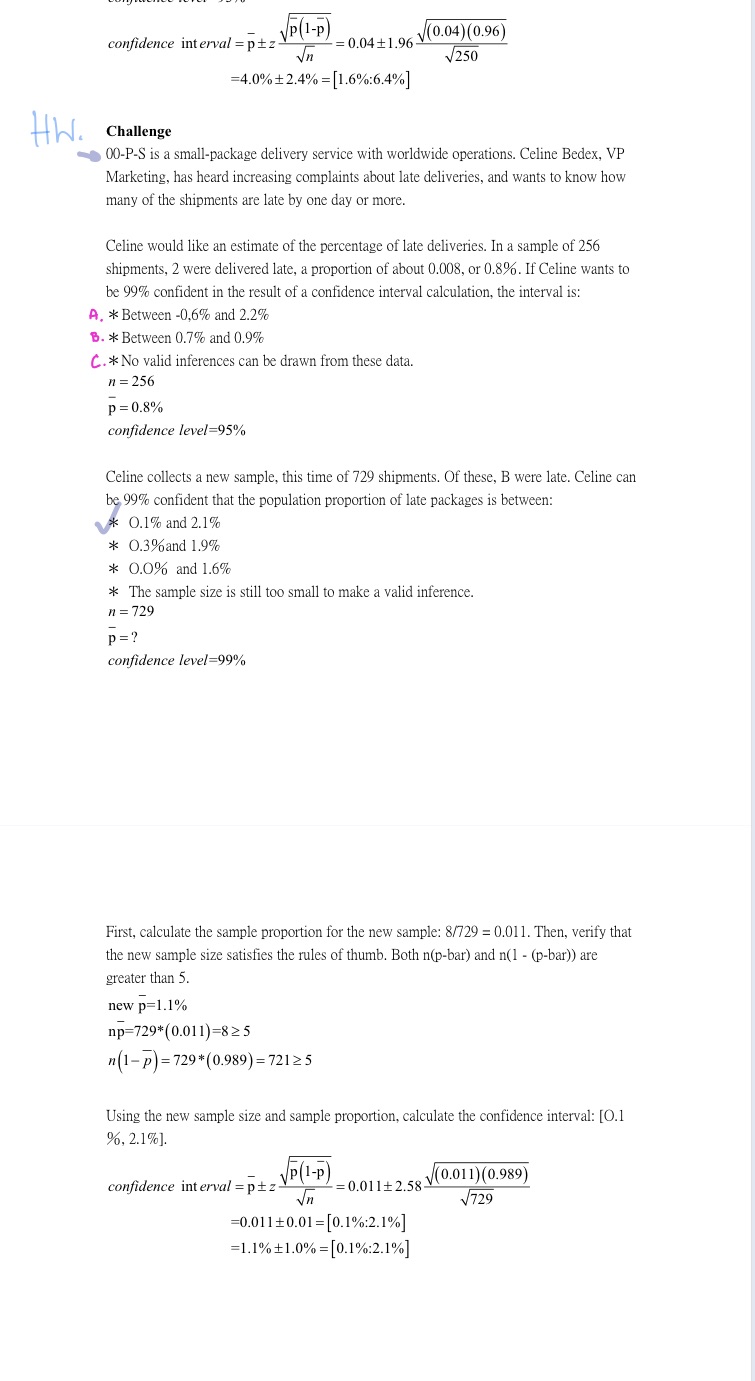
confidence interval = p+z- VP(1-p 0.04+1.96 V(0.04) (0.96) Vn V250 =4.0% + 2.4% = [1.6%:6.4%] HW. Challenge 00-P-S is a small-package delivery service with worldwide operations. Celine Bedex, VP Marketing, has heard increasing complaints about late deliveries, and wants to know how many of the shipments are late by one day or more. Celine would like an estimate of the percentage of late deliveries. In a sample of 256 shipments, 2 were delivered late, a proportion of about 0.008, or 0.89%. If Celine wants to be 99% confident in the result of a confidence interval calculation, the interval is: A. * Between -0,6% and 2.2% B. * Between 0.7% and 0.9% C. * No valid inferences can be drawn from these data. n = 256 p =0.8% confidence level=95% Celine collects a new sample, this time of 729 shipments. Of these, B were late. Celine can be 99% confident that the population proportion of late packages is between: * 0.1% and 2.1% * 0.39%and 1.9% * 0.0% and 1.6% * The sample size is still too small to make a valid inference. n = 729 p =? confidence level=99% First, calculate the sample proportion for the new sample: 8/729 = 0.011. Then, verify that the new sample size satisfies the rules of thumb. Both n(p-bar) and n(1 - (p-bar)) are greater than 5. new p=1.1% np=729*(0.011)=825 "(1-p) = 729*(0.989) =72125 Using the new sample size and sample proportion, calculate the confidence interval: [0.1 9%, 2.1%]. confidence interval = ptz~ VP(1-p) = 0.01 1+2.58 V(0.011)(0.989) Vn /729 =0.01 1+0.01 =[0.1%:2.1%] =1.1% +1.0% =[0.1%:2.1%]
Step by Step Solution
There are 3 Steps involved in it

Get step-by-step solutions from verified subject matter experts
 Study Help