



Question: which determines y=y(t) exactly and uniquely for all t . The more general version of (1.1) with initial value, Q^(')(t)=alpha Q(t),Q(0)=Q_(0) , is the venerable
which determines
y=y(t)exactly and uniquely for all
t. The more general version of (1.1) with initial value,
Q^(')(t)=\\\\alpha Q(t),Q(0)=Q_(0), is the venerable Malthusian population growth model, among other things. The constant
\\\\alpha is the intrinsic growth rate and the general solution to
Q^(')(t)=\\\\alpha Q(t)is
Q=Ce^(ct). Setting
t=0gives
C=Q(0)=Q_(0)or
Q(t)=Q_(0)e^(\\\\alpha t). This will be covered in detail.\ Here's another example. Suppose an object is dropped from a high altitude and falls subject to gravity and air resistance (for instance a sky diver hopping out of a stationary air balloon basket). Let
v(t)be the velocity of the object at time
t. If there were nothing to slow the falling object, one would write the equation for
v(t)as simply
v^(')(t)=g, where
g=32.17405f(t)/(sec^(2))is the gravity constant; this means that\ 1
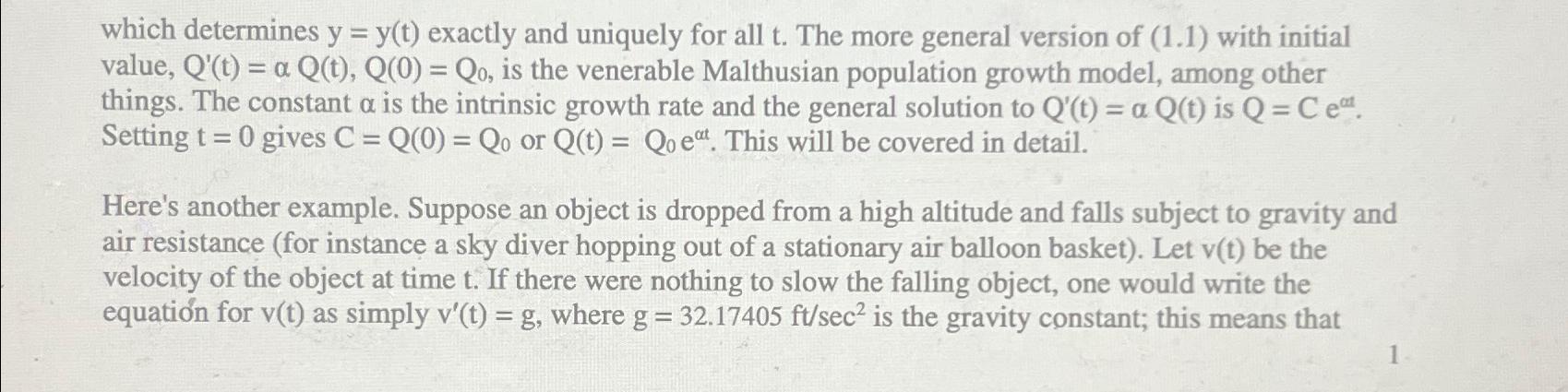
which determines y=y(t) exactly and uniquely for all t. The more general version of (1.1) with initial value, Q(t)=Q(t),Q(0)=Q0, is the venerable Malthusian population growth model, among other things. The constant is the intrinsic growth rate and the general solution to Q(t)=Q(t) is Q=Cect. Setting t=0 gives C=Q(0)=Q0 or Q(t)=Q0et. This will be covered in detail. Here's another example. Suppose an object is dropped from a high altitude and falls subject to gravity and air resistance (for instance a sky diver hopping out of a stationary air balloon basket). Let v(t) be the velocity of the object at time t. If there were nothing to slow the falling object, one would write the equation for v(t) as simply v(t)=g, where g=32.17405ft/sec2 is the gravity constant; this means that 1
Step by Step Solution
There are 3 Steps involved in it

Get step-by-step solutions from verified subject matter experts