Question: which is at ethe good ways to develop a business around a conce CASE 8.2 Webers, Inc. Webers is an omni-channel retailer with 250 stores
which is at ethe good ways to develop a business around a conce
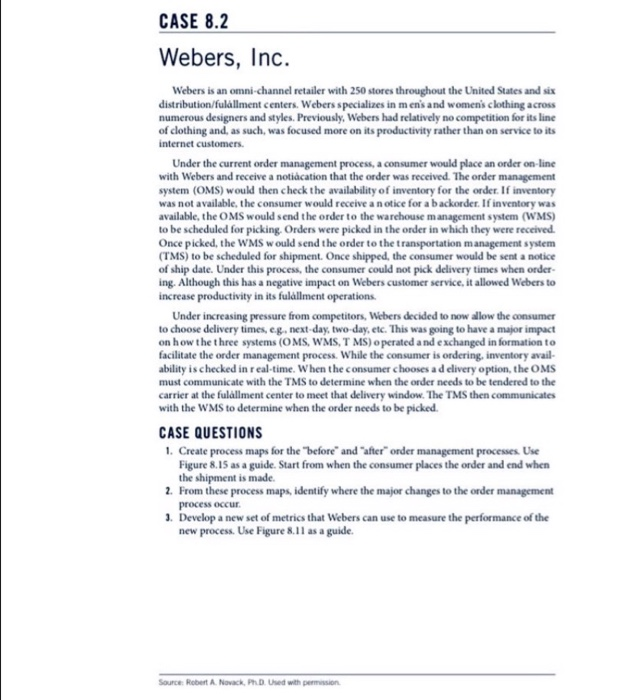
CASE 8.2 Webers, Inc. Webers is an omni-channel retailer with 250 stores throughout the United States and six distribution/fulllment centers. Webers specializes in men's and women's clothing across numerous designers and styles. Previously. Webers had relatively no competition for its line of clothing and, as such, was focused more on its productivity rather than on service to its internet customers. Under the current order management process, a consumer would place an order on-line with Webers and receive a notiacation that the order was received. The order management system (OMS) would then check the availability of inventory for the order. If inventory was not available, the consumer would receive a notice for a backorder. If inventory was available, the OMS would send the order to the warehouse management system (WMS) to be scheduled for picking. Orders were picked in the order in which they were received. Once picked, the WMS would send the order to the transportation management system (TMS) to be scheduled for shipment. Once shipped, the consumer would be sent a notice of ship date. Under this process, the consumer could not pick delivery times when order ing. Although this has a negative impact on Webers customer service, it allowed Webers to increase productivity in its fulllment operations. Under increasing pressure from competitors, Webers decided to now allow the consumer to choose delivery times, eg, next day, two-day, etc. This was going to have a major impact on how the three systems (OMS, WMS, T MS) operated and exchanged in formation to facilitate the order management process. While the consumer is ordering, inventory avail. ability is checked in real time. When the consumer chooses a delivery option, the OMS must communicate with the TMS to determine when the order needs to be tendered to the carrier at the fulallment center to meet that delivery window. The TMS then communicates with the WMS to determine when the order needs to be picked. CASE QUESTIONS 1. Create process maps for the "before" and "after" order management processes. Use Figure 8.15 as a guide . Start from when the consumer places the order and end when the shipment is made 2. From these process maps, identify where the major changes to the order management process occur 3. Develop a new set of metrics that Webers can use to measure the performance of the new process. Use Figure 8.11 as a guide. Source: Robert A. Novack, PhD. Used with person CASE 8.2 Webers, Inc. Webers is an omni-channel retailer with 250 stores throughout the United States and six distribution/fulllment centers. Webers specializes in men's and women's clothing across numerous designers and styles. Previously. Webers had relatively no competition for its line of clothing and, as such, was focused more on its productivity rather than on service to its internet customers. Under the current order management process, a consumer would place an order on-line with Webers and receive a notiacation that the order was received. The order management system (OMS) would then check the availability of inventory for the order. If inventory was not available, the consumer would receive a notice for a backorder. If inventory was available, the OMS would send the order to the warehouse management system (WMS) to be scheduled for picking. Orders were picked in the order in which they were received. Once picked, the WMS would send the order to the transportation management system (TMS) to be scheduled for shipment. Once shipped, the consumer would be sent a notice of ship date. Under this process, the consumer could not pick delivery times when order ing. Although this has a negative impact on Webers customer service, it allowed Webers to increase productivity in its fulllment operations. Under increasing pressure from competitors, Webers decided to now allow the consumer to choose delivery times, eg, next day, two-day, etc. This was going to have a major impact on how the three systems (OMS, WMS, T MS) operated and exchanged in formation to facilitate the order management process. While the consumer is ordering, inventory avail. ability is checked in real time. When the consumer chooses a delivery option, the OMS must communicate with the TMS to determine when the order needs to be tendered to the carrier at the fulallment center to meet that delivery window. The TMS then communicates with the WMS to determine when the order needs to be picked. CASE QUESTIONS 1. Create process maps for the "before" and "after" order management processes. Use Figure 8.15 as a guide . Start from when the consumer places the order and end when the shipment is made 2. From these process maps, identify where the major changes to the order management process occur 3. Develop a new set of metrics that Webers can use to measure the performance of the new process. Use Figure 8.11 as a guide. Source: Robert A. Novack, PhD. Used with person









 Study Help