



Question: Which molecule has given rise to the spectra shown below. Justify your answer with respect to IR, 1 H NMR and 13 C NMR. Keep
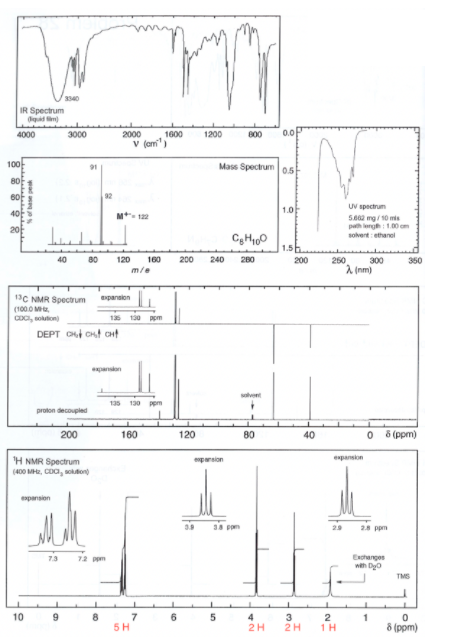
Which molecule has given rise to the spectra shown below. Justify your answer with respect to IR, 1 H NMR and 13 C NMR. Keep in mind that Hs that switch with D2O usually do not show connections to other nearby H. The integrals in HNMR are marked in red text. Below the image with spectral data, you will find various shift tables for NMR IR etc.
my IR Spectrum diqdim 4000 3000 1200 800 0.0 2000 1600 V mi) 100 Mass Spectrum 0.5 80E 1.0 UV spectrum 5.662 mg / 10 puthength: 100 cm solvent than Lundel CH00 40 80 200 240 280 200 300 120 160 mle 350 250 13C NMR Spectrum expansion (1000 M COCI, solution 130 DEPTH CH 135 130 pom 1- prolon de coupled 200 160 120 80 40 0 (ppm) persion expansion "H NMR Spectrum 1400 MH, COO, espansion 38 2.8 ppm 7.8 Exchanges who This 1 10 9 8 6 5 1 1 5 7 5 H 1 3 2 H 4 2H 1 2 1 H 0 8 (ppm)
Step by Step Solution
There are 3 Steps involved in it
1 Expert Approved Answer
Step: 1 Unlock

Question Has Been Solved by an Expert!
Get step-by-step solutions from verified subject matter experts
Step: 2 Unlock
Step: 3 Unlock