







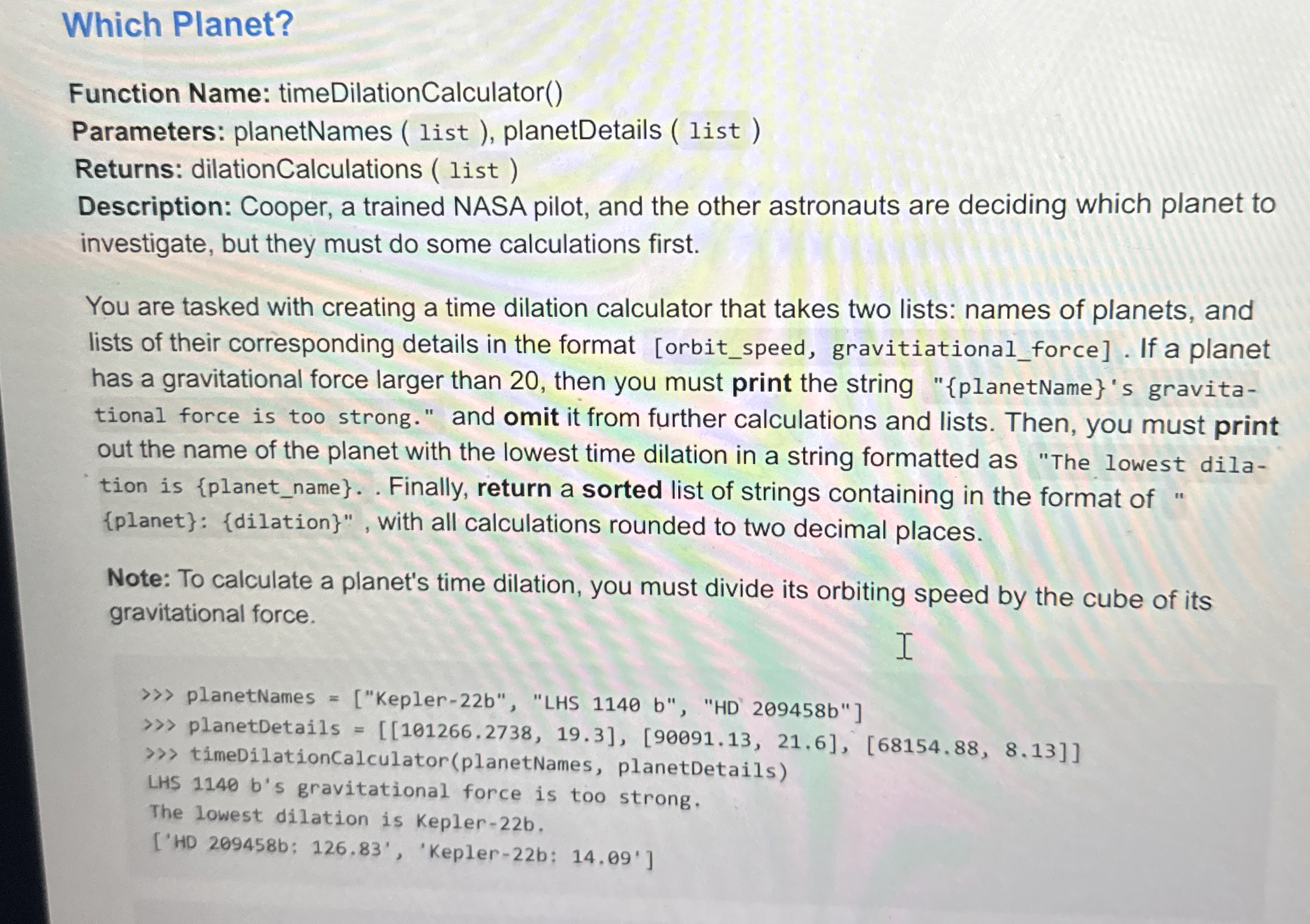
Question: Which Planet? Function Name: timeDilationCalculator ( ) Parameters: planetNames ( list ) , planetDetails ( list ) Returns: dilationCalculations ( list ) Description: Cooper, a
Which Planet?
Function Name: timeDilationCalculator
Parameters: planetNames list planetDetails list
Returns: dilationCalculations list
Description: Cooper, a trained NASA pilot, and the other astronauts are deciding which planet to
investigate, but they must do some calculations first.
You are tasked with creating a time dilation calculator that takes two lists: names of planets, and
lists of their corresponding details in the format orbitspeed, gravitiationalforce If a planet
has a gravitational force larger than then you must print the string planetNames gravita
tional force is too strong." and omit it from further calculations and lists. Then, you must print
out the name of the planet with the lowest time dilation in a string formatted as "The lowest dila
tion is planetname Finally, return a sorted list of strings containing in the format of
planet: dilation with all calculations rounded to two decimal places.
Note: To calculate a planet's time dilation, you must divide its orbiting speed by the cube of its
gravitational force.
planetNames
planetDetails
timeDilationCalculator planetDetails
gravitational force too strong,
The lowest dilation Kepler
: 'Kepler;
Step by Step Solution
There are 3 Steps involved in it
1 Expert Approved Answer
Step: 1 Unlock

Question Has Been Solved by an Expert!
Get step-by-step solutions from verified subject matter experts
Step: 2 Unlock
Step: 3 Unlock
 Study Help