







Question: Which state did Alice make? Consider a game in which Alice prepares one of two possible states: either 1 with a priori probability p1, or
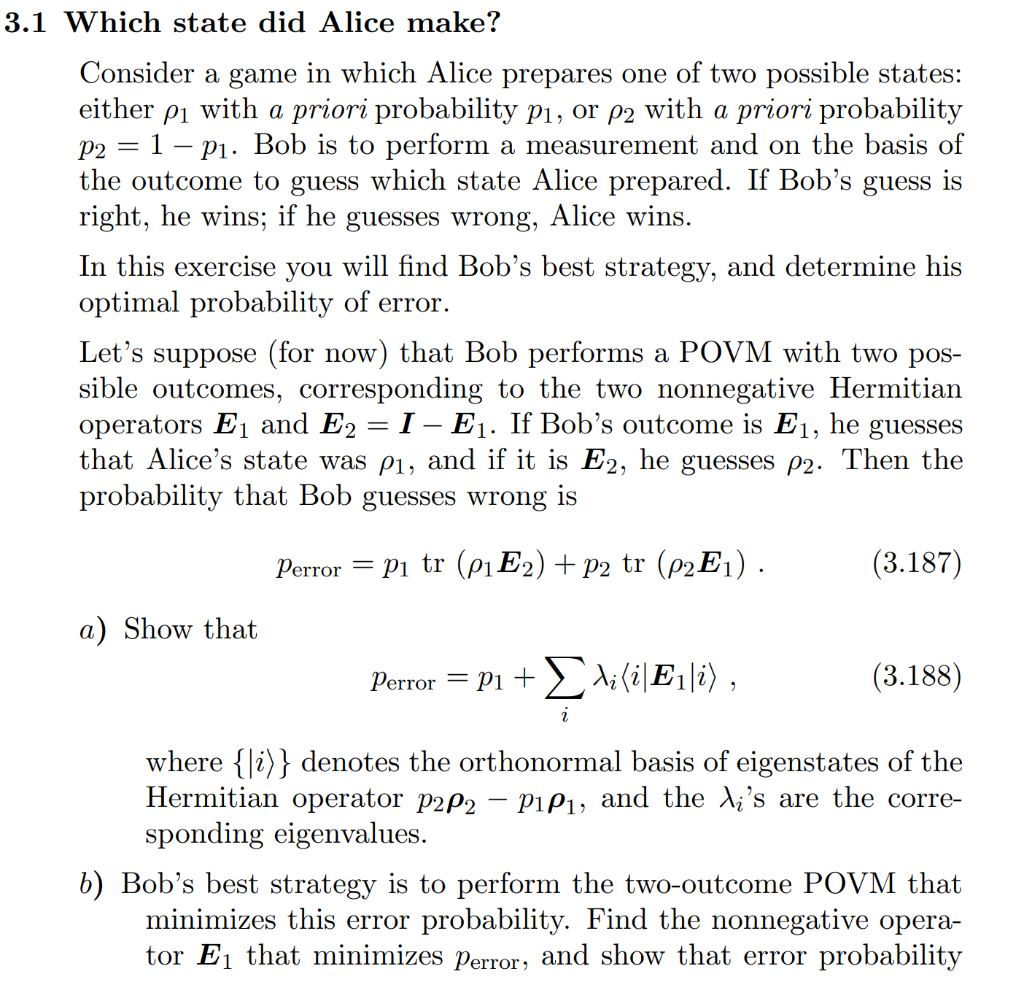
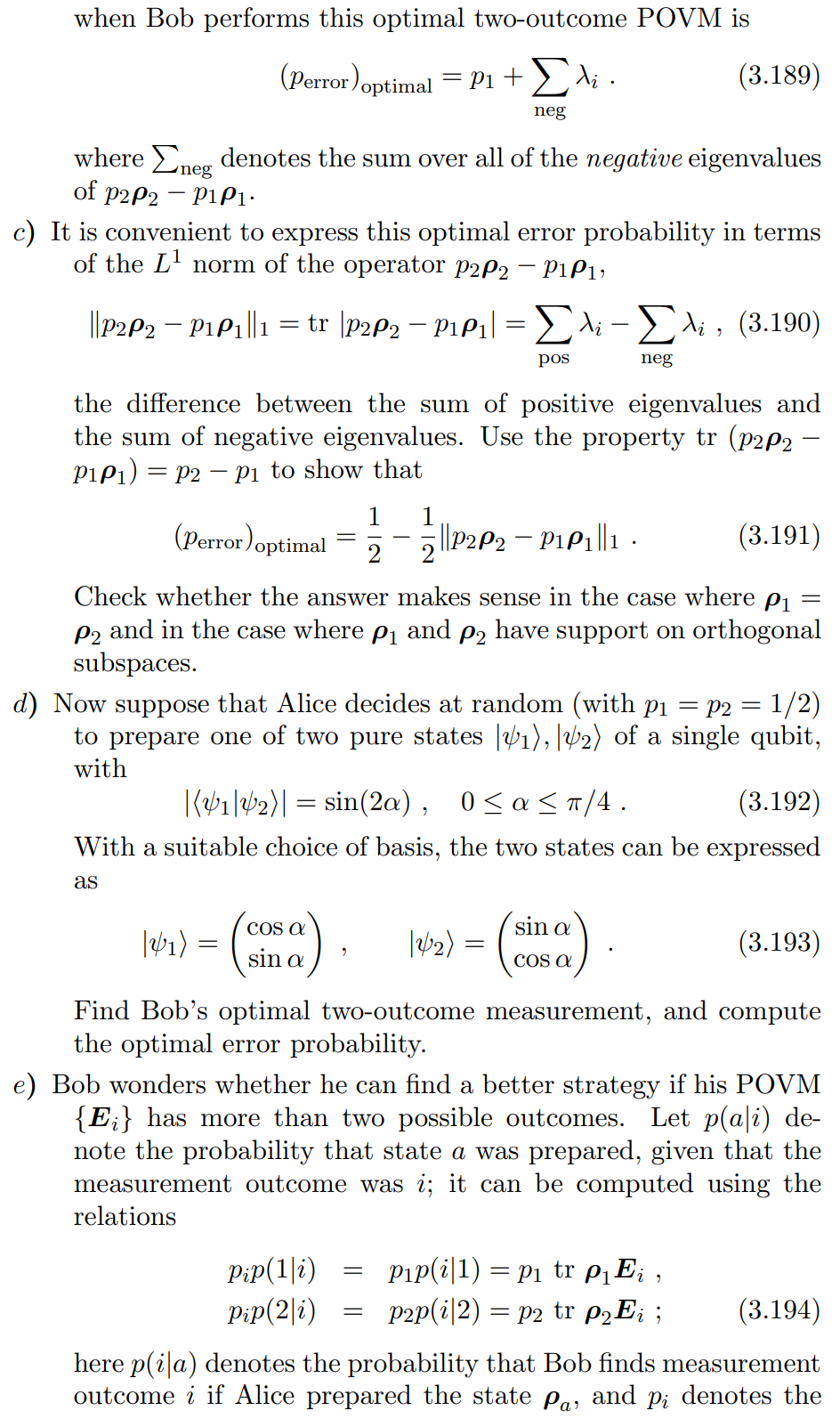
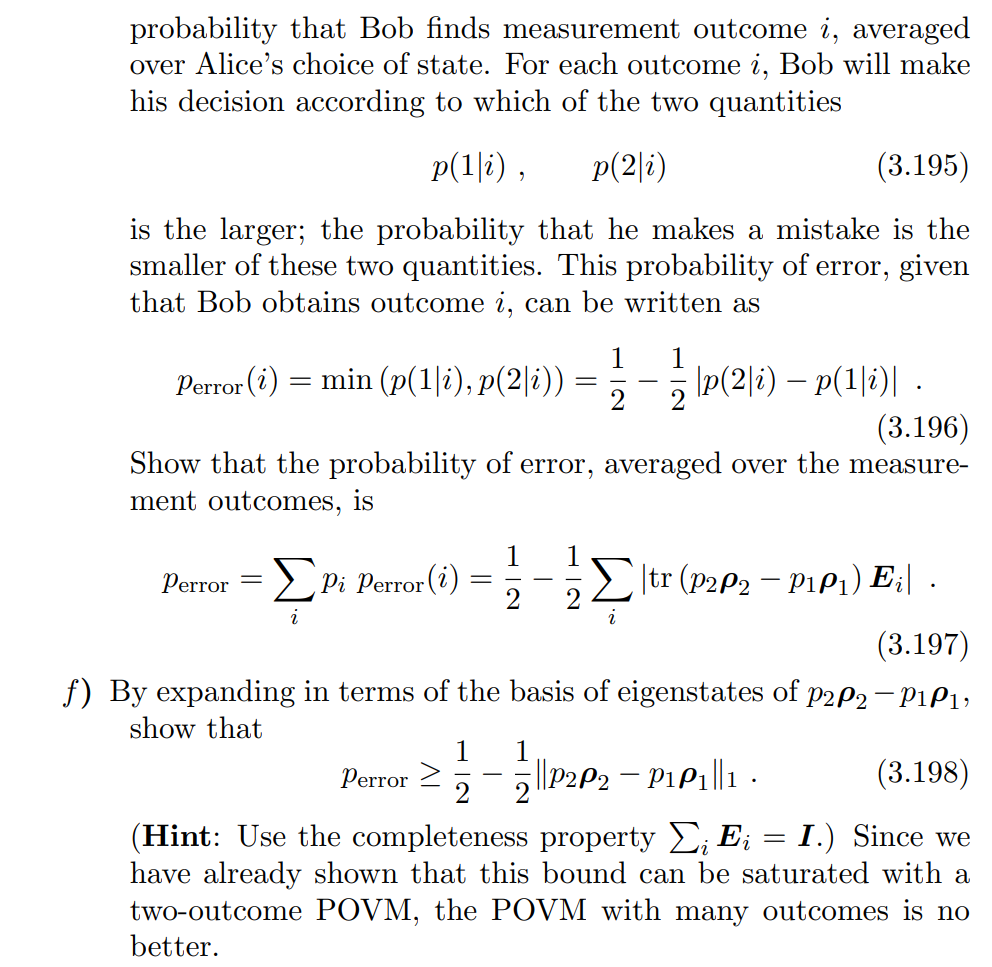
Which state did Alice make? Consider a game in which Alice prepares one of two possible states: either 1 with a priori probability p1, or 2 with a priori probability p2=1p1. Bob is to perform a measurement and on the basis of the outcome to guess which state Alice prepared. If Bob's guess is right, he wins; if he guesses wrong, Alice wins. In this exercise you will find Bob's best strategy, and determine his optimal probability of error. Let's suppose (for now) that Bob performs a POVM with two possible outcomes, corresponding to the two nonnegative Hermitian operators E1 and E2=IE1. If Bob's outcome is E1, he guesses that Alice's state was 1, and if it is E2, he guesses 2. Then the probability that Bob guesses wrong is perror=p1tr(1E2)+p2tr(2E1). a) Show that perror=p1+iiiE1i where {i} denotes the orthonormal basis of eigenstates of the Hermitian operator p22p11, and the i 's are the corresponding eigenvalues. b) Bob's best strategy is to perform the two-outcome POVM that minimizes this error probability. Find the nonnegative operator E1 that minimizes perror, and show that error probability when Bob performs this optimal two-outcome POVM is (perror)optimal=p1+negi where neg denotes the sum over all of the negative eigenvalues of p22p11. c) It is convenient to express this optimal error probability in terms of the L1 norm of the operator p22p11, p22p111=trp22p11=posinegi,(3.190) the difference between the sum of positive eigenvalues and the sum of negative eigenvalues. Use the property tr(p22 p11)=p2p1 to show that (perror)optimal=2121p22p111. Check whether the answer makes sense in the case where 1= 2 and in the case where 1 and 2 have support on orthogonal subspaces. d) Now suppose that Alice decides at random (with p1=p2=1/2 ) to prepare one of two pure states 1,2 of a single qubit, with 12=sin(2),0/4 With a suitable choice of basis, the two states can be expressed as 1=(cossin),2=(sincos). Find Bob's optimal two-outcome measurement, and compute the optimal error probability. e) Bob wonders whether he can find a better strategy if his POVM {Ei} has more than two possible outcomes. Let p(ai) denote the probability that state a was prepared, given that the measurement outcome was i; it can be computed using the relations pip(1i)=p1p(i1)=p1tr1Ei,pip(2i)=p2p(i2)=p2tr2Ei here p(ia) denotes the probability that Bob finds measurement outcome i if Alice prepared the state a, and pi denotes the probability that Bob finds measurement outcome i, averaged over Alice's choice of state. For each outcome i, Bob will make his decision according to which of the two quantities p(1i),p(2i) is the larger; the probability that he makes a mistake is the smaller of these two quantities. This probability of error, given that Bob obtains outcome i, can be written as perror(i)=min(p(1i),p(2i))=2121p(2i)p(1i) Show that the probability of error, averaged over the measurement outcomes, is perror=ipiperror(i)=2121itr(p22p11)Ei By expanding in terms of the basis of eigenstates of p22p11, show that perror2121p22p111. (Hint: Use the completeness property iEi=I.) Since we have already shown that this bound can be saturated with a two-outcome POVM, the POVM with many outcomes is no better
Step by Step Solution
There are 3 Steps involved in it

Get step-by-step solutions from verified subject matter experts
 Study Help