Question: Which statement is not a step used when constructing an inscribed equilateral triangle? Keep your compass at the width equal to the radius of the
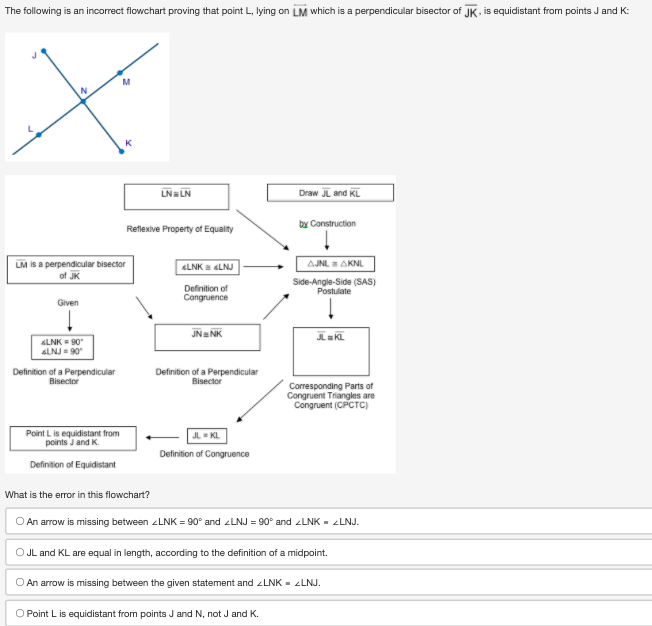
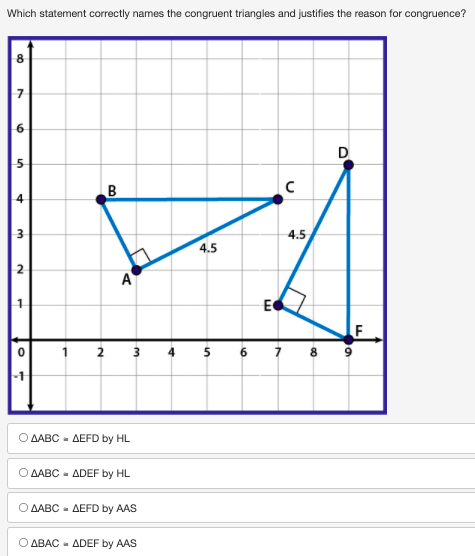
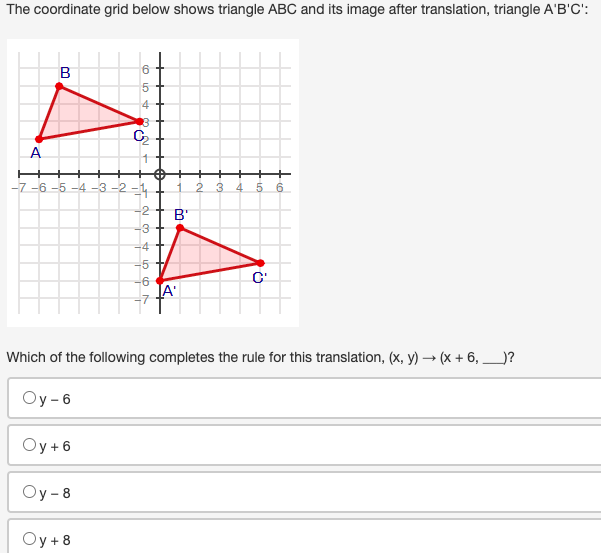
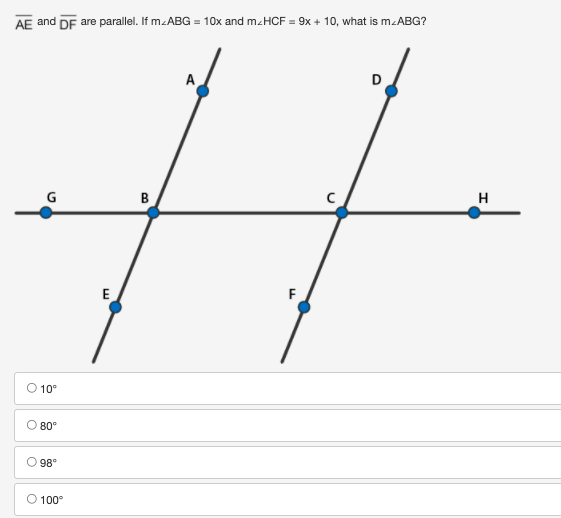
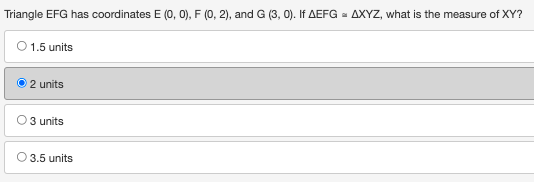
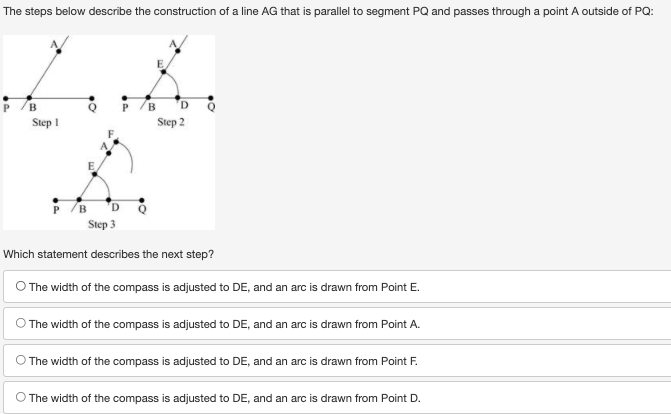
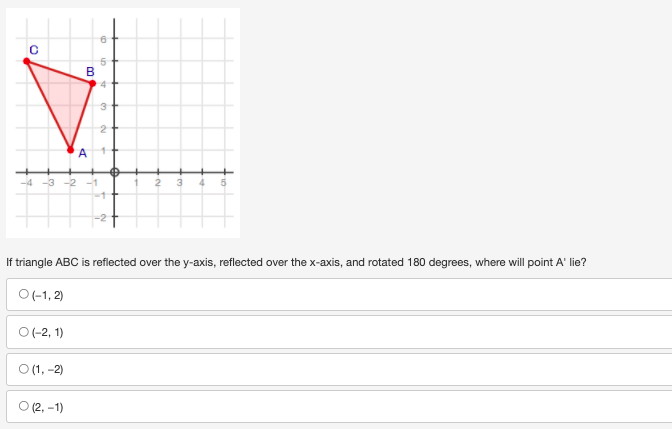
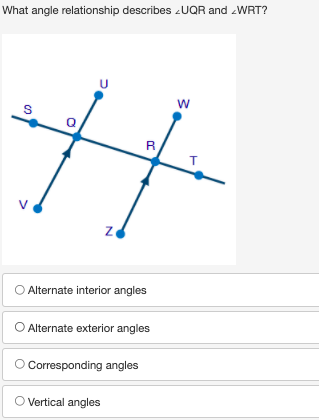
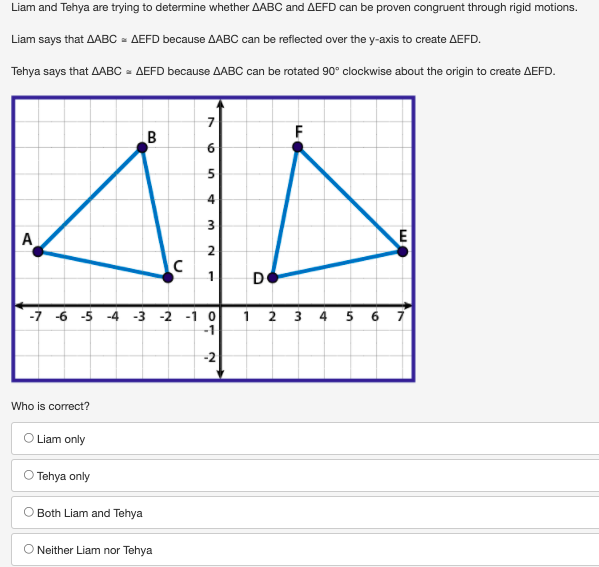
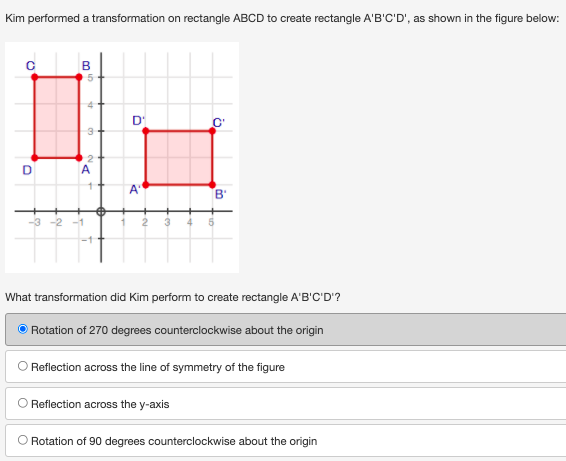
Which statement is not a step used when constructing an inscribed equilateral triangle? Keep your compass at the width equal to the radius of the circle. Place the compass on the point where the circle and radius intersect. Swing an arc the length of the radius from the point on the circle. O Connect the two circles together using the compass.The following is an incorrect flowchart proving that point L, lying on LM which is a perpendicular bisector of JK. is equidistant from points J and K: LN# LN Draw JL and KL Reflexive Property of Equality by Construction LM is a perpendicular bisector LNK = ALNJ AJNL = AKNL of JK Side-Angle-Side (SAS] Definition of Postulate Given Congruence JN - NK JL =KL ALNK - 90" ALNJ = 90' Definition of a Perpendicular Definition of a Perpendicular Bisector Bisector Corresponding Parts of Congruent Triangles are Congruent (CPCTC) Point L is equidistant from JL KL points J and K. Definition of Congruence Definition of Equidistant What is the error in this flowchart? An arrow is missing between LNK = 90* and 2LNJ = 90 and 2UNK = _LNJ. O JL and KL are equal in length, according to the definition of a midpoint. O An arrow is missing between the given statement and zLNK = _LNJ. O Point L is equidistant from points J and N, not J and K.Some steps to construct an angle MNT congruent to angle PQR are listed below. Step 1: Use a compass to draw an arc from point Q that intersects the side PQ at point A and the side QR at point B. Step 2: Draw a segment NT, and use the same width of the compass to draw an arc from point N that intersects the segment NT at a point X. Step 3: Step 4: Join points N and Y using a straightedge. Which statement describes step 3 correctly? O Adjust the width of the compass to AB, and draw an arc from point X such that it intersects the arc drawn from N in a point Y. O Adjust the width of the compass to AQ, and draw an arc from point X such that it intersects the arc drawn from N in a point Y. O Adjust the width of the compass to BQ, and draw an arc from point X such that it intersects the arc drawn from N in a point Y. O Adjust the width of the compass to NX, and draw an arc from point X such that it intersects the arc drawn from N in a point Y.Which transformation or sequence of transformations would produce an image that is not congruent to its pre-image? O A translation followed by a reflection O A rotation of 90 degrees about the origin OA dilation followed by a rotation O A translation of (x + 3, y + 4)Which statement correctly names the congruent triangles and justifies the reason for congruence? 8 7 6 5- D B C 4 3 4.5 4.5 2 A E F 0 1 2 3 4 5 6 7 8 9 O AABC . AEFD by HL O AABC . ADEF by HL O AABC - AEFD by AAS O ABAC - ADEF by AASThe coordinate grid below shows triangle ABC and its image after translation, triangle A'B'C': B C A -7 -6 -5 -4-3 -2 -1 2 3 4 5 6 B' C' A' Which of the following completes the rule for this translation, (x, y) - (x + 6, _)? Oy -6 Oy +6 Oy - 8 Oy + 8Rectangle LMNO is translated using the rule (x, y) -+ (x + 2, y + 2) to create rectangle L'M'N'O'. If a line segment is drawn from point L to point L' and from point O to point O', which statement would best describe the relationship between LL' and DO.? O They share the same midpoints. They are diameters of concentric circles. They are perpendicular to each other. They are parallel and congruent.AE and DF are parallel. If mcABG = 10x and mcHCF = 9x + 10, what is mcABG? D G B C H E O 10 O 805 O 100Triangle EFG has coordinates E (0, 0), F (0, 2), and G (3, 0). If AEFG = AXYZ, what is the measure of XY? O 1.5 units 2 units 0 3 units O 3.5 unitsThe steps below describe the construction of a line AG that is parallel to segment PQ and passes through a point A outside of PQ: P /B p /B D Step 1 Step 2 F E /B D Step 3 Which statement describes the next step? O The width of the compass is adjusted to DE, and an arc is drawn from Point E. The width of the compass is adjusted to DE, and an arc is drawn from Point A. The width of the compass is adjusted to DE, and an arc is drawn from Point F. The width of the compass is adjusted to DE, and an arc is drawn from Point D.6 C ch B 4 3 2 A -3 -2 2 3 5 If triangle ABC is reflected over the y-axis, reflected over the x-axis, and rotated 180 degrees, where will point A' lie? O (-1, 2) O (-2, 1) O (1, -2) O (2, -1)Which statement explains the difference between a plane and a ray? O A ray contains an infinite number of points, and a plane does not have width or depth. O A ray can be used to create other geometric shapes, and a plane is always part of a shape. O A plane does not have a formal definition, and a ray is described through undefined terms. O A plane continues infinitely in one direction, and a vertex does not have width or depth.What angle relationship describes










 Study Help