







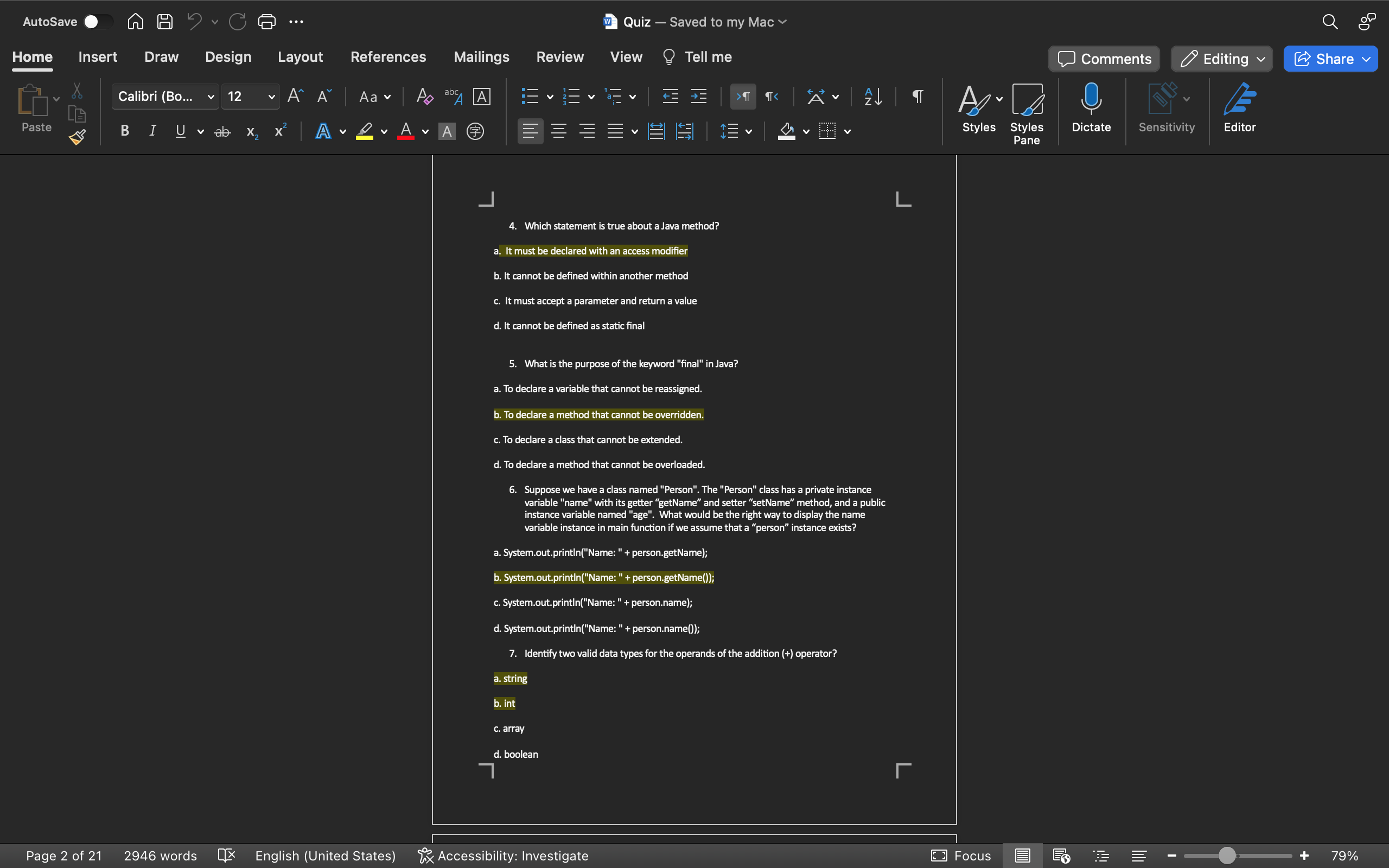
Question: Which statement is true about a Java method? a . It must be declared with an access modifier b . It cannot be defined within
Which statement is true about a Java method?
a It must be declared with an access modifier
b It cannot be defined within another method
c It must accept a parameter and return a value
d It cannot be defined as static final
What is the purpose of the keyword "final" in Java?
a To declare a variable that cannot be reassigned.
b To declare a method that cannot be overridden.
c To declare a class that cannot be extended.
d To declare a method that cannot be overloaded.
Suppose we have a class named "Person". The "Person" class has a private instance
variable "name" with its getter "getName" and setter "setName" method, and a public
instance variable named "age". What would be the right way to display the name
variable instance in main function if we assume that a "person" instance exists?
a System.out.printInName: person.getName;
b System.out.printInName: person.getName;
c System.out.printInName:
person.name;
d System.out.printInName:
person.name;
Identify two valid data types for the operands of the addition operator?
a string
b int
c array
d boolean
d boolean
Step by Step Solution
There are 3 Steps involved in it
1 Expert Approved Answer
Step: 1 Unlock

Question Has Been Solved by an Expert!
Get step-by-step solutions from verified subject matter experts
Step: 2 Unlock
Step: 3 Unlock
 Study Help