







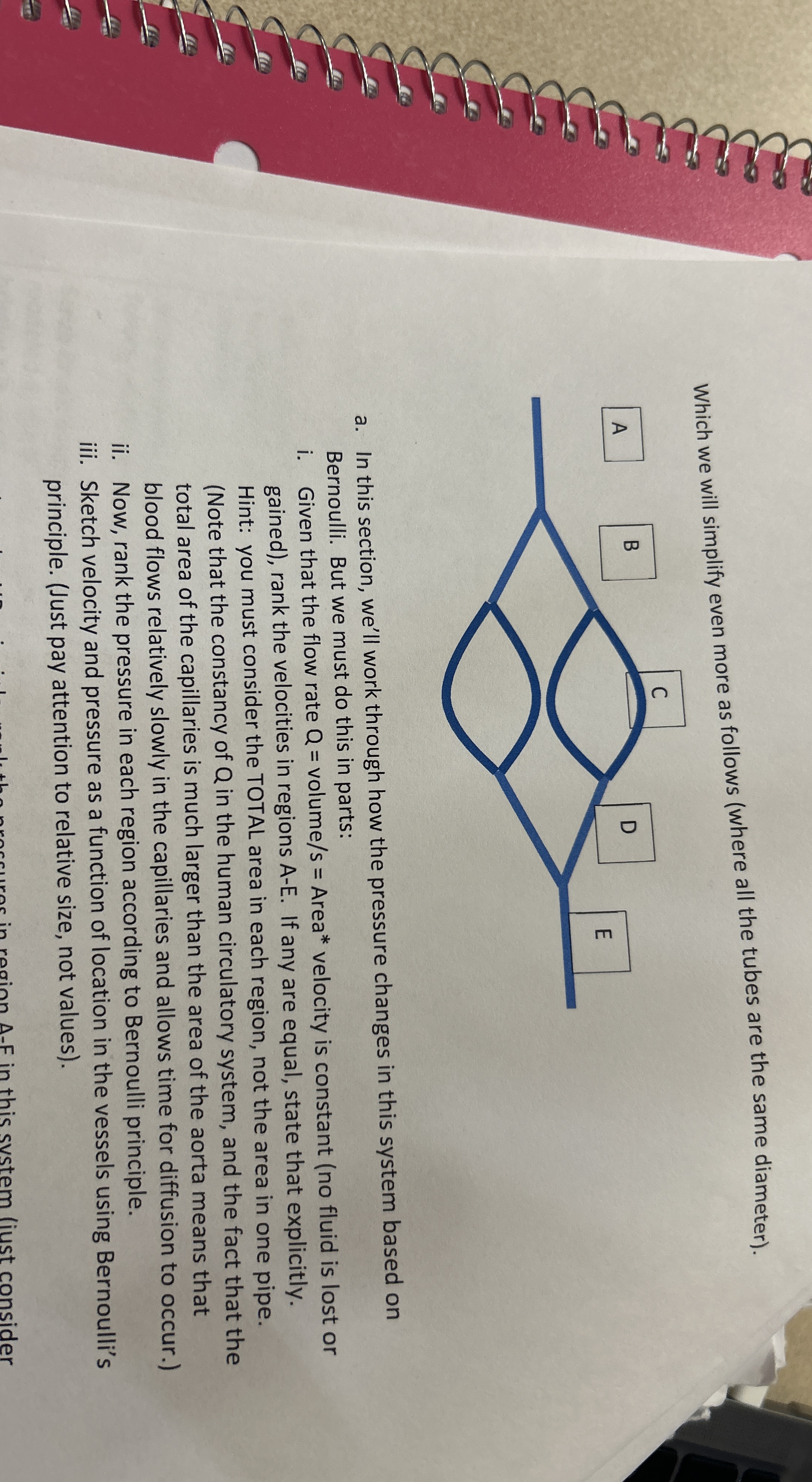
Question: Which we will simplify even more as follows ( where all the tubes are the same diameter ) . a . In this section, we'll
Which we will simplify even more as follows where all the tubes are the same diameter
a In this section, we'll work through how the pressure changes in this system based on Bernoulli. But we must do this in parts:
i Given that the flow rate volume Area velocity is constant no fluid is lost or gained rank the velocities in regions AE If any are equal, state that explicitly. Hint: you must consider the TOTAL area in each region, not the area in one pipe. Note that the constancy of Q in the human circulatory system, and the fact that the total area of the capillaries is much larger than the area of the aorta means that blood flows relatively slowly in the capillaries and allows time for diffusion to occur.
ii Now, rank the pressure in each region according to Bernoulli principle.
iii. Sketch velocity and pressure as a function of location in the vessels using Bernoulli's principle. Just pay attention to relative size, not values
Step by Step Solution
There are 3 Steps involved in it
1 Expert Approved Answer
Step: 1 Unlock

Question Has Been Solved by an Expert!
Get step-by-step solutions from verified subject matter experts
Step: 2 Unlock
Step: 3 Unlock
 Study Help