Question: while E,F,G are 32, 126 and 19, respectively. Question 13 (2 points) A retailer (she) sells souvenir shirts to tourists at the price of F
while E,F,G are 32, 126 and 19, respectively.
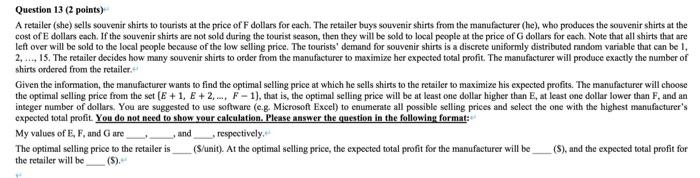
Question 13 (2 points) A retailer (she) sells souvenir shirts to tourists at the price of F dollars for each. The retailer buys souvenir shirts from the manufacturer (he), who produces the souvenir shirts at the cost of dollars each. If the souvenir shirts are not sold during the tourist season, then they will be sold to local people at the price of G dollars for each. Note that all shirts that are left over will be sold to the local people because of the low selling price. The tourists' demand for souvenir shirts is a discrete uniformly distributed random variable that can be 1. 2..... 15. The retailer decides how many souvenir shirts to order from the manufacturer to maximize her expected total profit. The manufacturer will produce exactly the number of shirts ordered from the retailer Given the information, the manufacturer wants to find the optimal selling price at which he sells shirts to the retailer to maximize his expected profits. The manufacturer will choose the optimal selling price from the set (E +1, E + 2... F-1), that is, the optimal selling price will be at least one dollar higher than E, at least one dollar lower than F, and an integer number of dollars. You are suggested to use software (eg. Microsoft Excel) to enumerate all possible selling prices and select the one with the highest manufacturer's expected total profit. You do not need to show your calculation. Please answer the question in the following format: My values of E, F, and Gare and respectively The optimal selling price to the retailer is (S/unit). At the optimal selling price, the expected total profit for the manufacturer will be (S), and the expected total profit for the retailer will be (5). Question 13 (2 points) A retailer (she) sells souvenir shirts to tourists at the price of F dollars for each. The retailer buys souvenir shirts from the manufacturer (he), who produces the souvenir shirts at the cost of dollars each. If the souvenir shirts are not sold during the tourist season, then they will be sold to local people at the price of G dollars for each. Note that all shirts that are left over will be sold to the local people because of the low selling price. The tourists' demand for souvenir shirts is a discrete uniformly distributed random variable that can be 1. 2..... 15. The retailer decides how many souvenir shirts to order from the manufacturer to maximize her expected total profit. The manufacturer will produce exactly the number of shirts ordered from the retailer Given the information, the manufacturer wants to find the optimal selling price at which he sells shirts to the retailer to maximize his expected profits. The manufacturer will choose the optimal selling price from the set (E +1, E + 2... F-1), that is, the optimal selling price will be at least one dollar higher than E, at least one dollar lower than F, and an integer number of dollars. You are suggested to use software (eg. Microsoft Excel) to enumerate all possible selling prices and select the one with the highest manufacturer's expected total profit. You do not need to show your calculation. Please answer the question in the following format: My values of E, F, and Gare and respectively The optimal selling price to the retailer is (S/unit). At the optimal selling price, the expected total profit for the manufacturer will be (S), and the expected total profit for the retailer will be









 Study Help