



Question: While gambling games are the typical go-to examples for computing expected value, they're not by any means the only application. Let's look at Page 284
While gambling games are the typical go-to examples for computing expected value, they're not by any means the only application. Let's look at
Page 284
the world of automobile insurance. If you think of it, buying insurance is kind of like gambling: You're betting that something bad will happen to your car. If nothing happens, you've paid the insurance company for nothing. But if something does happen, when they pay for repairs, you're basically
"winning" the bet.
Suppose that a driver named Karl pays $800 per year on insurance for his SUV. According to insurance industry stats I found online, the average motorist has a 5.6% chance of getting in an accident in any given year, and the average collision claim paid by insurance companies is $3,160. Our goal will be to find the expected value if Karl buys 1 year's worth of car insurance.

While gambling games are the typical go-to examples for computing expected value, they're not by any means the only application. Let's look at
Page 284
the world of automobile insurance. If you think of it, buying insurance is kind of like gambling: You're betting that something bad will happen to your car. If nothing happens, you've paid the insurance company for nothing. But if something does happen, when they pay for repairs, you're basically
"winning" the bet.
Suppose that a driver named Karl pays $800 per year on insurance for his SUV. According to insurance industry stats I found online, the average motorist has a 5.6% chance of getting in an accident in any given year, and the average collision claim paid by insurance companies is $3,160. Our goal will be to find the expected value if Karl buys 1 year's worth of car insurance.
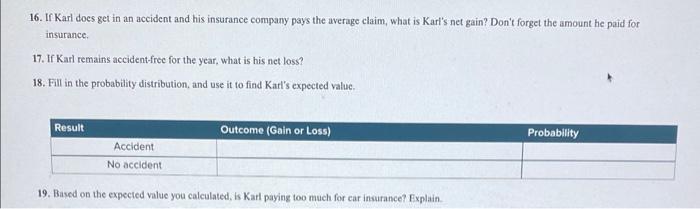
16. If Karl does get in an accident and his insurance company pays the average claim, what is Karl's net gain? Don't forget the amount he paid for insurance. 17. If Karl remains accident-free for the year, what is his net loss? 18. Fill in the probability distribution, and use it to find Karl's expected value. 16. If Karl does get in an accident and his insurance company pays the average claim, what is Karl's net gain? Don't forget the amount he paid for insurance. 17. If Karl remains accident-free for the year, what is his net loss? 18. Fill in the probability distribution, and use it to find Karl's expected value. 19. Based on the expected value you calculated, is Karl paying too much for car insurance? Explain. 16. If Karl does get in an accident and his insurance company pays the average claim, what is Karl's net gain? Don't forget the amount he paid for insurance. 17. If Karl remains accident-free for the year, what is his net loss? 18. Fill in the probability distribution, and use it to find Karl's expected value. 16. If Karl does get in an accident and his insurance company pays the average claim, what is Karl's net gain? Don't forget the amount he paid for insurance. 17. If Karl remains accident-free for the year, what is his net loss? 18. Fill in the probability distribution, and use it to find Karl's expected value. 19. Based on the expected value you calculated, is Karl paying too much for car insurance? Explain
Step by Step Solution
There are 3 Steps involved in it

Get step-by-step solutions from verified subject matter experts