







Question: While Newton's method is an excellent way to solve The heart of the subdivision method is the intermediate value theorem which states that if a
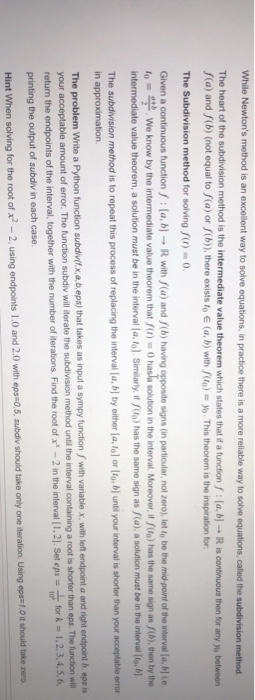
While Newton's method is an excellent way to solve The heart of the subdivision method is the intermediate value theorem which states that if a function f la.b)-R is continuous then for any Jo between f(a) and f(b) (not equal to f(a) or f(b)), there exists fo E (a, b) with o)yo. This theorem is the inspiration for The Subdivision method for solving f) o Given a continuous function f: la,b)-IR with f(a) and /b) having opposite signs (in particular, not zero), let fo be the mid-point of the interval la b foWe know by the intermediate value theorem that )-0 hasa solution in the interval. Moreover, t a) has the same sign as /b), then by the intermediate value theorem, a solution must be in the interval la, 'o Simiarly if fo) has the same sign as (a), a solution must be in the interval e The subdivision method is to repeat this process of replacing the interval la,b] by either la. tol or fa bl untl your interval is shorter than your acceptable error in approximation function subdivtx.a,b.eps) that takes as input a sympy function f with variable x, with left endpoint a and right endpoint b.eps is or. The function subdiv will iterate the subdivision method until the interval containing a root is shorter than eps. The function wil intervail 1.2]. Set epsfor k1.2.3,4,5,6 return the endpoints of the interval, together with the number of iterations. Find the root of a-2 in the printing the output of subdiv in each case ng for the root of a -2, using endpoints 1.0 and 2.0 with eps 5, subdiv should take only one teration. Using epe 1 0 il should take zero
Step by Step Solution
There are 3 Steps involved in it

Get step-by-step solutions from verified subject matter experts
 Study Help