







Question: While team diversity is a good thing , it does come with kind of things do you think organization can do to support diverse teams
While team diversity is a good thing , it does come with kind of things do you think organization can do to support diverse teams in becoming high functioning teams?
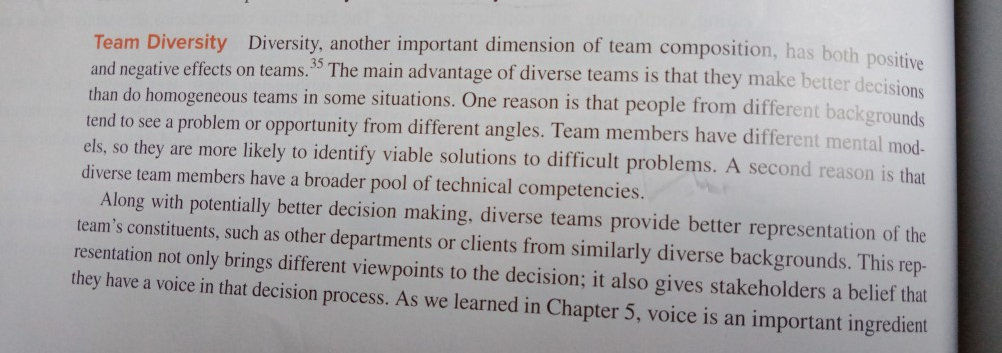
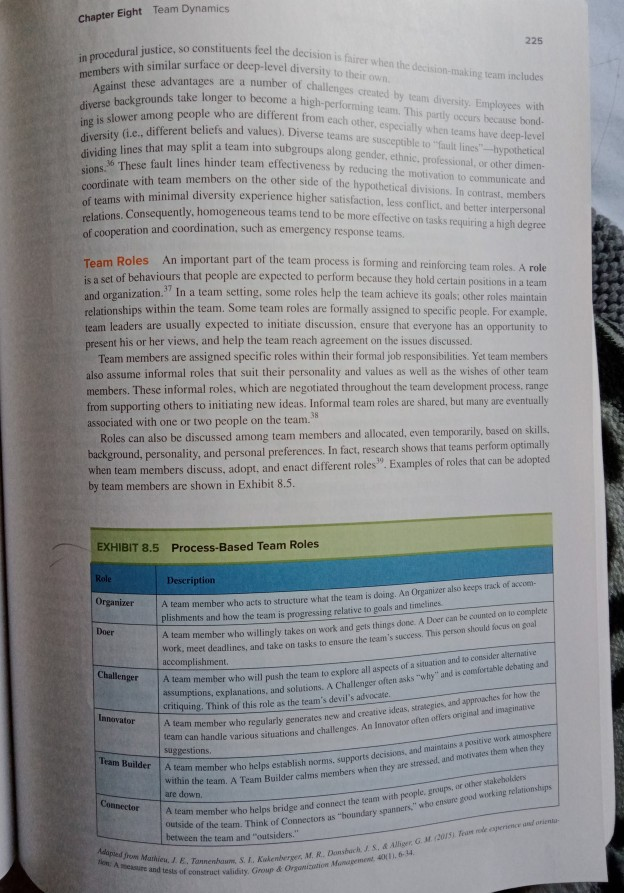
Team Diversity Diversity, another important dimension of team composition, has both positive and negative effects on teams. The main advantage of diverse teams is that they make better decisions than do homogeneous teams in some situations. One reason is that people from different backgrounds tend to see a problem or opportunity from different angles. Team members have different mental mod- els, so they are more likely to identify viable solutions to difficult problems. A second reason is that diverse team members have a broader pool of technical competencies. Along with potentially better decision making, diverse teams provide better representation of the team's constituents, such as other departments or clients from similarly diverse backgrounds. This rep- resentation not only brings different viewpoints to the decision; it also gives stakeholders a belief that they have a voice in that decision process. As we learned in Chapter 5, voice is an important ingredient Chapter Eight Team Dynamics 225 16 sions. and organization." in procedural justice, so constituents feel the decision is fairer when the decision-making team includes members with similar surface or deep-level diversity to their own Against these advantages are a number of challenges created by team diversity. Employees with diverse backgrounds take longer to become a high-performing team. This partly occurs because bond- ing is slower among people who are different from each other, especially when teams have deep-level diversity (i.e., different beliefs and values). Diverse teams are susceptible to "Fault lines--hypothetical dividing lines that may split a team into subgroups along gender, ethnic, professional, or other dimen- coordinate with team members on the other side of the hypothetical divisions. In contrast, members A team member who helps establish norms, supports decisions and maintains a positive work opene A team member who helps bridge and connect the end with people groups, or other stakeholders outside of the team. Think of Connectors as boundary spanners, whose food working relationships Madr Mathieu. E. Tannenhum, SL kwen, MR. DAGO Friend en Ace and tests of construct validity Grow & OM-4 EXHIBIT 8.5 Process-Based Team Roles Role Description Organizer accomplishment suggestions are down between the team and "outsiders." These fault lines hinder team effectiveness by reducing the motivation to communicate and of teams with minimal diversity experience higher satisfaction, less conflict, and better interpersonal relations. Consequently, homogeneous teams tend to be more effective on tasks requiring a high degree of cooperation and coordination, such as emergency response teams. Team Roles An important part of the team process is forming and reinforcing team roles. A role is a set of behaviours that people are expected to perform because they hold certain positions in a team In a team setting, some roles help the team achieve its goals; other roles maintain relationships within the team. Some team roles are formally assigned to specific people. For example. team leaders are usually expected to initiate discussion, ensure that everyone has an opportunity to present his or her views, and help the team reach agreement on the issues discussed. Team members are assigned specific roles within their formal job responsibilities. Yet team members also assume informal roles that suit their personality and values as well as the wishes of other team members. These informal roles, which are negotiated throughout the team development process, range from supporting others to initiating new ideas. Informal team roles are shared, but many are eventually associated with one or two people on the team." Roles can also be discussed among team members and allocated, even temporarily, based on skills. background, personality, and personal preferences. In fact, research shows that teams perform optimally when team members discuss, adopt, and enact different roles". Examples of roles that can be adopted by team members are shown in Exhibit 8.5. Door A team member who acts to structure what the team is doing. An Organizer also keep track of accom plishments and how the team is progressing relative to goals and timelines A team member who willingly takes on work and gets things done. A Deer can be counted on to complete Mork, meet deadlines, and take on tasks to ensure the team's success. This person should focus on goal Challenger Innovator A team member who will push the team to explore all aspects of a situation and to consider alternative assumptions, explanations, and solutions. A Challenger often asks why" and is comfortable debating and critiquing. Think of this role as the team's devil's advocate A team member who regularly generates new and creative ideas, strategies and approaches for how the team can handle various situations and challenges. An Innowator often offers original and imaginative Team Builder Connector
Step by Step Solution
There are 3 Steps involved in it
1 Expert Approved Answer
Step: 1 Unlock

Question Has Been Solved by an Expert!
Get step-by-step solutions from verified subject matter experts
Step: 2 Unlock
Step: 3 Unlock
 Study Help