







Question: Why do plaintiffs try to have their cases heard in court rather than through arbitration? Does this case show the U.S. Supreme Court's position on
Why do plaintiffs try to have their cases heard in court rather than through arbitration? Does this case show the U.S. Supreme Court's position on the importance of abrogation agreements? 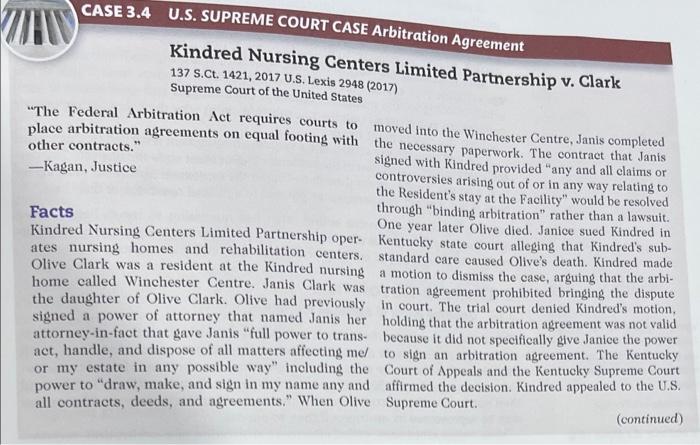
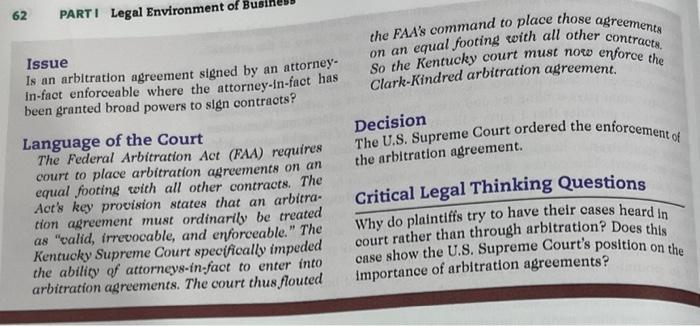
CASE 3.4 U.S. SUPREME COURT CASE Arbitration Agreement WWW "The Federal Arbitration Act requires courts to place arbitration agreements on equal footing with other contracts." -Kagan, Justice Facts Kindred Nursing Centers Limited Partnership oper- ates nursing homes and rehabilitation centers. Olive Clark was a resident at the Kindred nursing home called Winchester Centre. Janis Clark was the daughter of Olive Clark. Olive had previously signed a power of attorney that named Janis her attorney-in-fact that gave Janis "full power to trans- act, handle, and dispose of all matters affecting me or my estate in any possible way" including the power to "draw, make, and sign in my name any and all contracts, deeds, and agreements." When Olive Kindred Nursing Centers Limited Partnership v. Clark 137 S.Ct. 1421, 2017 U.S. Lexis 2948 (2017) Supreme Court of the United States moved into the Winchester Centre, Janis completed the necessary paperwork. The contract that Janis signed with Kindred provided "any and all claims or controversies arising out of or in any way relating to the Resident's stay at the Facility" would be resolved through "binding arbitration" rather than a lawsuit. Kentucky state court alleging that Kindred's sub- One year later Olive died. Janice sued Kindred in standard care caused Olive's death. Kindred made a motion to dismiss the case, arguing that the arbi- in court. The trial court denied Kindred's motion, tration agreement prohibited bringing the dispute holding that the arbitration agreement was not valid because it did not specifically give Janice the power to sign an arbitration agreement. The Kentucky Court of Appeals and the Kentucky Supreme Court affirmed the decision. Kindred appealed to the U.S. Supreme Court. (continued) PARTI Legal Environment of Bur Issue Is an arbitration agreement signed by an attorney- in-fact enforceable where the attorney-in-fact has been granted broad powers to sign contracts? Language of the Court The Federal Arbitration Act (FAA) requires court to place arbitration agreements on an equal footing with all other contracts. The Act's key provision states that an arbitra- tion agreement must ordinarily be treated as "valid, irrevocable, and enforceable." The Kentucky Supreme Court specifically impeded the ability of attorneys-in-fact to enter into arbitration agreements. The court thus flouted 62 the FAA's command to place those agreements on an equal footing with all other contracts. So the Kentucky court must now enforce the Clark-Kindred arbitration agreement. Decision The U.S. Supreme Court ordered the enforcement of the arbitration agreement. Critical Legal Thinking Questions Why do plaintiffs try to have their cases heard in court rather than through arbitration? Does this case show the U.S. Supreme Court's position on the importance of arbitration agreements
Step by Step Solution
There are 3 Steps involved in it
1 Expert Approved Answer
Step: 1 Unlock

Question Has Been Solved by an Expert!
Get step-by-step solutions from verified subject matter experts
Step: 2 Unlock
Step: 3 Unlock
 Study Help