







Question: Why do so many students hate math, fear it, or both? , write what you think. Why do so many students hate math, fear it,
Why do so many students hate math, fear it, or both? , write what you think.
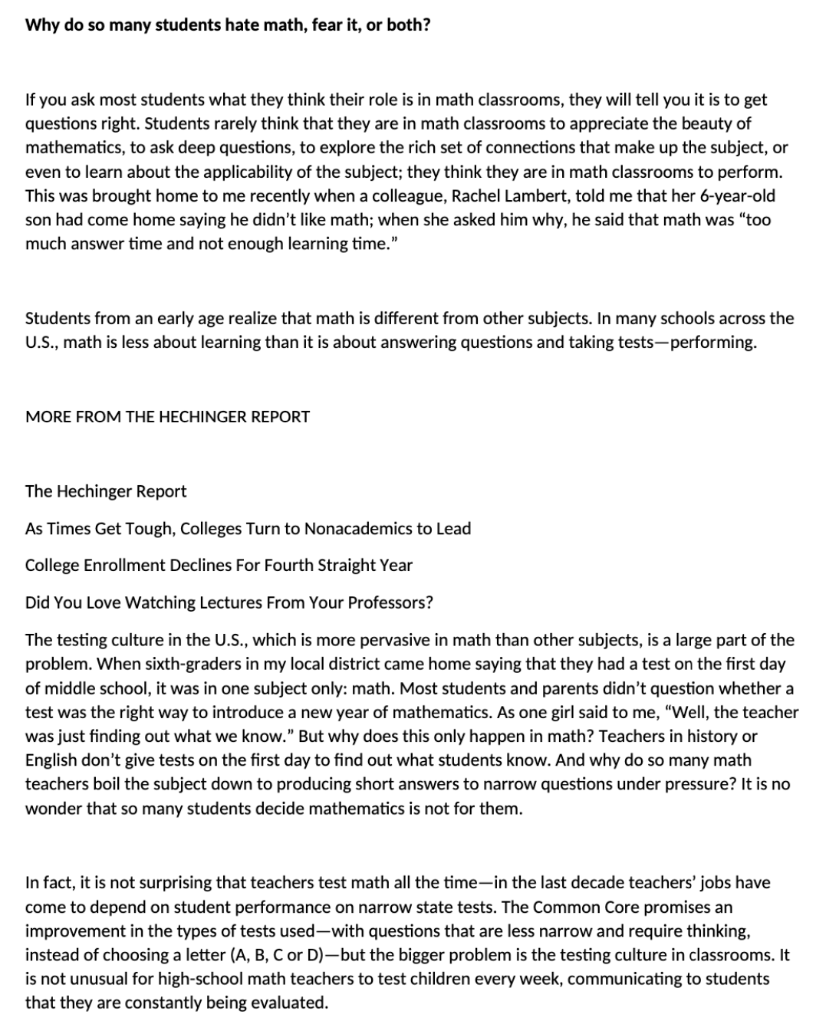
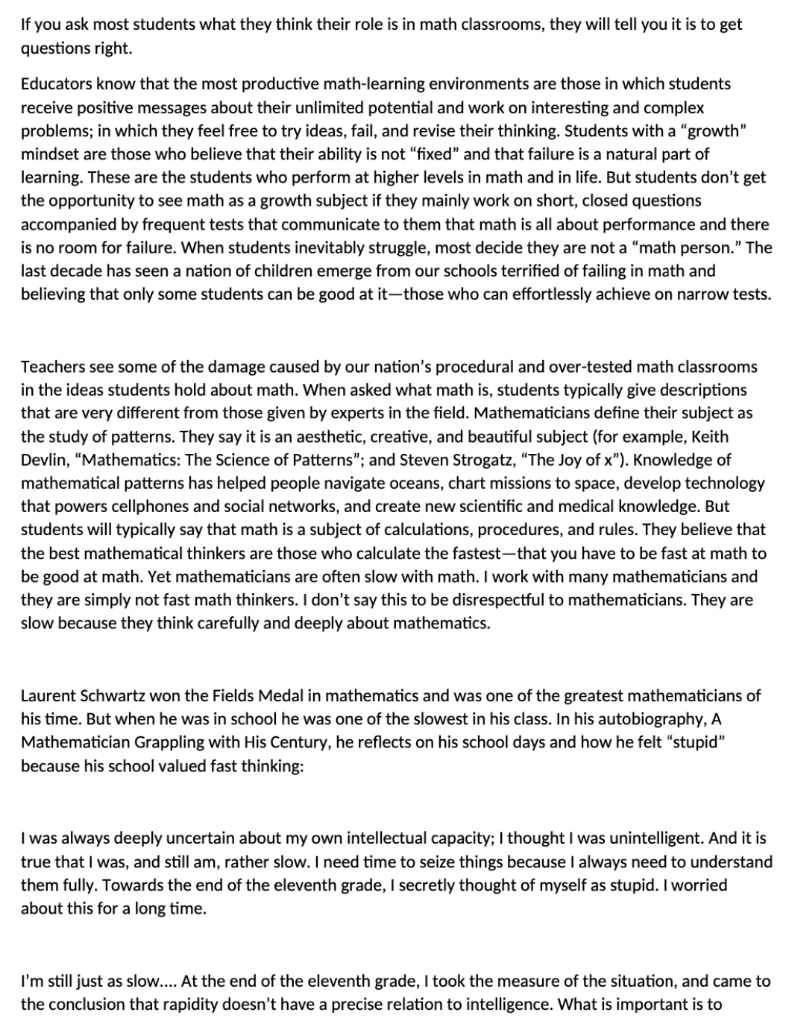
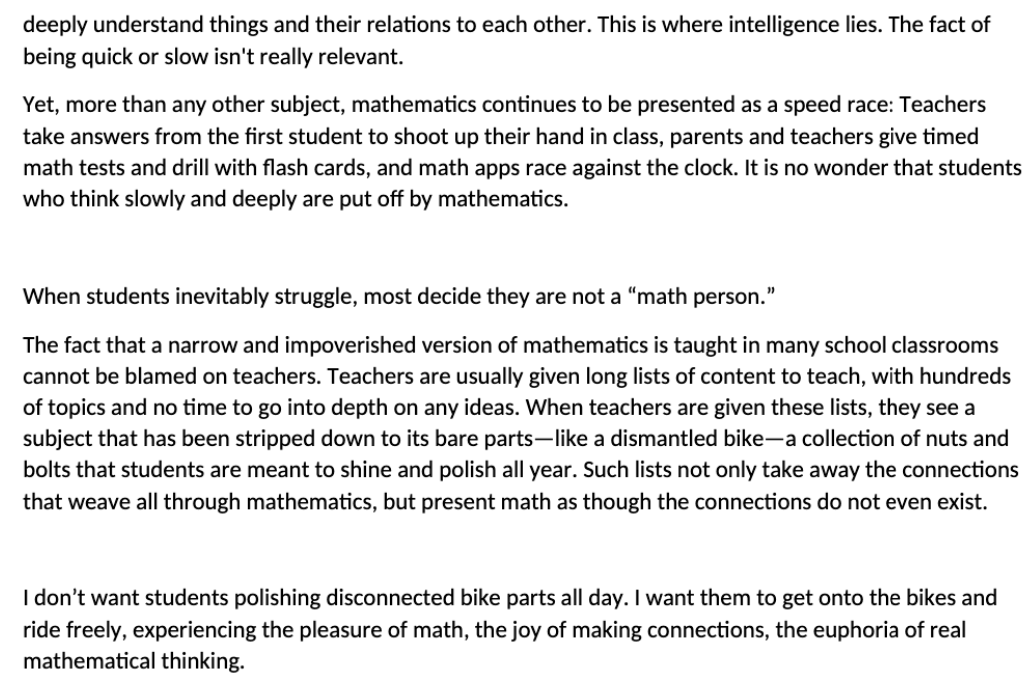
Why do so many students hate math, fear it, or both? If you ask most students what they think their role is in math classrooms, they will tell you it is to get questions right. Students rarely think that they are in math classrooms to appreciate the beauty of mathematics, to ask deep questions, to explore the rich set of connections that make up the subject, or even to learn about the applicability of the subject; they think they are in math classrooms to perform. This was brought home to me recently when a colleague, Rachel Lambert, told me that her 6-year-old son had come home saying he didn't like math; when she asked him why, he said that math was "too much answer time and not enough learning time." Students from an early age realize that math is different from other subjects. In many schools across the U.S., math is less about learning than it is about answering questions and taking tests-performing. MORE FROM THE HECHINGER REPORT The Hechinger Report As Times Get Tough, Colleges Turn to Nonacademics to Lead College Enrollment Declines For Fourth Straight Year Did You Love Watching Lectures From Your Professors? The testing culture in the U.S., which is more pervasive in math than other subjects, is a large part of the problem. When sixth-graders in my local district came home saying that they had a test on the first day of middle school, it was in one subject only: math. Most students and parents didn't question whether a test was the right way to introduce a new year of mathematics. As one girl said to me, "Well, the teacher was just finding out what we know." But why does this only happen in math? Teachers in history or English don't give tests on the first day to find out what students know. And why do so many math teachers boil the subject down to producing short answers to narrow questions under pressure? It is no wonder that so many students decide mathematics is not for them. In fact, it is not surprising that teachers test math all the time-in the last decade teachers' jobs have come to depend on student performance on narrow state tests. The Common Core promises an improvement in the types of tests used-with questions that are less narrow and require thinking, instead of choosing a letter (A, B, C or D)-but the bigger problem is the testing culture in classrooms. It is not unusual for high-school math teachers to test children every week, communicating to students that they are constantly being evaluated. If you ask most students what they think their role is in math classrooms, they will tell you it is to get questions right. Educators know that the most productive math-learning environments are those in which students receive positive messages about their unlimited potential and work on interesting and complex problems; in which they feel free to try ideas, fail, and revise their thinking. Students with a "growth" mindset are those who believe that their ability is not "fixed" and that failure is a natural part of learning. These are the students who perform at higher levels in math and in life. But students don't get the opportunity to see math as a growth subject if they mainly work on short, closed questions accompanied by frequent tests that communicate to them that math is all about performance and there is no room for failure. When students inevitably struggle, most decide they are not a "math person." The last decade has seen a nation of children emerge from our schools terrified of failing in math and believing that only some students can be good at it-those who can effortlessly achieve on narrow tests. Teachers see some of the damage caused by our nation's procedural and over-tested math classrooms in the ideas students hold about math. When asked what math is, students typically give descriptions that are very different from those given by experts in the field. Mathematicians define their subject as the study of patterns. They say it is an aesthetic, creative, and beautiful subject (for example, Keith Devlin, "Mathematics: The Science of Patterns"; and Steven Strogatz, "The Joy of x "). Knowledge of mathematical patterns has helped people navigate oceans, chart missions to space, develop technology that powers cellphones and social networks, and create new scientific and medical knowledge. But students will typically say that math is a subject of calculations, procedures, and rules. They believe that the best mathematical thinkers are those who calculate the fastest-that you have to be fast at math to be good at math. Yet mathematicians are often slow with math. I work with many mathematicians and they are simply not fast math thinkers. I don't say this to be disrespectful to mathematicians. They are slow because they think carefully and deeply about mathematics. Laurent Schwartz won the Fields Medal in mathematics and was one of the greatest mathematicians of his time. But when he was in school he was one of the slowest in his class. In his autobiography, A Mathematician Grappling with His Century, he reflects on his school days and how he felt "stupid" because his school valued fast thinking: I was always deeply uncertain about my own intellectual capacity; I thought I was unintelligent. And it is true that I was, and still am, rather slow. I need time to seize things because I always need to understand them fully. Towards the end of the eleventh grade, I secretly thought of myself as stupid. I worried about this for a long time. I'm still just as slow.... At the end of the eleventh grade, I took the measure of the situation, and came to the conclusion that rapidity doesn't have a precise relation to intelligence. What is important is to deeply understand things and their relations to each other. This is where intelligence lies. The fact of being quick or slow isn't really relevant. Yet, more than any other subject, mathematics continues to be presented as a speed race: Teachers take answers from the first student to shoot up their hand in class, parents and teachers give timed math tests and drill with flash cards, and math apps race against the clock. It is no wonder that students who think slowly and deeply are put off by mathematics. When students inevitably struggle, most decide they are not a "math person." The fact that a narrow and impoverished version of mathematics is taught in many school classrooms cannot be blamed on teachers. Teachers are usually given long lists of content to teach, with hundreds of topics and no time to go into depth on any ideas. When teachers are given these lists, they see a subject that has been stripped down to its bare parts-like a dismantled bike-a collection of nuts and bolts that students are meant to shine and polish all year. Such lists not only take away the connections that weave all through mathematics, but present math as though the connections do not even exist. I don't want students polishing disconnected bike parts all day. I want them to get onto the bikes and ride freely, experiencing the pleasure of math, the joy of making connections, the euphoria of real mathematical thinking
Step by Step Solution
There are 3 Steps involved in it

Get step-by-step solutions from verified subject matter experts
 Study Help