







Question: Why does the short-run aggregate supply curve shift to the left in the long run, following an increase in aggregate demand? Select one: O a.
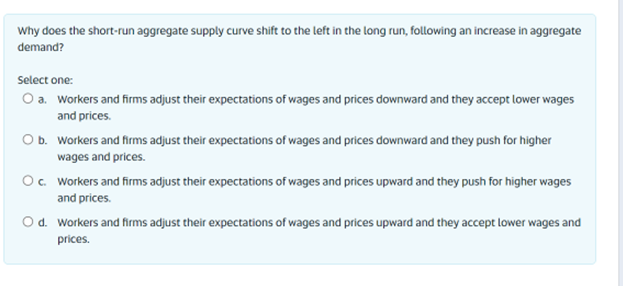
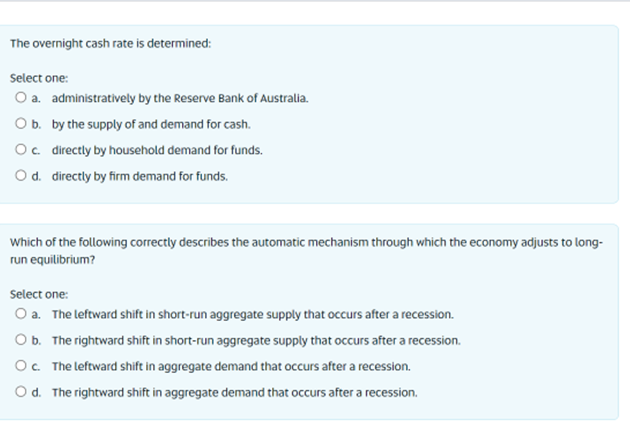
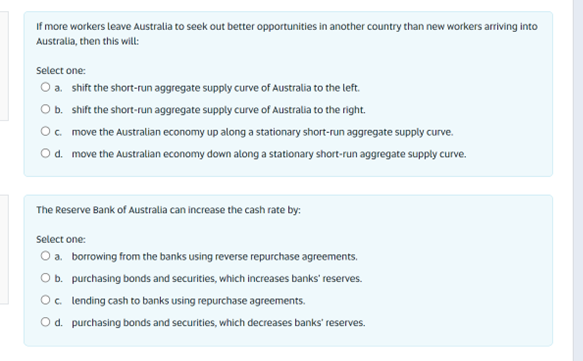
Why does the short-run aggregate supply curve shift to the left in the long run, following an increase in aggregate demand? Select one: O a. Workers and firms adjust their expectations of wages and prices downward and they accept lower wages and prices. O b. Workers and firms adjust their expectations of wages and prices downward and they push for higher wages and prices. O c. Workers and firms adjust their expectations of wages and prices upward and they push for higher wages and prices. O d. Workers and firms adjust their expectations of wages and prices upward and they accept lower wages and prices.The overnight cash rate is determined: Select one: O a. administratively by the Reserve Bank of Australia. O b. by the supply of and demand for cash. O c. directly by household demand for funds. O d. directly by firm demand for funds. Which of the following correctly describes the automatic mechanism through which the economy adjusts to long- run equilibrium? Select one: a. The leftward shift in short-run aggregate supply that occurs after a recession. O b. The rightward shift in short-run aggregate supply that occurs after a recession. O c. The leftward shift in aggregate demand that occurs after a recession. O d. The rightward shift in aggregate demand that occurs after a recession.If more workers leave Australia to seek out better opportunities in another country than new workers arriving into Australia, then this will: Select one: O a. shift the short-run aggregate supply curve of Australia to the left. O b. shift the short-run aggregate supply curve of Australia to the right. O c. move the Australian economy up along a stationary short-run aggregate supply curve. O d. move the Australian economy down along a stationary short-run aggregate supply curve. The Reserve Bank of Australia can increase the cash rate by: Select one: O a. borrowing from the banks using reverse repurchase agreements. O b. purchasing bonds and securities, which increases banks' reserves. O c. lending cash to banks using repurchase agreements. O d. purchasing bonds and securities, which decreases banks' reserves
Step by Step Solution
There are 3 Steps involved in it

Get step-by-step solutions from verified subject matter experts
 Study Help