Question: Why has outsourcing of the IT function been such a focus for businesses over the last few decades? (Tick all that apply) Much of the
Why has outsourcing of the IT function been suchWhy has outsourcing of the IT function been suchWhy has outsourcing of the IT function been such

Why has outsourcing of the IT function been such

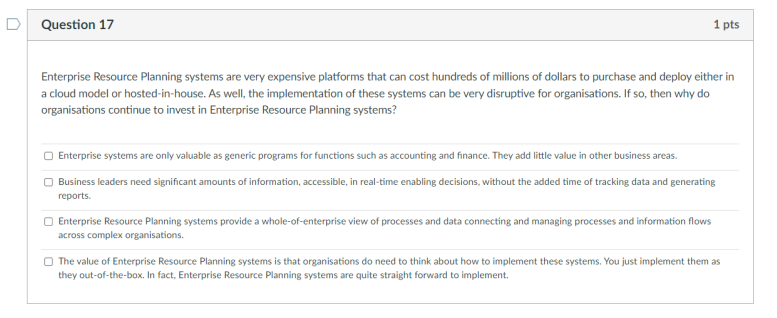
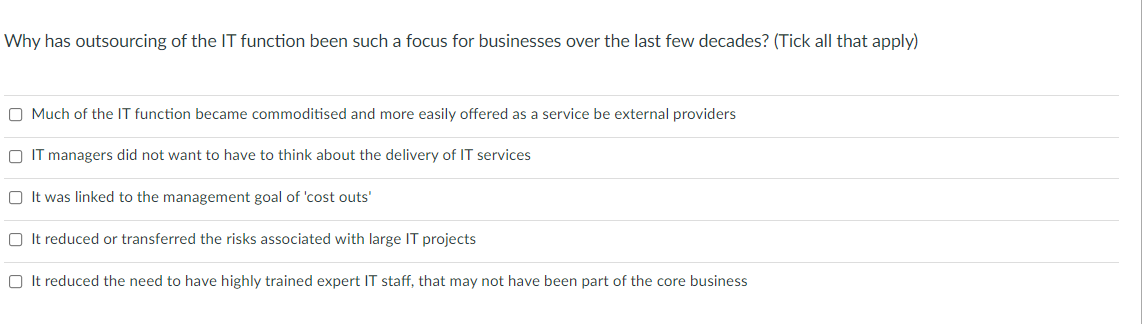
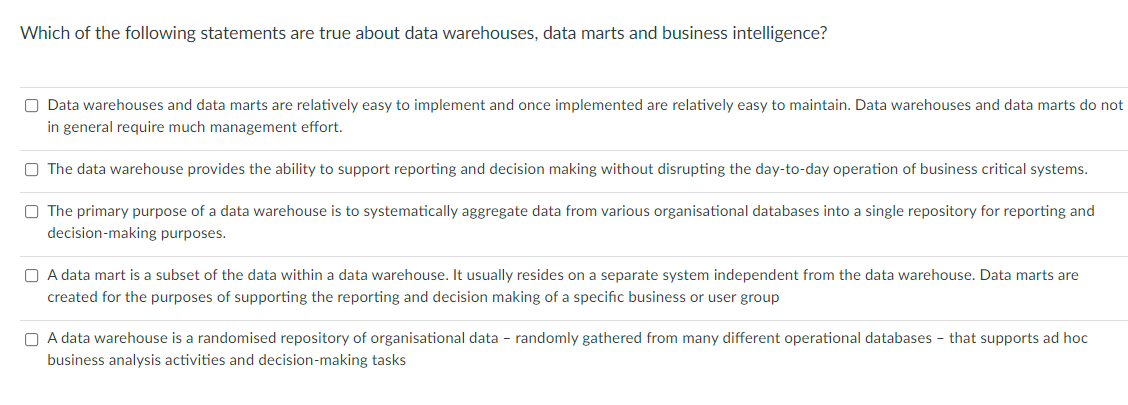
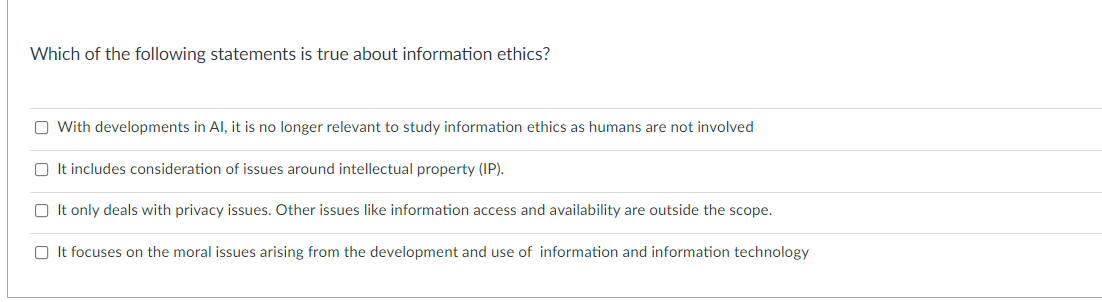
Why has outsourcing of the IT function been such a focus for businesses over the last few decades? (Tick all that apply) Much of the IT function became commoditised and more easily offered as a service be external providers IT managers did not want to have to think about the delivery of IT services It was linked to the management goal of cost outs' It reduced or transferred the risks associated with large IT projects It reduced the need to have highly trained expert IT staff, that may not have been part of the core business Which of the following statements are true about data warehouses, data marts and business intelligence? Data warehouses and data marts are relatively easy to implement and once implemented are relatively easy to maintain. Data warehouses and data marts do not in general require much management effort. The data warehouse provides the ability to support reporting and decision making without disrupting the day-to-day operation of business critical systems. The primary purpose of a data warehouse is to systematically aggregate data from various organisational databases into a single repository for reporting and decision-making purposes. A data mart is a subset of the data within a data warehouse. It usually resides on a separate system independent from the data warehouse. Data marts are created for the purposes of supporting the reporting and decision making of a specific business or user group A data warehouse is a randomised repository of organisational data - randomly gathered from many different operational databases - that supports ad hoc business analysis activities and decision-making tasks Which of the following statements is true about information ethics? O With developments in Al, it is no longer relevant to study information ethics as humans are not involved It includes consideration of issues around intellectual property (IP). It only deals with privacy issues. Other issues like information access and availability are outside the scope. It focuses on the moral issues arising from the development and use of information and information technology Question 17 1 pts Enterprise Resource Planning systems are very expensive platforms that can cost hundreds of millions of dollars to purchase and deploy either in a cloud model or hosted-in-house. As well, the implementation of these systems can be very disruptive for organisations. If so, then why do organisations continue to invest in Enterprise Resource Planning systems? Enterprise systems are only valuable as generic programs for functions such as accounting and finance. They add little value in other business areas. Business leaders need significant amounts of information, accessible, in real-time enabling decisions, without the added time of tracking data and generating reports Enterprise Resource Planning systems provide a whole-of-enterprise view of processes and data connecting and managing processes and information flows across complex organisations. The value of Enterprise Resource Planning systems is that organisations do need to think about how to implement these systems. You just implement them as they out-of-the-box. In fact, Enterprise Resource Planning systems are quite straight forward to implement
Step by Step Solution

There are 3 Steps involved in it

1 Expert Approved Answer
Step: 1 Unlock blur-text-image

Question Has Been Solved by an Expert!

Get step-by-step solutions from verified subject matter experts

Step: 2 Unlock
Step: 3 Unlock

Students Have Also Explored These Related General Management Questions!