







Question: Why is the allowance method preferred over the direct write-off method of accounting for bad debts? a. Allowance method is used for tax purposes. b.
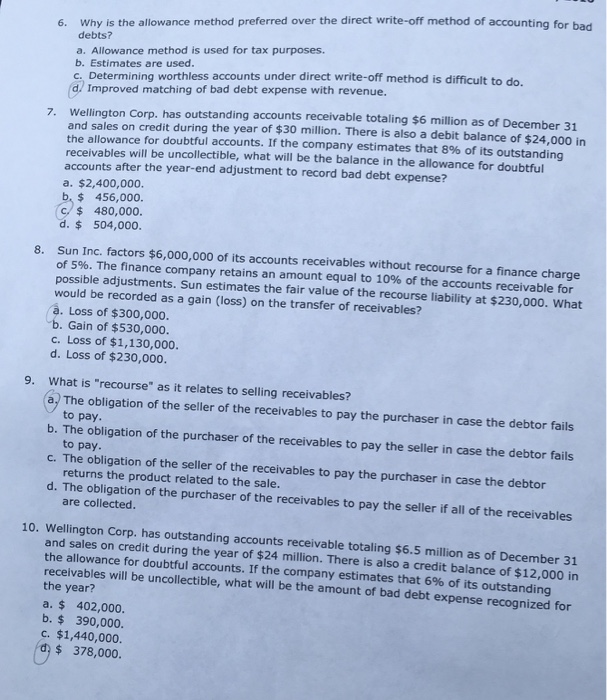
Why is the allowance method preferred over the direct write-off method of accounting for bad debts? a. Allowance method is used for tax purposes. b. Estimates are used. c. Determining worthless accounts under direct write-off method is difficult to do. d. Improved matching of bad debt expense with revenue. Wellington Corp. has outstanding accounts receivable totaling $6 million as of December 31 and sales on credit during the year of $30 million. There is also a debit balance of $24,000 in the allowance for doubtful accounts. If the company estimates that 8% of its outstanding receivables will be uncollectible, what will be the balance in the allowance for doubtful accounts after the year-end adjustment to record bad debt expense? a. $2, 400,000. b. $ 456,000. c. $ 480,000. d. $ 504,000. Sun Inc. factors $6,000,000 of its accounts receivables without recourse for a finance charge of 5%. The finance company retains an amount equal to 10% of the accounts receivable for possible adjustments. Sun estimates the fair value of the recourse liability at $230,000. What would be recorded as a gain (loss) on the transfer of receivables? a. Loss of $300,000. b. Gain of $530,000. c. Loss of $1, 130,000. d. Loss of $230,000. What is "recourse" as it relates to selling receivables? a. The obligation of the seller of the receivables to pay the purchaser in case the debtor fails to pay. b. The obligation of the purchaser of the receivables to pay the seller in case the debtor fails to pay. c. The obligation of the seller of the receivables to pay the purchaser in case the debtor returns the product related to the sale. d. The obligation of the purchaser of the receivables to pay the seller if all of the receivables are collected. Wellington Corp. has outstanding accounts receivable totaling $6.5 million as of December 31 and sales on credit during the year of $24 million There is also a credit balance of $12,000 in the allowance for doubtful accounts. If the company estimates that 6% of its outstanding receivables will be uncollectible, what will be the amount of bad debt expense recognized for the year? a. $ 402,000. b. $ 390,000. c. $1, 440,000. d.$ 378,000
Step by Step Solution
There are 3 Steps involved in it

Get step-by-step solutions from verified subject matter experts
 Study Help