







Question: WHY is the bond called when the yield is 5% but not 7%!!! (b) (15 points] A company has issued a $100 5-year 6% fixed
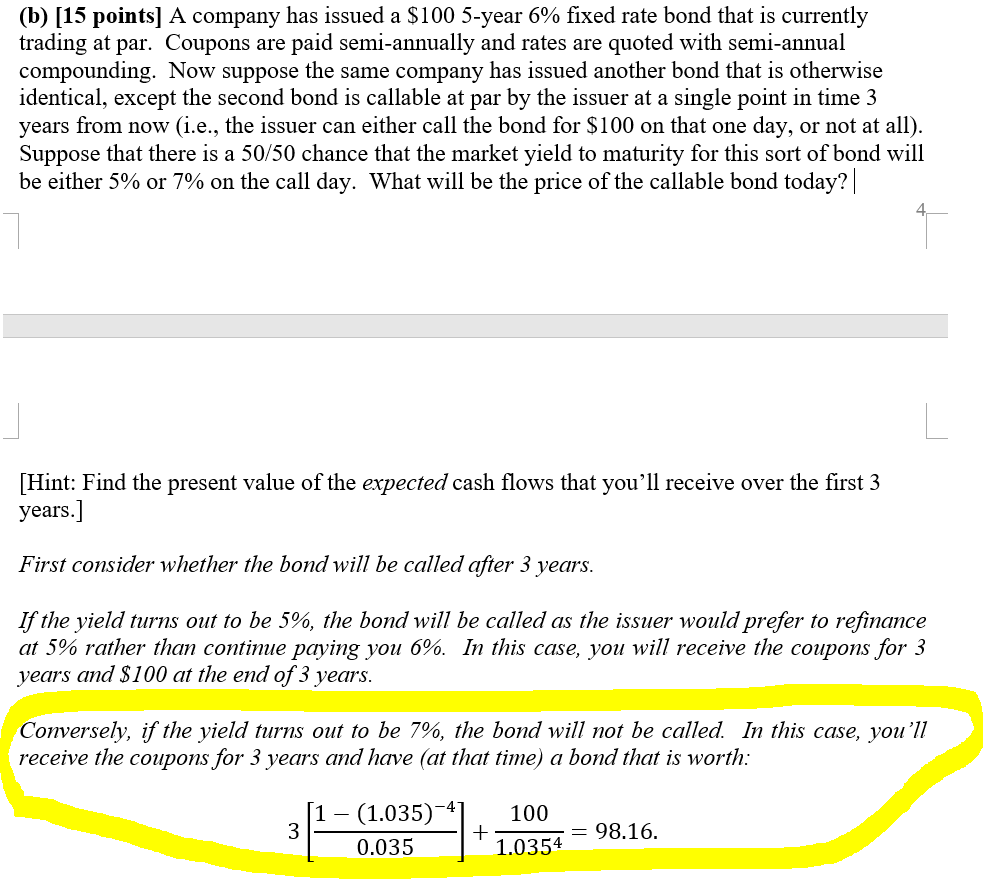 WHY is the bond called when the yield is 5% but not 7%!!!
(b) (15 points] A company has issued a $100 5-year 6% fixed rate bond that is currently trading at par. Coupons are paid semi-annually and rates are quoted with semi-annual compounding. Now suppose the same company has issued another bond that is otherwise identical, except the second bond is callable at par by the issuer at a single point in time 3 years from now (i.e., the issuer can either call the bond for $100 on that one day, or not at all). Suppose that there is a 50/50 chance that the market yield to maturity for this sort of bond will be either 5% or 7% on the call day. What will be the price of the callable bond today? [Hint: Find the present value of the expected cash flows that you'll receive over the first 3 years.] First consider whether the bond will be called after 3 years. If the yield turns out to be 5%, the bond will be called as the issuer would prefer to refinance at 5% rather than continue paying you 6%. In this case, you will receive the coupons for 3 years and $100 at the end of 3 years. Conversely, if the yield turns out to be 7%, the bond will not be called. In this case, you'll receive the coupons for 3 years and have (at that time) a bond that is worth: [1 (1.035)-41. 0.035 100 1.025498.16
Step by Step Solution
There are 3 Steps involved in it

Get step-by-step solutions from verified subject matter experts
 Study Help