







Question: Why is the code failing the JUnit test? Refer to this link for the code: https://www.chegg.com/homework-help/questions-and-answers/package-eduwitcscomp1050-todo-document-classpublic-class-linearequation-initialize-linear--q108908684?new=true @Timeout(1) public class PA3bTestCase { private static final double
Why is the code failing the JUnit test?
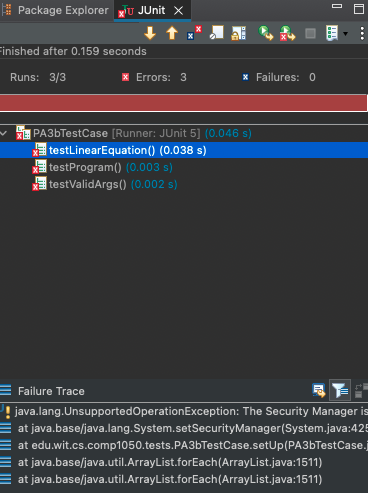
Refer to this link for the code: https://www.chegg.com/homework-help/questions-and-answers/package-eduwitcscomp1050-todo-document-classpublic-class-linearequation-initialize-linear--q108908684?new=true
@Timeout(1) public class PA3bTestCase { private static final double THRESH = 0.00001; private static final String ERR_USAGE = "Please supply 6 numbers (a-f)."; private static final String ERR_NOSLTN = "The equation has no solution."; @SuppressWarnings("serial") private static class ExitException extends SecurityException {} private static class NoExitSecurityManager extends SecurityManager { @Override public void checkPermission(Permission perm) {} @Override public void checkPermission(Permission perm, Object context) {} @Override public void checkExit(int status) { super.checkExit(status); throw new ExitException(); } } @BeforeEach public void setUp() throws Exception { System.setSecurityManager(new NoExitSecurityManager()); } @AfterEach public void tearDown() throws Exception { System.setSecurityManager(null); } private void _test(String[] a, String msg) { final ByteArrayOutputStream outContent = new ByteArrayOutputStream(); final String expected = TestSuite.stringOutput(new String[] { msg + "%n" }, new Object[] {}); System.setIn(null); System.setOut(new PrintStream(outContent)); try { PA3b.main(a); } catch (ExitException e) {} assertEquals(expected, outContent.toString()); System.setIn(null); System.setOut(null); } private void _testValidArgs(String[] a, double[] expected) { double[] result = null; try { result = PA3b.validateArgs(a); } catch (ExitException e) {} assertArrayEquals(expected, result, THRESH); } private void _testLinearEquation(LinearEquation leq, double a, double b, double c, double d, double e, double f, boolean eS, Double eX, Double eY) { assertNotNull(leq); assertEquals(a, leq.getA(), THRESH); assertEquals(b, leq.getB(), THRESH); assertEquals(c, leq.getC(), THRESH); assertEquals(d, leq.getD(), THRESH); assertEquals(e, leq.getE(), THRESH); assertEquals(f, leq.getF(), THRESH); assertEquals(eS, leq.isSolvable()); if (eX == null) { assertNull(leq.getX()); } else { assertEquals(eX, leq.getX(), THRESH); } if (eY == null) { assertNull(leq.getY()); } else { assertEquals(eY, leq.getY(), THRESH); } } private void _testLinearEquation(double a, double b, double c, double d, double e, double f, boolean eS, Double eX, Double eY) { LinearEquation leq; leq = null; try { leq = new LinearEquation(a, b, c, d, e, f); } catch (ExitException ex) {} _testLinearEquation(leq, a, b, c, d, e, f, eS, eX, eY); leq = null; try { leq = new LinearEquation(new double[] {a, b, c, d, e, f}); } catch (ExitException ex) {} _testLinearEquation(leq, a, b, c, d, e, f, eS, eX, eY); } @Test public void testLinearEquation() { _testLinearEquation(9.0, 4.0, 3.0, -5.0, -6.0, -21.0, true, -2., 3.); _testLinearEquation(1.0, 2.0, 2.0, 4.0, 4.0, 5.0, false, null, null); } @Test public void testValidArgs() { _testValidArgs(new String[] {}, null); _testValidArgs(new String[] {"9.0"}, null); _testValidArgs(new String[] {"9.0", "4.0"}, null); _testValidArgs(new String[] {"9.0", "4.0", "3.0"}, null); _testValidArgs(new String[] {"9.0", "4.0", "3.0", "-5.0"}, null); _testValidArgs(new String[] {"9.0", "4.0", "3.0", "-5.0", "-6.0"}, null); _testValidArgs(new String[] {"9.0", "4.0", "3.0", "-5.0", "-6.0", "-21.0"}, new double[] {9., 4., 3., -5., -6., -21.}); _testValidArgs(new String[] {"a", "4.0", "3.0", "-5.0", "-6.0", "-21.0"}, null); _testValidArgs(new String[] {"9.0", "B", "3.0", "-5.0", "-6.0", "-21.0"}, null); _testValidArgs(new String[] {"9.0", "4.0", ":(", "-5.0", "-6.0", "-21.0"}, null); _testValidArgs(new String[] {"9.0", "4.0", "3.0", "!", "-6.0", "-21.0"}, null); _testValidArgs(new String[] {"9.0", "4.0", "3.0", "-5.0", " ", "-21.0"}, null); _testValidArgs(new String[] {"9.0", "4.0", "3.0", "-5.0", "-6.0", "_?weird!_"}, null); _testValidArgs(new String[] {"1.0"}, null); _testValidArgs(new String[] {"1.0", "2.0"}, null); _testValidArgs(new String[] {"1.0", "2.0", "2.0"}, null); _testValidArgs(new String[] {"1.0", "2.0", "2.0", "4.0"}, null); _testValidArgs(new String[] {"1.0", "2.0", "2.0", "4.0", "4.0"}, null); _testValidArgs(new String[] {"1.0", "2.0", "2.0", "4.0", "4.0", "5.0"}, new double[] {1., 2., 2., 4., 4., 5.}); _testValidArgs(new String[] {"Hi", "2.0", "2.0", "4.0", "4.0", "5.0"}, null); _testValidArgs(new String[] {"1.0", "there!", "2.0", "4.0", "4.0", "5.0"}, null); _testValidArgs(new String[] {"1.0", "2.0", "How", "4.0", "4.0", "5.0"}, null); _testValidArgs(new String[] {"1.0", "2.0", "2.0", "are", "4.0", "5.0"}, null); _testValidArgs(new String[] {"1.0", "2.0", "2.0", "4.0", "you", "5.0"}, null); _testValidArgs(new String[] {"1.0", "2.0", "2.0", "4.0", "4.0", "doing?"}, null); }
@Test public void testProgram() { _test(new String[] {}, ERR_USAGE); _test(new String[] {"9.0"}, ERR_USAGE); _test(new String[] {"9.0", "4.0"}, ERR_USAGE); _test(new String[] {"9.0", "4.0", "3.0"}, ERR_USAGE); _test(new String[] {"9.0", "4.0", "3.0", "-5.0"}, ERR_USAGE); _test(new String[] {"9.0", "4.0", "3.0", "-5.0", "-6.0"}, ERR_USAGE); _test(new String[] {"a", "4.0", "3.0", "-5.0", "-6.0", "-21.0"}, ERR_USAGE); _test(new String[] {"9.0", "B", "3.0", "-5.0", "-6.0", "-21.0"}, ERR_USAGE); _test(new String[] {"9.0", "4.0", ":(", "-5.0", "-6.0", "-21.0"}, ERR_USAGE); _test(new String[] {"9.0", "4.0", "3.0", "!", "-6.0", "-21.0"}, ERR_USAGE); _test(new String[] {"9.0", "4.0", "3.0", "-5.0", " ", "-21.0"}, ERR_USAGE); _test(new String[] {"9.0", "4.0", "3.0", "-5.0", "-6.0", "_?weird!_"}, ERR_USAGE); _test(new String[] {"1.0"}, ERR_USAGE); _test(new String[] {"1.0", "2.0"}, ERR_USAGE); _test(new String[] {"1.0", "2.0", "2.0"}, ERR_USAGE); _test(new String[] {"1.0", "2.0", "2.0", "4.0"}, ERR_USAGE); _test(new String[] {"1.0", "2.0", "2.0", "4.0", "4.0"}, ERR_USAGE); _test(new String[] {"Hi", "2.0", "2.0", "4.0", "4.0", "5.0"}, ERR_USAGE); _test(new String[] {"1.0", "there!", "2.0", "4.0", "4.0", "5.0"}, ERR_USAGE); _test(new String[] {"1.0", "2.0", "How", "4.0", "4.0", "5.0"}, ERR_USAGE); _test(new String[] {"1.0", "2.0", "2.0", "are", "4.0", "5.0"}, ERR_USAGE); _test(new String[] {"1.0", "2.0", "2.0", "4.0", "you", "5.0"}, ERR_USAGE); _test(new String[] {"1.0", "2.0", "2.0", "4.0", "4.0", "doing?"}, ERR_USAGE); _test(new String[] {"9.0", "4.0", "3.0", "-5.0", "-6.0", "-21.0"}, "Solution: x=-2.000, y=3.000"); _test(new String[] {"1.0", "2.0", "2.0", "4.0", "4.0", "5.0"}, ERR_NOSLTN); } }
java.lang.UnsupportedOperationException: The Security Manager is at java.base/java.lang.System.setSecurityManager(System.java:425 at edu.wit.cs.comp1050.tests.PA3bTestCase.setUp(PA3bTestCase.) at java.base/java.util.ArrayList.forEach(ArrayList.java:1511) at java.base/java.util.ArrayList.forEach(ArrayList.java:1511)
Step by Step Solution
There are 3 Steps involved in it

Get step-by-step solutions from verified subject matter experts
 Study Help