





Question: Why the basis is 9? how did we get it? The Toyo plant has two categories of production overhead: maintenance and inspection. Costs expected for

Why the basis is 9? how did we get it?
Why the basis is 9? how did we get it? The Toyo
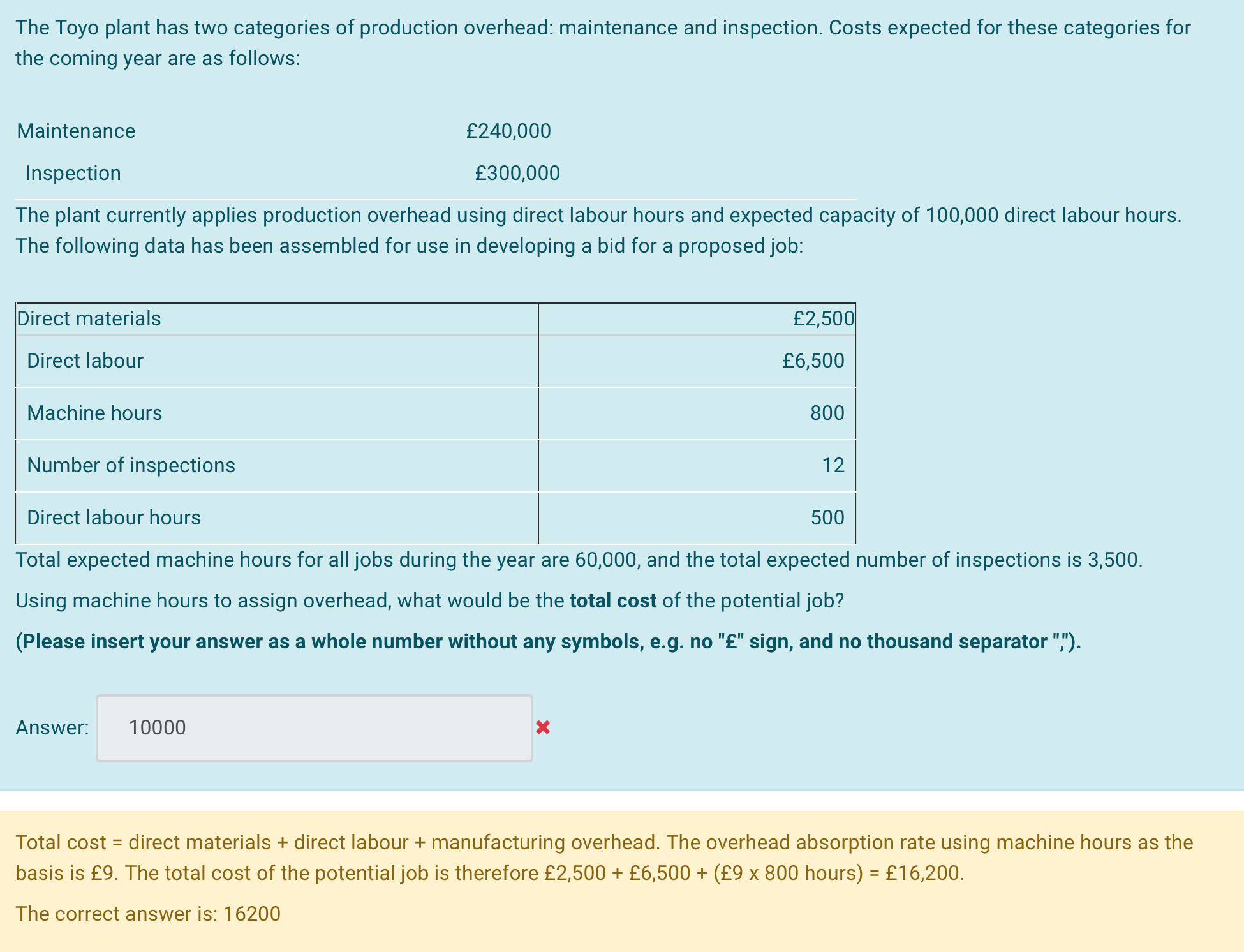
The Toyo plant has two categories of production overhead: maintenance and inspection. Costs expected for these categories for the coming year are as follows: Maintenance f240,000 Inspection E300,000 The plant currently applies production overhead using direct labour hours and expected capacity of 100,000 direct labour hours. The following data has been assembled for use in developing a bid for a proposed job: Direct materials f2,500 Direct labour f6,500 Machine hours 800 Number of inspections 12 Direct labour hours 500 Total expected machine hours for all jobs during the year are 60,000, and the total expected number of inspections is 3,500. Using machine hours to assign overhead, what would be the total cost of the potential job? (Please insert your answer as a whole number without any symbols, e.g. no "f" sign, and no thousand separator ","). Answer: 10000 Total cost = direct materials + direct labour + manufacturing overhead. The overhead absorption rate using machine hours as the basis is f9. The total cost of the potential job is therefore f2,500 + 16,500 + (69 x 800 hours) = f16,200. The correct answer is: 16200

Step by Step Solution

There are 3 Steps involved in it

1 Expert Approved Answer
Step: 1 Unlock blur-text-image

Question Has Been Solved by an Expert!

Get step-by-step solutions from verified subject matter experts

Step: 2 Unlock
Step: 3 Unlock

Students Have Also Explored These Related Accounting Questions!