







Question: will give you a thumbs up if answer all :) 6 pts D Question 5 The achieved upper deviation limit is 8% and the risk
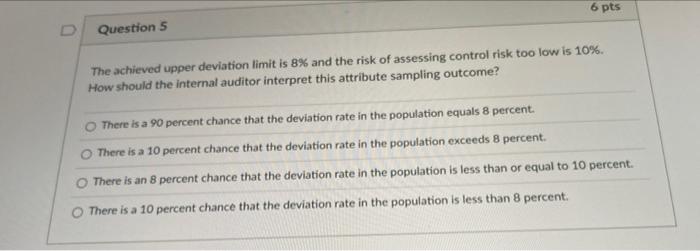
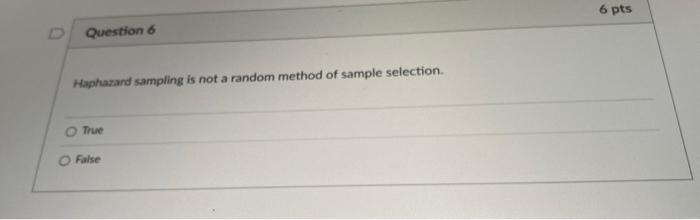
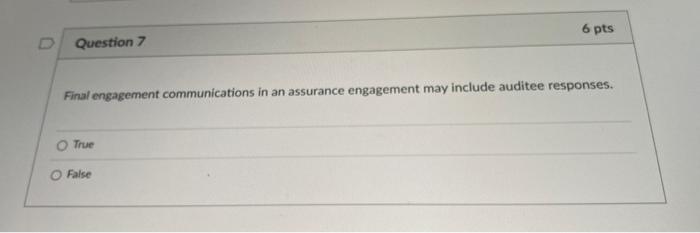
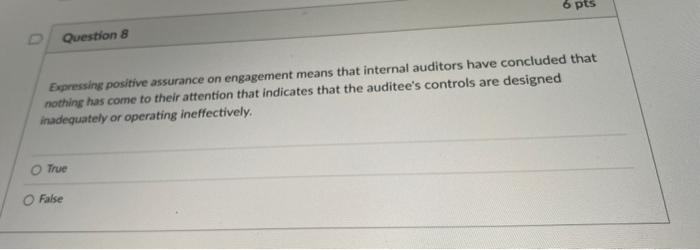
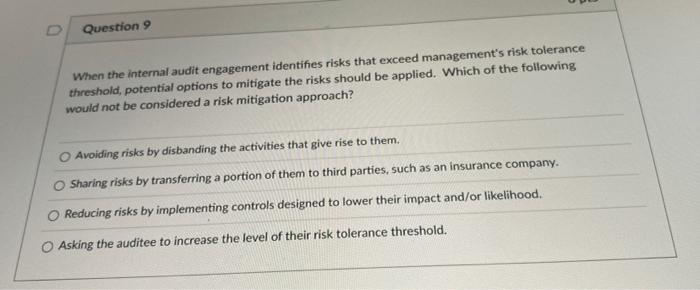
6 pts D Question 5 The achieved upper deviation limit is 8% and the risk of assessing control risk too low is 10%. How should the internal auditor interpret this attribute sampling outcome? O There is a 90 percent chance that the deviation rate in the population equals 8 percent. O There is a 10 percent chance that the deviation rate in the population exceeds 8 percent. O There is an 8 percent chance that the deviation rate in the population is less than or equal to 10 percent. There is a 10 percent chance that the deviation rate in the population is less than 8 percent. Question 6 Haphazard sampling is not a random method of sample selection. O True False 6 pts 0 6 pts Question 7 Final engagement communications in an assurance engagement may include auditee responses. O True False 6 pts Question 8 Expressing positive assurance on engagement means that internal auditors have concluded that nothing has come to their attention that indicates that the auditee's controls are designed inadequately or operating ineffectively. True False Question 9 When the internal audit engagement identifies risks that exceed management's risk tolerance threshold, potential options to mitigate the risks should be applied. Which of the following would not be considered a risk mitigation approach? Avoiding risks by disbanding the activities that give rise to them. Sharing risks by transferring a portion of them to third parties, such as an insurance company. O Reducing risks by implementing controls designed to lower their impact and/or likelihood. O Asking the auditee to increase the level of their risk tolerance threshold
Step by Step Solution
There are 3 Steps involved in it

Get step-by-step solutions from verified subject matter experts
 Study Help