







Question: WILL UPVOTE FOR COMPLETE WORK. PLEASE HELP 1. Which step in the financial planning process comes before monitoring? a. Presenting the plan. b. Analyzing the
WILL UPVOTE FOR COMPLETE WORK. PLEASE HELP
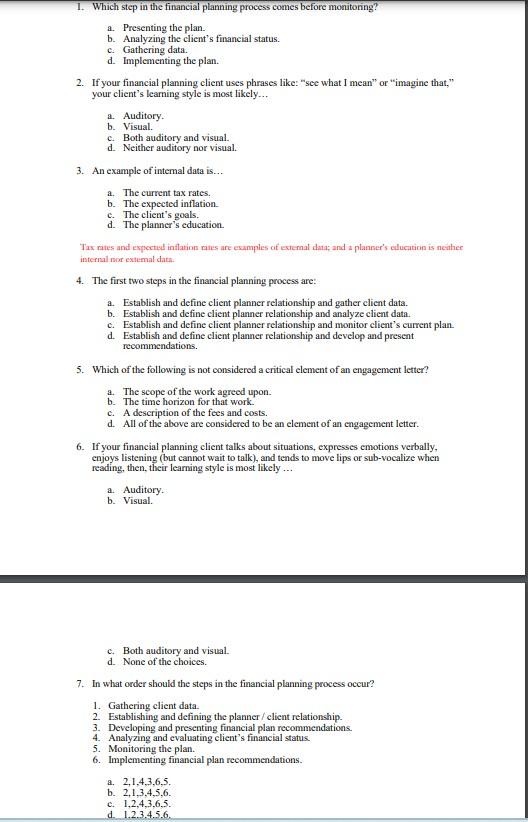
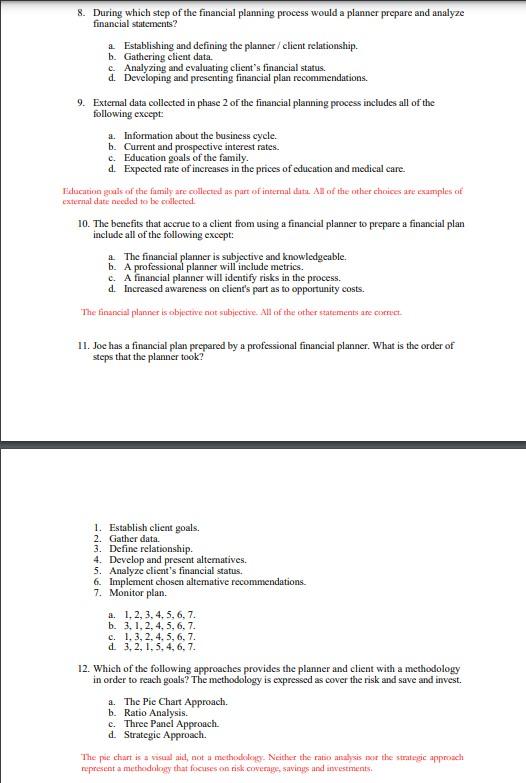
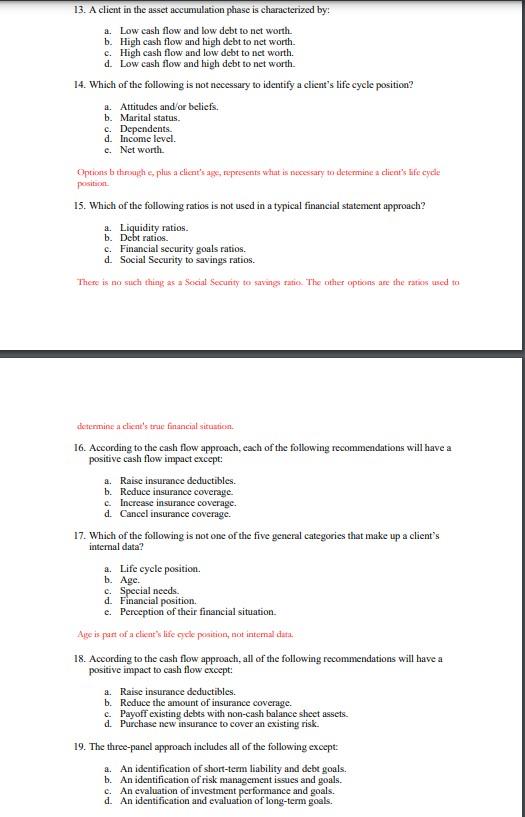
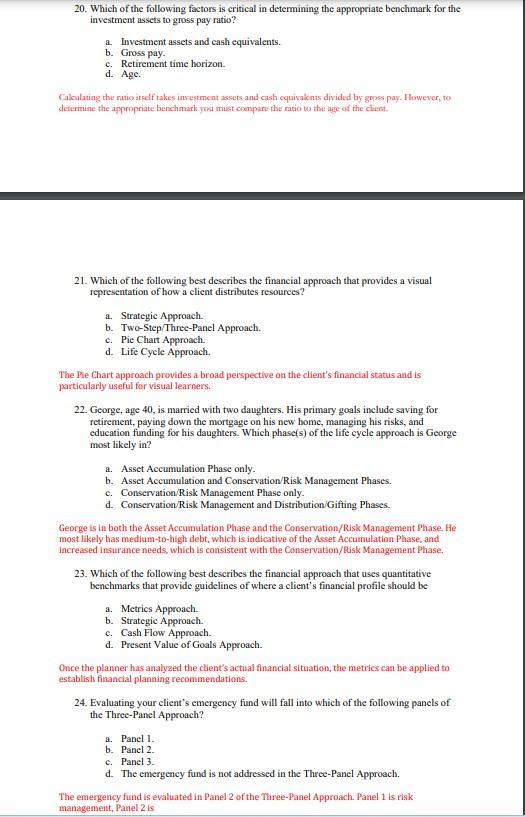
1. Which step in the financial planning process comes before monitoring? a. Presenting the plan. b. Analyzing the client's financial status. c. Gathering data. d. Implementing the plan. 2. If your financial planning client uses phrases like: "see what I mean" or "imagine that," your client's learning style is most likely... a. Auditory. b. Visual. c. Both auditory and visual. d. Neither auditory nor visual. 3. An example of intemal data is... a. The current tax rates. b. The expected inflation. c. The client's goals. d. The planner's cducation. Tas rites and expectud inflation rites are esumples of extemal dani; and a planner's elucation is neather internal mor extemal data. 4. The first two steps in the financial planning process are: a. Establish and define client planner relationship and gather client data. b. Establish and define client planner relationship and analyze client data. c. Establish and define client planner relationship and monitor client's current plan d. Establish and define client planner relationship and develop and present recommendations. 5. Which of the following is not considered a critical element of an engagement letter? a. The scope of the work agreed upon. b. The time horizon for that work. c. A description of the fees and costs. d. All of the above are considered to be an element of an engagement letter. 6. If your financial planning elient talks about situations, expresses emotions verbally, enjoys listening (but cannot wait to talk), and tends to move lips or sub-vocalize when reading, then, their learning style is most likely ... a. Auditory. b. Visual. c. Both auditory and visual. d. None of the choices. 7. In what order should the steps in the financial planning process occur? 1. Gathering client data. 2. Establishing and defining the planner/client relationship. 3. Developing and presenting financial plan recommendations 4. Analyzing and evaluating client's financial status 5. Monitoring the plan. 6. Implementing financial plan recommendations. a. 2,1,4,3,6,5. b. 2,1,3,4,5,6. c. 1,2,4,3,6,5. 8. During which step of the financial planning process would a planner prepare and analyze financial statements? a. Establishing and defining the planner / client relationship. b. Gathering client data. c. Analyzing and evaluating client's financial status. d. Developing and presenting financial plan recommendations. 9. Extemal data collected in phase 2 of the financial planning process includes all of the following except a. Information about the business cycle. b. Current and prospective interest rates. c. Education goals of the family. d. Expected rate of increases in the prices of education and medical care. Eiducation gavals of the family are collectud as part of internal ditu. All of the other chaice are examples of external dare aendast to be collected. 10. The benefits that accrue to a client from using a financial planner to prepare a financial plan include all of the following except: a. The financial planner is subjective and knowledgeable. b. A professional planner will include metrics. c. A financial planner will identify risks in the process. d. Increased awareness on client's part as to opportunity costs. The financial planner is abjective ant subjectike All of the ather statements ane correct. 11. Joe has a financial plan prepared by a professional financial planner. What is the order of steps that the planner took? 1. Establish client goals. 2. Gather data. 3. Define relationship. 4. Develop and present altematives. 5. Analyze client's financial status, 6. Implement chosen altemative recommendations. 7. Monitor plan. a. 1,2,3,4,5,6,7. b. 3,1,2,4,5,6,7 c. 1,3,2,4,5,6,7. d. 3,2,1,5,4,6,7 12. Which of the following approaches provides the planner and client with a methodology in order to reach goals? The methodology is expressed as cover the risk and save and invest. a. The Pie Chart Approach. b. Ratio Analysis. c. Three Panel Approach d. Strategic Approach. The pie chart is a nisual aid, not a methodolong. Neitler the ratio analysis now the strategic approach nepresent a methudnlagy that focuses on risk coverage, savinys and investments. 13. A client in the asset accumulation phase is characterized by: a. Low cash flow and low debt to net worth. b. High cash flow and high debt to net worth. c. High cash flow and low debt to net worth. d. Low cash flow and high debt to net worth. 14. Which of the following is not necessary to identify a client's life cycle position? a. Attitudes and/or beliefs. b. Marital status. c. Dependents. d. Income level. e. Net worth. Options b through e, pliss a client's agge, represents what is necessary to determine a client's life cydle positisen 15. Which of the following ratios is not used in a typical financial statement approach? a. Liquidity ratios. b. Debt ratios. c. Financial security goals ratios. d. Social Security to savings ratios. Thene is no such thing as a Social Secunity to savings ratio. The other opsisins are the ratios used to detennine a clecat's true financial sirustion. 16. Aceording to the cash flow approach, each of the following recommendations will have a positive cash flow impact except: a. Raise insurance deductibles. b. Reduce insurance coverage. c. Increase insurance coverage. d. Cancel insurance coverage. 17. Which of the following is not one of the five general categories that make up a client's internal data? a. Life cycle position. b. Age. c. Special needs. d. Financial position. e. Perception of their financial situation. Age is part of a client's life grole position, not intemal data. 18. According to the cash flow approach, all of the following recommendations will have a positive impact to cash flow exeept: a. Raise insurance deductibles. b. Reduce the amount of insurance coverage. c. Payoff existing debts with non-cash balance sheet assets. d. Purchase new insurance to cover an existing risk. 19. The three-panel approach includes all of the following except: a. An identification of short-term liability and debt goals. b. An identification of risk management issues and goals. c. An evaluation of investment performance and goals. d. An identification and evaluation of long-term goals. 20. Which of the following factors is critical in deternining the appropriate benchmark for the investment assets to gross pay ratio? a. Investment assets and cash equivalents. b. Gross pay. c. Retirement time horizon. d. Age. Fakulating the ratio itself takes investment assets and cash equivaknss divided by gross pay. However, to deternine the appropriate benchmark yoa must compane the natio to the age of the client. 21. Which of the following best describes the financial approach that provides a visual representation of how a client distributes resources? a. Strategic Approach. b. Two-Step/Three-Panel Approach. c. Pie Chart Approach. d. Life Cycle Approach. The Pie Chart approach provides a broad perspective on the client's financial status and is particularly useful for visual learners. 22. George, age 40 , is married with two daughters. His primary goals include saving for retirement, paying down the mortgage on his new home, managing his risks, and education funding for his daughters. Which phase(s) of the life eycle approach is George most likely in? a. Asset Accumulation Phase only. b. Asset Aceumulation and Conservation/Risk Management Phases. c. Conservation/Risk Management Phase only. d. Conservation/Risk Management and Distribution/Gifting Phases. George is in both the Asset Accusnulation Phase and the Conservation/Risk Management Phase. He most likely has medium-to-high debt, which is indicative of the Asset Accumulation Phase, and increased insurance needs, which is consistent with the Conservation/Risk Management Phase. 23. Which of the following best describes the financial approach that uses quantitative benchmarks that provide guidelines of where a client's financial profile should be a. Metrics Approach. b. Strategic Approach. c. Cash Flow Approach. d. Present Value of Goals Approach. Once the planner has analyzed the client's actial financlal situation, the metrics can be applied to establish financial planning recommendations. 24. Evaluating your client's emergency fund will fall into which of the following panels of the Three-Panel Approach? a. Panel 1 . b. Panel 2 . c. Panel 3. d. The emergency fund is not addressed in the Three-Panel Approach. The emergency fund is evaluated in Panel 2 of the Three-Panel Approach. Panel 1 is risk management, Panel 2 is
Step by Step Solution
There are 3 Steps involved in it

Get step-by-step solutions from verified subject matter experts
 Study Help