


Question: will upvote if the answer is correct 5. (20) Parsing Consider the CFG for in the slides (of L6) for parsing (Page 16), and an
will upvote if the answer is correct
 will upvote if the answer is correct 5. (20) Parsing Consider

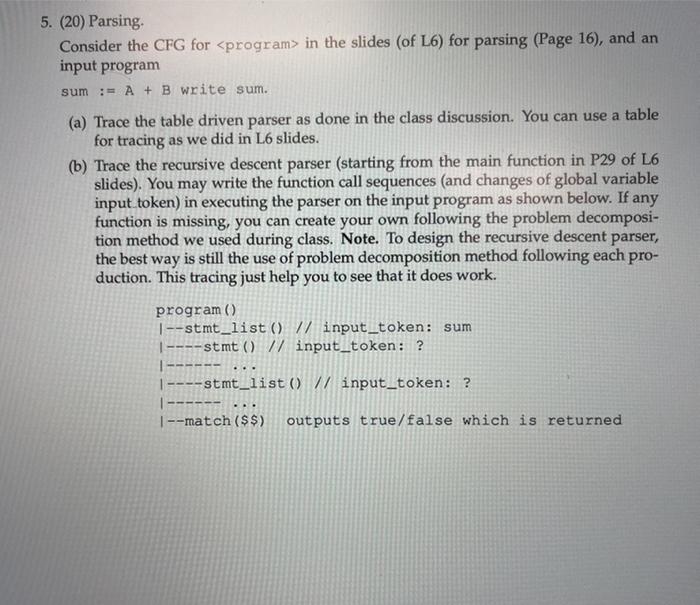
5. (20) Parsing Consider the CFG for in the slides (of L6) for parsing (Page 16), and an input program sum := A + B write sum. (a) Trace the table driven parser as done in the class discussion. You can use a table for tracing as we did in L6 slides. (b) Trace the recursive descent parser (starting from the main function in P29 of L6 slides). You may write the function call sequences and changes of global variable input token) in executing the parser on the input program as shown below. If any function is missing, you can create your own following the problem decomposi- tion method we used during class. Note. To design the recursive descent parser, the best way is still the use of problem decomposition method following each pro- duction. This tracing just help you to see that it does work. program () | --stmt_list() // input_token: sum 1 ----stmt () // input_token: ? 1 ----stmt_list() // input_token: ? |--match($$) outputs true/false which is returned 5. (20) Parsing Consider the CFG for in the slides (of L6) for parsing (Page 16), and an input program sum := A + B write sum. (a) Trace the table driven parser as done in the class discussion. You can use a table for tracing as we did in L6 slides. (b) Trace the recursive descent parser (starting from the main function in P29 of L6 slides). You may write the function call sequences and changes of global variable input token) in executing the parser on the input program as shown below. If any function is missing, you can create your own following the problem decomposi- tion method we used during class. Note. To design the recursive descent parser, the best way is still the use of problem decomposition method following each pro- duction. This tracing just help you to see that it does work. program () | --stmt_list() // input_token: sum 1 ----stmt () // input_token: ? 1 ----stmt_list() // input_token: ? |--match($$) outputs true/false which is returned

Step by Step Solution

There are 3 Steps involved in it

1 Expert Approved Answer
Step: 1 Unlock blur-text-image
Question Has Been Solved by an Expert!

Get step-by-step solutions from verified subject matter experts

Step: 2 Unlock
Step: 3 Unlock

Students Have Also Explored These Related Databases Questions!