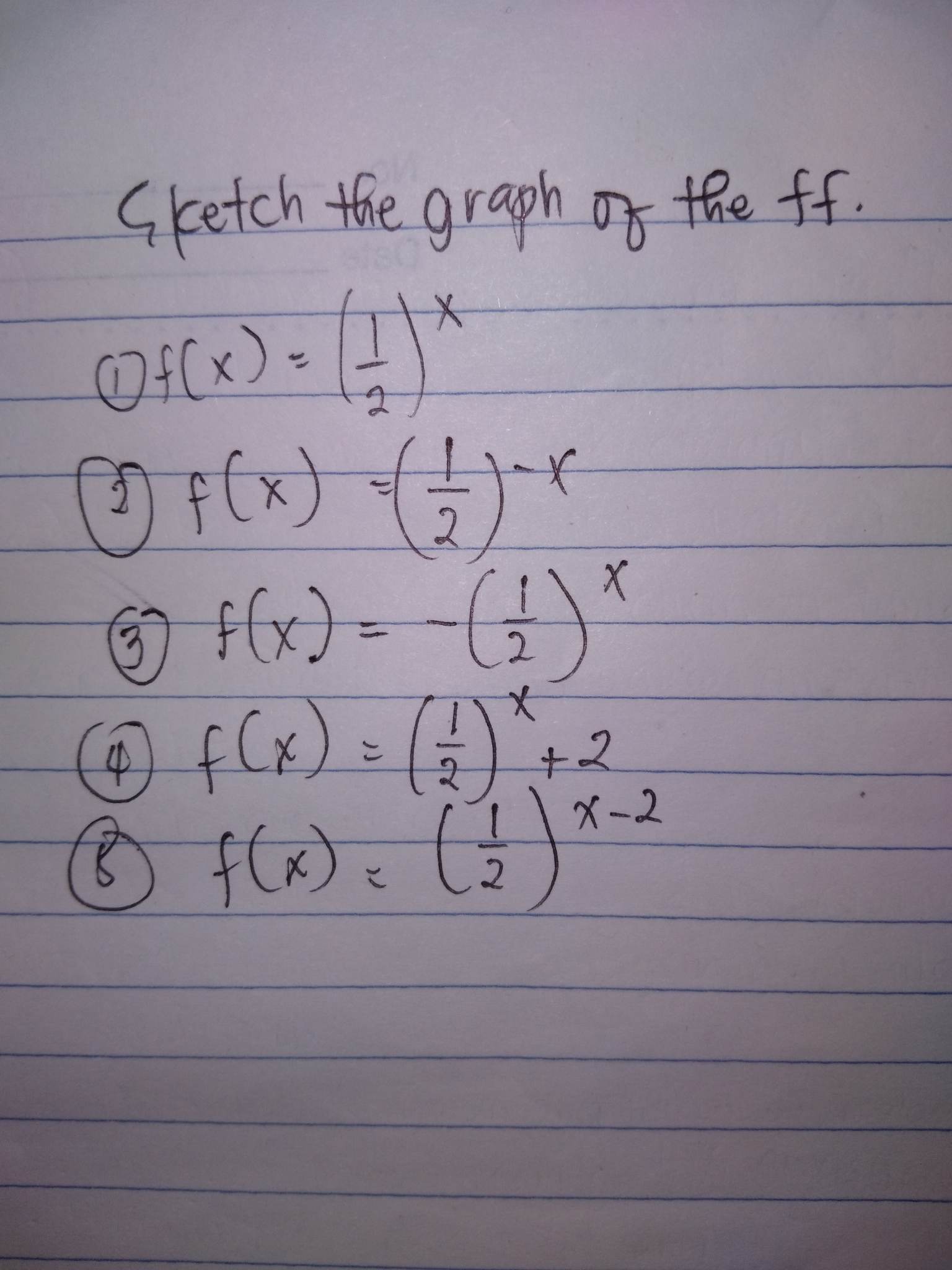
Question: WILL UPVOTE!! PLEASE ANSWER ASAP! lesson: GRAPHING EXPONENTIAL FUNCTIONS Properties of Exponential Functions: 1. The domain is the set of real numbers. Domain: {xER} or
WILL UPVOTE!! PLEASE ANSWER ASAP!
lesson:
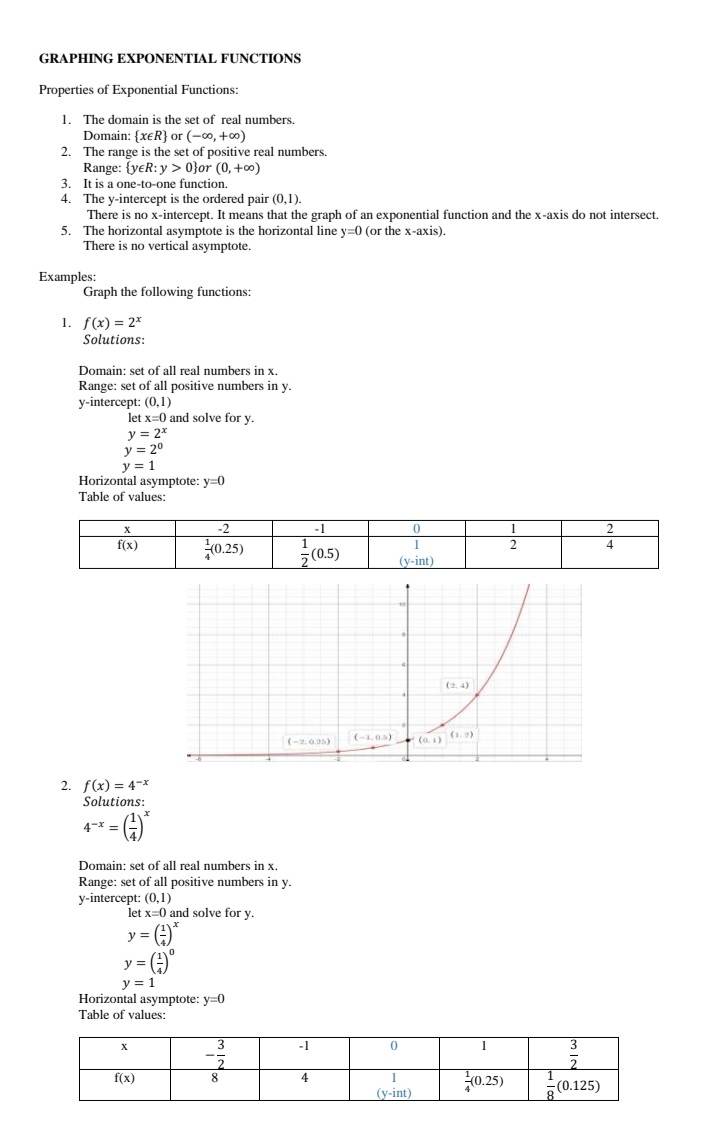
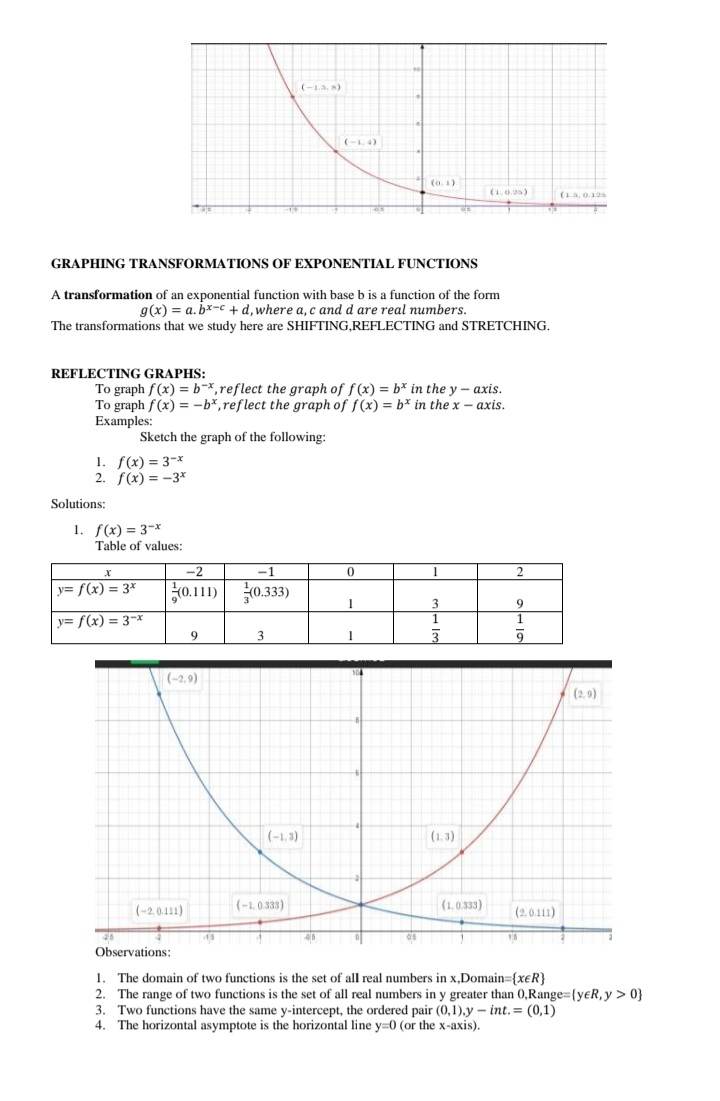
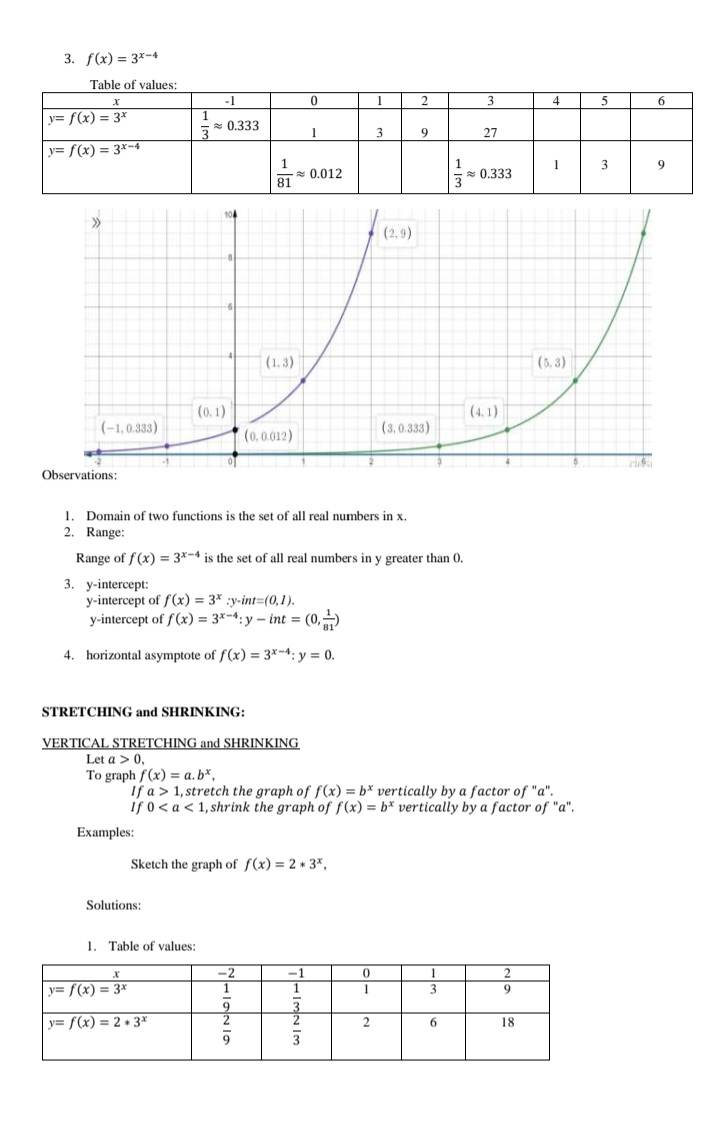
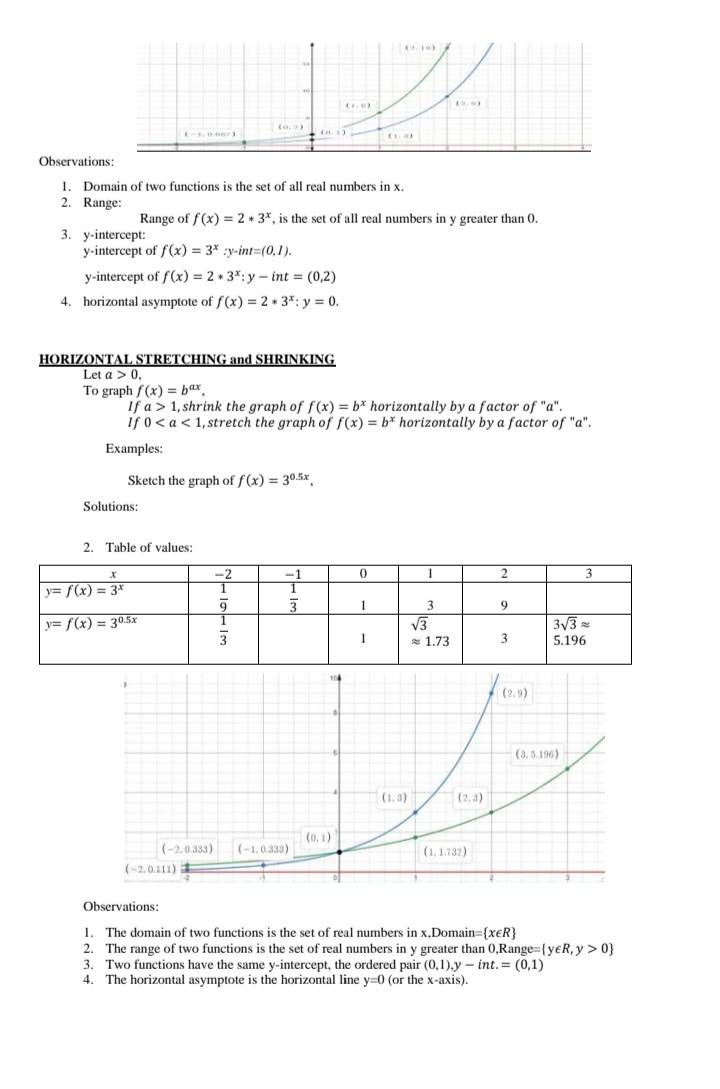
GRAPHING EXPONENTIAL FUNCTIONS Properties of Exponential Functions: 1. The domain is the set of real numbers. Domain: {xER} or (-00, +co) 2. The range is the set of positive real numbers. Range: {yER: y > 0jor (0, +co) 3. It is a one-to-one function. 4. The y-intercept is the ordered pair (0, 1). There is no x-intercept. It means that the graph of an exponential function and the x-axis do not intersect. . The horizontal asymptote is the horizontal line y=0 (or the x-axis). There is no vertical asymptote. Examples: Graph the following functions: 1. f(x) = 2x Solutions: Domain: set of all real numbers in x. Range: set of all positive numbers in y. y-intercept: (0.1) let x=0 and solve for y. y = 2x y = 20 y =1 Horizontal asymptote: y=0 Table of values: -2 0 AN f(x) (0.25) 2 5 (0.5) (y-int) (2. 1) (-103) 2. f(x) = 4-x Solutions: 4-* = () Domain: set of all real numbers in x. Range: set of all positive numbers in y. y-intercept: (0.1) let x=0 and solve for y. y = () y = 9 y =1 Horizontal asymptote: y=0 Table of values: X -1 0 chiw f(x) 4 -(0.25) (y-int) (0.125)(-La, 2) GRAPHING TRANSFORMATIONS OF EXPONENTIAL FUNCTIONS A transformation of an exponential function with base b is a function of the form g(x) = a. b*= + d, where a, c and d are real numbers. The transformations that we study here are SHIFTING, REFLECTING and STRETCHING. REFLECTING GRAPHS: To graph f(x) = b *, reflect the graph of f (x) = b* in they - axis. To graph f(x) = -b*, reflect the graph of f (x) = b* in the x - axis. Examples: Sketch the graph of the following: 1. f (x) = 3-x 2. f (x) = -3* Solutions: 1. f (x) = 3-x Table of values: -2 -1 0 1 y= f (x) = 3* -(0.1 1 1) (0.333) y= f(x) = 3-x 9 3 (-2.9) (2.9) (-1,3) (1.3) (-2 0411) (-1. 0 335) (1. 0.339) (20111) Observations: 1. The domain of two functions is the set of all real numbers in x,Domain {xER) 2. The range of two functions is the set of all real numbers in y greater than 0,Range=(yER, y > 0} 3. Two functions have the same y-intercept, the ordered pair (0, 1).y - int. = (0,1) 4. The horizontal asymptote is the horizontal line y=0 (or the x-axis).f (x) = -3* Table of values 0 1 y= f (x) = 3* WILWI-L 3 9 y= f (x) = -3* - 1 - 3 - 9 (20) (0, 1 ) (-2.0411) (-1.0.333) (1.3) (-2 -0121) (-1. -0.353) (0. =1) ( 1 - 3 ) (2 -D) 1. The domain of two functions is the set of all real numbers in x, Domain (xER} 2. The range of the functions y= f(x) = -3* is the set of all real numbers in y less than 0,Range=( yER, y 0, To graph f (x) = b* + c, shift the graph of f(x) = b* upward c units. To graph yf (x) = b* - c, shift the graph of f(x) = b* downward c units. HORIZONTAL SHIFTING Suppose c > 0, To graph f(x) = b*+, shift the graph of f(x) = b* to the right c units. To graph f(x) = b*=, shift the graph Of f(x) = b* to the left c units. Examples: 1. f(x) = 3* + 2, the graph of f(x) = 3* shift upward by 2 units. 2. f(x) = 3* - 2, the graph of f(x) = 3* shift downward by 2vunits. 3. f(x) = 3*-*, the graph of f(x) = 3* shift to the right by 4 units. 4. f(x) = 3*+*, the graph of f(x) = 3* shift to the left by 4 units Examples: sketch the graph of the following: 1. f(x) = 3* + 2 2. f(x) = 3* - 2 3. f(x) = 3x-4 Solutions: 1. f(x) = 3* +2 Table of values: -2 0 1 y= f (x) = 3* WI -L 3 y= f(x) = 3* +2 2 3 5 11(2. 11) 10 (2,9) (1. 5) (D. 3) (-2, 2.111) (-1.2.833) (o. 1) (1.3) (-2, 0.111) (-1,0,333) Observations: 1. Domain of two functions is the set of all real numbers in x. 2. Range: Range of f(x) = 3* + 2 is the set of all real numbers in y greater than or equal to 2. 3. y-intercept: y-intercept of f(x) = 3* :y-int=(0.1). y-intercept of f(x) = 3* + 2:y - int = (0,3) 4. horizontal asymptote of f(x) = 3* + 2: y=2 2. f(x) = 3* -2 Solutions: Table of values: 0 1 N y= f (x) = 3* WI - - y= f (x) = 3* - 2 -1 w I UT or 1- (20) (2,7) (1.3) (0,1) ( -2.011) (-1,0.323) (1.1) (-1 -1.567) (0. ~1) Observations: 1. Domain of two functions is the set of all real numbers in x. 2. Range: Range of f (x) = 3* - 2is the set of all real numbers in y greater than -2. 3. y-intercept: y-intercept of f(x) = 3* ;y-int=(0,1). y-intercept of f (x) = 3x - 2: y - int = (0,-1) 4. horizontal asymptote of f (x) = 3* - 2: y = -23. f(x) = 3x-4 Table of values: -1 0 2 3 4 5 6 y= f(x) = 3x 5 0.333 3 27 y= f (x) = 3*-4 1 0.012 9 31 0.333 3 (2.9 ) (1.3) (5.3) (0.1) (4.1 ) (-1, 0.333) (0. 0.012) (3, 0.333) Observations: 1. Domain of two functions is the set of all real numbers in x. 2. Range: Range of f(x) = 3*-4 is the set of all real numbers in y greater than 0. 3. y-intercept: y-intercept of f(x) = 3* :y-int=(0,1). y-intercept of f(x) = 3*-4: y - int = (0, -) 4. horizontal asymptote of f(x) = 3*-4: y = 0. STRETCHING and SHRINKING: VERTICAL STRETCHING and SHRINKING Let a > 0, To graph f(x) = a. bx. If a > 1, stretch the graph of f(x) = b* vertically by a factor of "a". If 0 0. To graph f(x) = bax. If a > 1, shrink the graph of f(x) = b* horizontally by a factor of "a". If 0 0} 3. Two functions have the same y-intercept, the ordered pair (0.1).y - int. = (0,1) 4. The horizontal asymptote is the horizontal line y=0 (or the x-axis).G ketch the graph of the ff. Of ( x ) = I () f ( x ) ( 3) f (x ) =(, X ( 4 ) f ( x ) = (2) + 2 X - 2
Step by Step Solution
There are 3 Steps involved in it
1 Expert Approved Answer
Step: 1 Unlock
Question Has Been Solved by an Expert!
Get step-by-step solutions from verified subject matter experts
Step: 2 Unlock
Step: 3 Unlock
Students Have Also Explored These Related Mathematics Questions!











 Study Help