







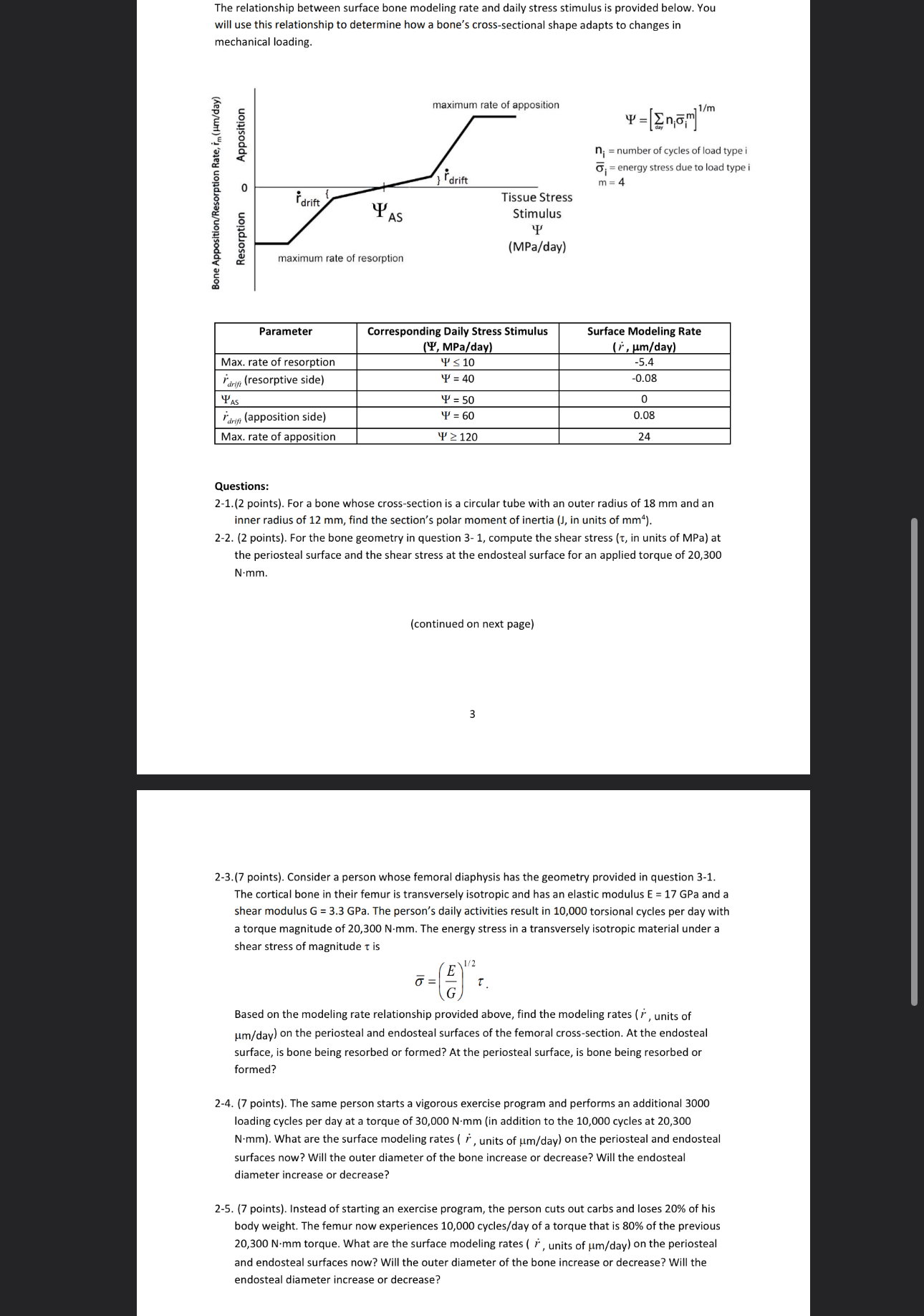
Question: will use this relationship to determine how a bone's cross - sectional shape adapts to changes in mechanical loading. Questions: 2 - 1 . (
will use this relationship to determine how a bone's crosssectional shape adapts to changes in
mechanical loading.
Questions:
points For a bone whose crosssection is a circular tube with an outer radius of mm and an
inner radius of mm find the sections polar moment of inertia J in units of
points For the bone geometry in question compute the shear stress in units of MPa at
the periosteal surface and the shear stress at the endosteal surface for an applied torque of
continued on next page
points Consider a person whose femoral diaphysis has the geometry provided in question
The cortical bone in their femur is transversely isotropic and has an elastic modulus GPa and a
shear modulus GPa. The person's daily activities result in torsional cycles per day with
a torque magnitude of The energy stress in a transversely isotropic material under a
shear stress of magnitude is
Based on the modeling rate relationship provided above, find the modeling rates units of
day on the periosteal and endosteal surfaces of the femoral crosssection. At the endosteal
surface, is bone being resorbed or formed? At the periosteal surface, is bone being resorbed or
formed?
points The same person starts a vigorous exercise program and performs an additional
loading cycles per day at a torque of in addition to the cycles at
What are the surface modeling rates units of day on the periosteal and endosteal
surfaces now? Will the outer diameter of the bone increase or decrease? Will the endosteal
diameter increase or decrease?
points Instead of starting an exercise program, the person cuts out carbs and loses of his
body weight. The femur now experiences cyclesday of a torque that is of the previous
torque. What are the surface modeling rates units of day on the periosteal
and endosteal surfaces now? Will the outer diameter of the bone increase or decrease? Will the
endosteal diameter increase or decrease?
Step by Step Solution
There are 3 Steps involved in it
1 Expert Approved Answer
Step: 1 Unlock

Question Has Been Solved by an Expert!
Get step-by-step solutions from verified subject matter experts
Step: 2 Unlock
Step: 3 Unlock
 Study Help