







Question: wing payoff table. (a) If the probability that the rezoning will be approved is 0.5 , what decision is recommended? purchase do not purchase What
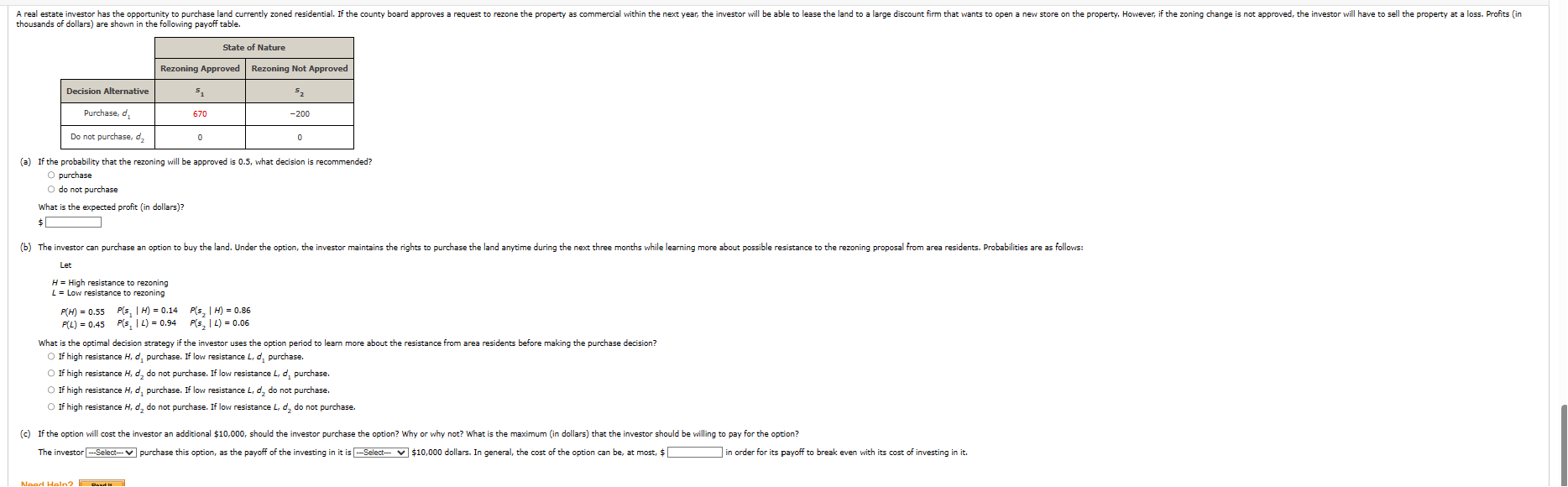
wing payoff table. (a) If the probability that the rezoning will be approved is 0.5 , what decision is recommended? purchase do not purchase What is the expected profit (in dollars)? Let H= High resistance to rezoning L= Low resistance to rezoning P(H)=0.55P(L)=0.45P(s1H)=0.14P(s1L)=0.94P(s2H)=0.86P(s2L)=0.06 What is the optimal decision strategy if the investor uses the option period to learn more about the resistance from area residents before making the purchase decision? If high resistance Hrd1 purchase. If low resistance Lrd1 purchase. If high resistance Hrd2 do not purchase. If low resistance L,d1 purchase. If high resistance Hrd1 purchase. If low resistance Lrd2 do not purchase. If high resistance H1d2 do not purchase. If low resistance L,d2 do not purchase. (c) If the option will cost the investor an additional $10,000, should the investor purchase the option? Why or why not? What is the maximum (in dollars) that the investor should be willing to pay for the option? The investor --Select-- purchase this option, as the payoff of the investing in it is - -Select- $10,000 dollars. In general, the cost of the option can be, at most, $ in order for its payoff to break even with its cost of investing in it. wing payoff table. (a) If the probability that the rezoning will be approved is 0.5 , what decision is recommended? purchase do not purchase What is the expected profit (in dollars)? Let H= High resistance to rezoning L= Low resistance to rezoning P(H)=0.55P(L)=0.45P(s1H)=0.14P(s1L)=0.94P(s2H)=0.86P(s2L)=0.06 What is the optimal decision strategy if the investor uses the option period to learn more about the resistance from area residents before making the purchase decision? If high resistance Hrd1 purchase. If low resistance Lrd1 purchase. If high resistance Hrd2 do not purchase. If low resistance L,d1 purchase. If high resistance Hrd1 purchase. If low resistance Lrd2 do not purchase. If high resistance H1d2 do not purchase. If low resistance L,d2 do not purchase. (c) If the option will cost the investor an additional $10,000, should the investor purchase the option? Why or why not? What is the maximum (in dollars) that the investor should be willing to pay for the option? The investor --Select-- purchase this option, as the payoff of the investing in it is - -Select- $10,000 dollars. In general, the cost of the option can be, at most, $ in order for its payoff to break even with its cost of investing in it
Step by Step Solution
There are 3 Steps involved in it
To solve the given problem we need to calculate the expected profits and determine the optimal decisions based on probability Lets break it down stepb... View full answer

Get step-by-step solutions from verified subject matter experts
 Study Help