







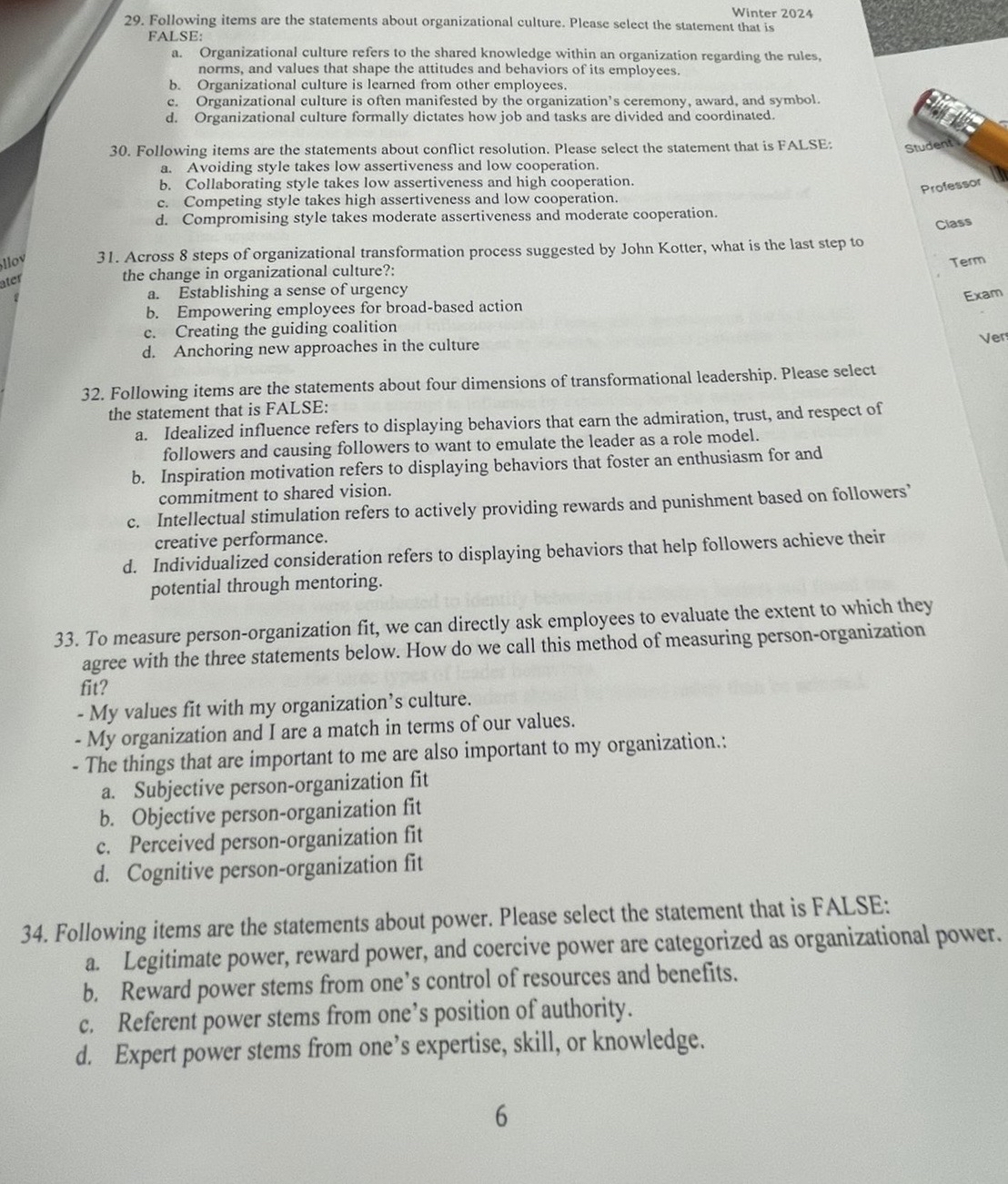
Question: Winter 2 0 2 4 2 9 . Following items are the statements about organizational culture. Please select the statement that is FALSE: a .
Winter
Following items are the statements about organizational culture. Please select the statement that is FALSE:
a Organizational culture refers to the shared knowledge within an organization regarding the rules, norms, and values that shape the attitudes and behaviors of its employees.
b Organizational culture is learned from other employees.
c Organizational culture is often manifested by the organization's ceremony, award, and symbol.
d Organizational culture formally dictates how job and tasks are divided and coordinated.
Following items are the statements about conflict resolution. Please select the statement that is FALSE:
a Avoiding style takes low assertiveness and low cooperation.
b Collaborating style takes low assertiveness and high cooperation.
c Competing style takes high assertiveness and low cooperation.
d Compromising style takes moderate assertiveness and moderate cooperation.
Across steps of organizational transformation process suggested by John Kotter, what is the last step to the change in organizational culture?:
a Establishing a sense of urgency
b Empowering employees for broadbased action
c Creating the guiding coalition
d Anchoring new approaches in the culture
Following items are the statements about four dimensions of transformational leadership. Please select the statement that is FALSE:
a Idealized influence refers to displaying behaviors that earn the admiration, trust, and respect of followers and causing followers to want to emulate the leader as a role model.
b Inspiration motivation refers to displaying behaviors that foster an enthusiasm for and commitment to shared vision.
c Intellectual stimulation refers to actively providing rewards and punishment based on followers' creative performance.
d Individualized consideration refers to displaying behaviors that help followers achieve their potential through mentoring.
To measure personorganization fit, we can directly ask employees to evaluate the extent to which they agree with the three statements below. How do we call this method of measuring personorganization fit?
My values fit with my organization's culture.
My organization and I are a match in terms of our values.
The things that are important to me are also important to my organization::
a Subjective personorganization fit
b Objective personorganization fit
c Perceived personorganization fit
d Cognitive personorganization fit
Following items are the statements about power. Please select the statement that is FALSE:
a Legitimate power, reward power, and coercive power are categorized as organizational power.
b Reward power stems from one's control of resources and benefits.
c Referent power stems from one's position of authority.
d Expert power stems from one's expertise, skill, or knowledge.
Step by Step Solution
There are 3 Steps involved in it
1 Expert Approved Answer
Step: 1 Unlock

Question Has Been Solved by an Expert!
Get step-by-step solutions from verified subject matter experts
Step: 2 Unlock
Step: 3 Unlock
 Study Help