





Question: With B being int, and A being real, use same process of the Attribute-Grammar example (slides 3.58-3.63) to analyze statement: B = B + A.
 With B being int, and A being real, use same process

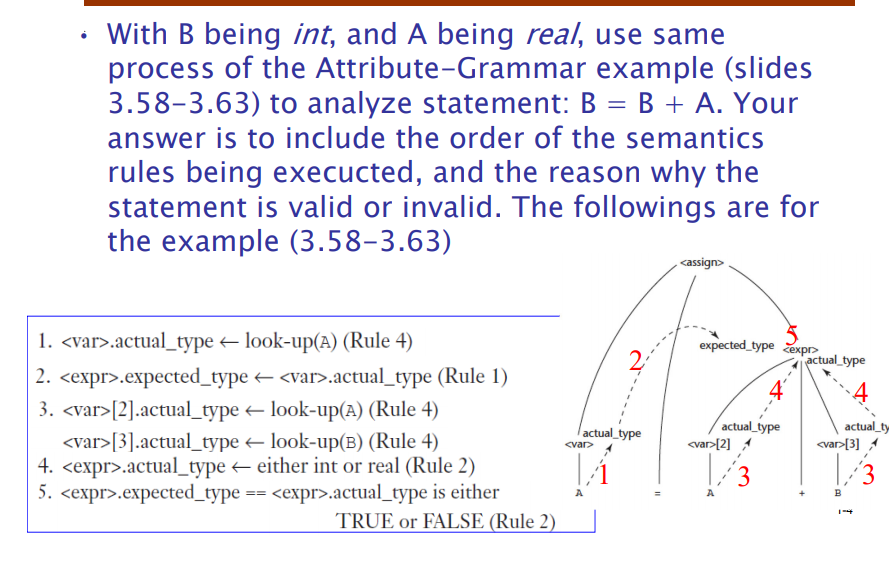
With B being int, and A being real, use same process of the Attribute-Grammar example (slides 3.58-3.63) to analyze statement: B = B + A. Your answer is to include the order of the semantics rules being execucted, and the reason why the statement is valid or invalid. The followings are for the example (3.58-3.63) expected_type cexpr> i actual_type 1. .actual_type look-up(A) (Rule 4) 2. .expected_type.actual_type (Rule 1) 3. [2].actual_type look-up(A) (Rule 4) [3].actual_type look-up(B) (Rule 4) 4. .actual_type - either int or real (Rule 2) 5. .expected_type == .actual_type is either TRUE or FALSE (Rule 2) actual_type actual_type svar>[2] , actual_ty svar>[3] 3 With B being int, and A being real, use same process of the Attribute-Grammar example (slides 3.58-3.63) to analyze statement: B = B + A. Your answer is to include the order of the semantics rules being execucted, and the reason why the statement is valid or invalid. The followings are for the example (3.58-3.63) expected_type cexpr> i actual_type 1. .actual_type look-up(A) (Rule 4) 2. .expected_type.actual_type (Rule 1) 3. [2].actual_type look-up(A) (Rule 4) [3].actual_type look-up(B) (Rule 4) 4. .actual_type - either int or real (Rule 2) 5. .expected_type == .actual_type is either TRUE or FALSE (Rule 2) actual_type actual_type svar>[2] , actual_ty svar>[3] 3

Step by Step Solution

There are 3 Steps involved in it

1 Expert Approved Answer
Step: 1 Unlock blur-text-image
Question Has Been Solved by an Expert!

Get step-by-step solutions from verified subject matter experts

Step: 2 Unlock
Step: 3 Unlock

Students Have Also Explored These Related Databases Questions!