



Question: With reading the star bucks article and the information that I have shared below the article can some help me with a 3 page paper
With reading the star bucks article and the information that I have shared below the article can some help me with a 3 page paper
.
Based on your knowledge of Starbucks, does Starbucks strategy seem to set it apart from rivals, such as Seattle's Best, Dunkin Donuts, Dutch Brothers, etc? Can you identify a specific strategy and support your choice based on the information from your readings? What is there about Starbucks strategy that can lead to sustainable competitive advantage?
This is about Starbucks' unique strategy and sustainable competitive advantage.
For the given question, the correct answer will be -
- Starbucks, a global coffeehouse chain, has undoubtedly established itself as a dominant player in the coffee industry, setting itself apart from rivals such as Seattle's Best, Dunkin' Donuts, Dutch Brothers, and others.
- The company's success can be attributed to a combination of factors that constitute its unique strategy, which fosters a sustainable competitive advantage.
Starbucks has pursued a differentiation strategy, positioning itself as more than just a place to grab a cup of coffee. This strategy is evident in several key aspects of the company's operations.
1. Premium Coffee Experience: Unlike many of its rivals, Starbucks focuses on providing a premium coffee experience. The company places a strong emphasis on sourcing high-quality, ethically traded coffee beans from around the world. This commitment to quality extends to its skilled baristas who craft intricate coffee beverages, elevating the coffee-drinking experience beyond the simple act of consumption. Starbucks' "Third Place" concept, where customers can enjoy a cozy and inviting environment distinct from home and work, has become a hallmark of the brand.
2. Innovation and Customization: Starbucks has been at the forefront of beverage innovation. The introduction of the Pumpkin Spice Latte and other seasonal offerings has created a cult-like following, fostering anticipation and excitement among customers. Moreover, Starbucks embraces customization, allowing customers to tailor their beverages to their preferences. This level of personalization not only satisfies individual tastes but also fosters a sense of connection with the brand.
3. Digital Transformation: Starbucks was an early adopter of digital technology to enhance customer experience. The Starbucks mobile app allows for seamless ordering, payment, and loyalty rewards, streamlining the transaction process and providing convenience to customers. This technological integration enhances the overall customer journey and reinforces brand loyalty.
4. Store Design and Atmosphere: Starbucks stores are designed to provide a comfortable and welcoming atmosphere. The interior dcor, lighting, and layout are carefully curated to encourage customers to linger, socialize, and work. This design approach contributes to the creation of an experience that goes beyond a mere coffee purchase.
Explanation:
This is about Starbucks' differentiation strategy.
Starbucks' strategy has enabled it to build a sustainable competitive advantage in the coffee industry.
1. Brand Equity and Recognition: Starbucks has built a strong brand that is synonymous with quality, innovation, and a unique coffee experience. This brand equity translates into customer loyalty, allowing Starbucks to charge premium prices for its products. The Starbucks logo alone is often enough to attract and retain customers seeking a specific coffee experience.
2. Customer Loyalty Programs: Starbucks' loyalty programs, including the Starbucks Rewards program, play a significant role in maintaining customer retention. By offering rewards for repeat business, Starbucks incentivizes customer loyalty and ensures a steady stream of returning customers.
3. Global Presence: Starbucks' extensive global network of stores gives it a significant advantage. The ubiquity of Starbucks outlets in major cities and airports provides customers with a consistent experience and increases the chances of customer choice when seeking a coffee shop.
4. Ethical and Sustainable Practices: Starbucks' commitment to ethical sourcing, environmental sustainability, and community engagement has resonated with a growing segment of socially conscious consumers. This not only enhances the brand's reputation but also appeals to consumers who align with these values.
5. Continuous Innovation: Starbucks' dedication to ongoing innovation, evidenced by its seasonal offerings, limited-time promotions, and menu expansions, keeps the brand fresh and exciting. This approach keeps customers engaged and curious, increasing the likelihood of repeat visits.
- Starbucks' differentiation strategy, encompassing premium coffee experiences, innovation, digital integration, and inviting store atmospheres, sets it apart from rivals like Seattle's Best, Dunkin' Donuts, and Dutch Brothers.
- The company's emphasis on brand equity, customer loyalty, global presence, ethical practices, and continuous innovation contributes to its sustainable competitive advantage.
- By providing a unique and holistic coffee experience that transcends mere caffeine consumption, Starbucks has cultivated a loyal customer base that values not just the products but the entire Starbucks culture.
- As long as Starbucks maintains its commitment to differentiation and customer-centricity, its strategy is well-positioned to continue delivering a sustainable competitive advantage in the coffee industry.
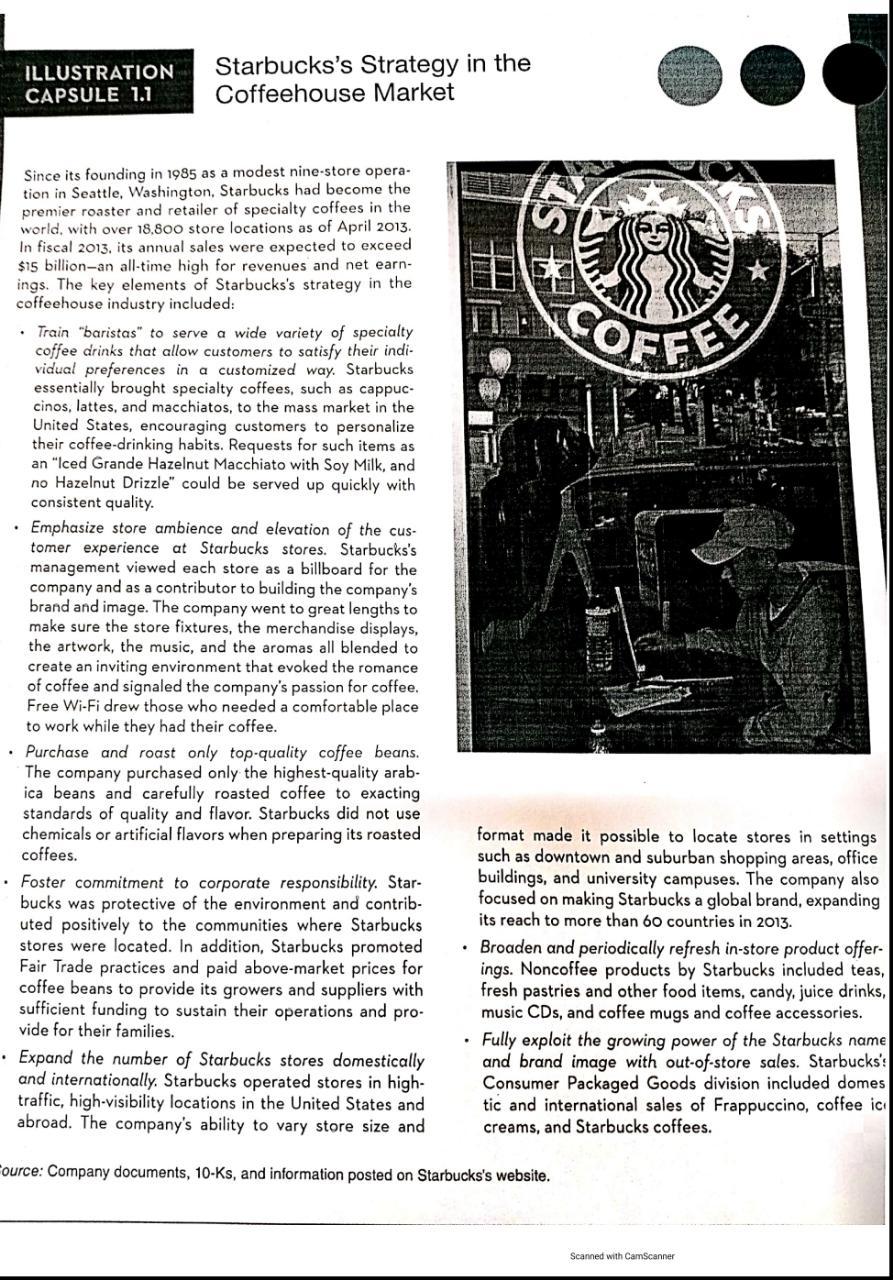
ILLUSTRATION Starbucks's Strategy in the CAPSULE 1.1 Coffeehouse Market Since its founding in 1985 as a modest nine-store operation in Seattle, Washington, Starbucks had become the premier roaster and retailer of specialty coffees in the world, with over 18,800 store locations as of April 2013. In fiscal 2013, its annual sales were expected to exceed $15 billion-an all-time high for revenues and net earnings. The key elements of Starbucks's strategy in the coffeehouse industry included: - Train "baristas" to serve a wide variety of specialty coffee drinks that allow customers to satisfy their individual preferences in a customized way. Starbucks essentially brought specialty coffees, such as cappuccinos, lattes, and macchiatos, to the mass market in the United States, encouraging customers to personalize their coffee-drinking habits. Requests for such items as an "Iced Grande Hazelnut Macchiato with Soy Milk, and no Hazelnut Drizzle" could be served up quickly with consistent quality. - Emphasize store ambience and elevation of the customer experience at Starbucks stores. Starbucks's management viewed each store as a billboard for the company and as a contributor to building the company's brand and image. The company went to great lengths to make sure the store fixtures, the merchandise displays, the artwork, the music, and the aromas all blended to create an inviting environment that evoked the romance of coffee and signaled the company's passion for coffee. Free Wi-Fi drew those who needed a comfortable place to work while they had their coffee. - Purchase and roast only top-quality coffee beans. The company purchased only the highest-quality arabica beans and carefully roasted coffee to exacting standards of quality and flavor. Starbucks did not use chemicals or artificial flavors when preparing its roasted coffees. - Foster commitment to corporate responsibility. Starbucks was protective of the environment and contributed positively to the communities where Starbucks stores were located. In addition, Starbucks promoted Fair Trade practices and paid above-market prices for coffee beans to provide its growers and suppliers with sufficient funding to sustain their operations and provide for their families. - Expand the number of Starbucks stores domestically and internationally. Starbucks operated stores in hightraffic, high-visibility locations in the United States and abroad. The company's ability to vary store size and format made it possible to locate stores in settings such as downtown and suburban shopping areas, office buildings, and university campuses. The company also focused on making Starbucks a global brand, expanding its reach to more than 60 countries in 2013. - Broaden and periodically refresh in-store product offerings. Noncoffee products by Starbucks included teas, fresh pastries and other food items, candy, juice drinks music CDs, and coffee mugs and coffee accessories. - Fully exploit the growing power of the Starbucks name and brand image with out-of-store sales. Starbucks' Consumer Packaged Goods division included domes tic and international sales of Frappuccino, coffee ic creams, and Starbucks coffees. ource: Company documents, 10Ks, and information posted on Starbucks's website
Step by Step Solution
There are 3 Steps involved in it

Get step-by-step solutions from verified subject matter experts