



Question: with solution pls. thanks 2. You are given the following table of payoffs (positive) and losses (negative) when there are three possible outcomes and three
with solution pls. thanks
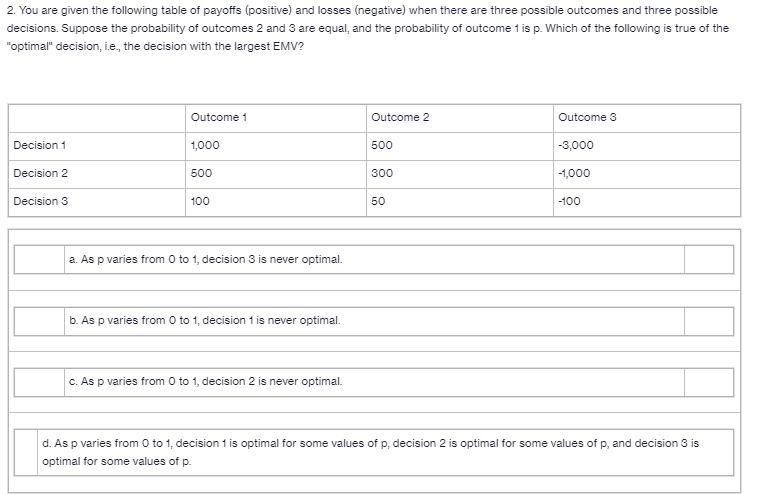
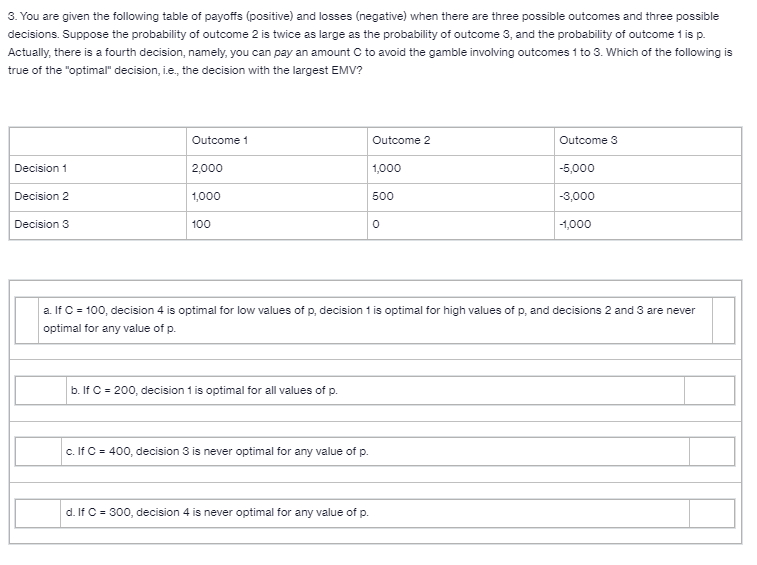
2. You are given the following table of payoffs (positive) and losses (negative) when there are three possible outcomes and three possible decisions. Suppose the probability of outcomes 2 and 3 are equal, and the probability of outcome 1 is p. Which of the following is true of the "optimal" decision, i.e., the decision with the largest EMV? a. As p varies from 0 to 1 , decision 3 is never optimal. b. As p varies from 0 to 1 , decision 1 is never optimal. c. As p varies from 0 to 1 , decision 2 is never optimal. d. As p varies from 0 to 1 , decision 1 is optimal for some values of p, decision 2 is optimal for some values of p, and decision 3 is optimal for some values of p. 3. You are given the following table of payoffs (positive) and losses (negative) when there are three possible outcomes and three possible decisions. Suppose the probability of outcome 2 is twice as large as the probability of outcome 3 , and the probability of outcome 1 is p. Actually, there is a fourth decision, namely, you can pay an amount C to avoid the gamble involving outcomes 1 to 3 . Which of the following is true of the "optimal" decision, i.e., the decision with the largest EMV? a. If C=100, decision 4 is optimal for low values of p, decision 1 is optimal for high values of p, and decisions 2 and 3 are never optimal for any value of p. b. If C=200, decision 1 is optimal for all values of p. c. If C=400, decision 3 is never optimal for any value of p
Step by Step Solution
There are 3 Steps involved in it

Get step-by-step solutions from verified subject matter experts